Shen Dexin, Fang Yayun, Zhou Fenfang, Deng Zhao, Qian Kaiyu, Wang Gang, Xiao Yu, Ju Lingao, Wang Xinghuan
Department of Urology, Zhongnan Hospital of Wuhan University, Wuhan, China.
Department of Biological Repositories, Zhongnan Hospital of Wuhan University, Wuhan, China.
Cancer Cell Int. 2021 May 12;21(1):257. doi: 10.1186/s12935-021-01969-x.
CDCA3 is an important component of the E3 ligase complex with SKP1 and CUL1, which could regulate the progress of cell mitosis. CDCA3 has been widely identified as a proto-oncogene in multiple human cancers, however, its role in promoting human bladder urothelial carcinoma has not been fully elucidated.
Bioinformatic methods were used to analyze the expression level of CDCA3 in human bladder urothelial carcinoma tissues and the relationship between its expression level and key clinical characteristics. In vitro studies were performed to validate the specific functions of CDCA3 in regulating cell proliferation, cell migration and cell cycle process. Alterations of related proteins was investigated by western blot assays. In vivo studies were constructed to validate whether silencing CDCA3 could inhibit the proliferation rate in mice model.
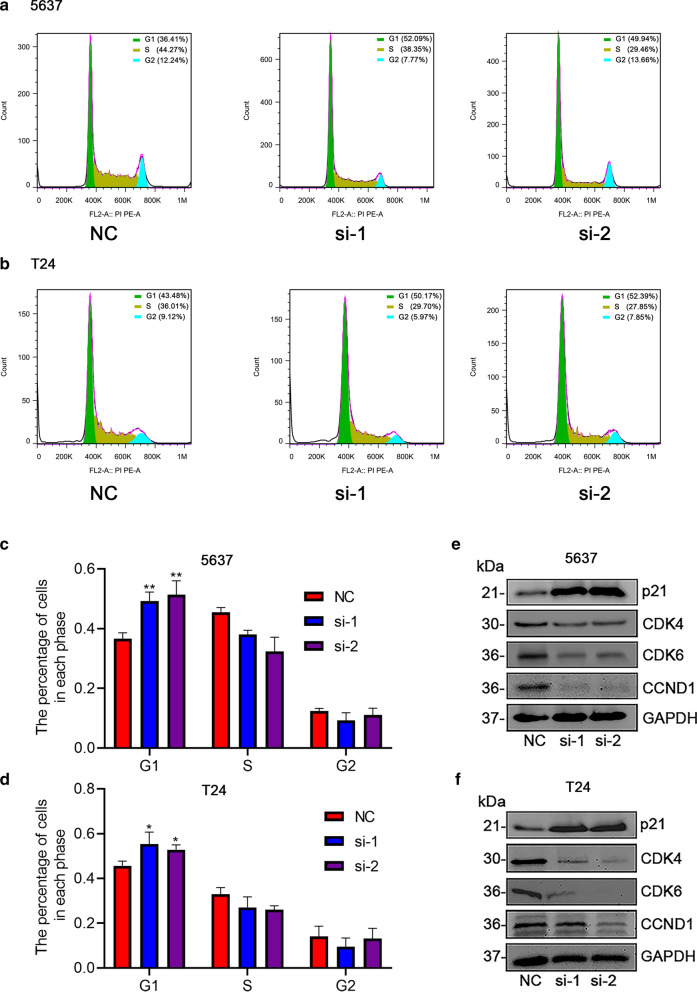
Bioinformatic analysis revealed that CDCA3 was significantly up-regulated in bladder urothelial carcinoma samples and was related to key clinical characteristics, such as tumor grade and metastasis. Moreover, patients who had higher expression level of CDCA3 tend to show a shorter life span. In vitro studies revealed that silencing CDCA3 could impair the migration ability of tumor cells via down-regulating EMT-related proteins such as MMP9 and Vimentin and inhibit tumor cell growth via arresting cells in the G1 cell cycle phase through regulating cell cycle related proteins like p21. In vivo study confirmed that silencing CDCA3 could inhibit the proliferation of bladder urothelial carcinoma cells.
CDCA3 is an important oncogene that could strengthen the migration ability of bladder urothelial carcinoma cells and accelerate tumor cell growth via regulating cell cycle progress and is a potential biomarker of bladder urothelial carcinoma.
CDCA3是与SKP1和CUL1组成的E3连接酶复合物的重要组成部分,可调节细胞有丝分裂进程。CDCA3在多种人类癌症中已被广泛鉴定为原癌基因,然而,其在促进人类膀胱尿路上皮癌中的作用尚未完全阐明。
采用生物信息学方法分析CDCA3在人类膀胱尿路上皮癌组织中的表达水平及其表达水平与关键临床特征之间的关系。进行体外研究以验证CDCA3在调节细胞增殖、细胞迁移和细胞周期进程中的特定功能。通过蛋白质印迹分析研究相关蛋白的变化。构建体内研究以验证沉默CDCA3是否能抑制小鼠模型中的增殖率。
生物信息学分析显示,CDCA3在膀胱尿路上皮癌样本中显著上调,且与肿瘤分级和转移等关键临床特征相关。此外,CDCA3表达水平较高的患者往往寿命较短。体外研究表明,沉默CDCA3可通过下调MMP9和波形蛋白等EMT相关蛋白来损害肿瘤细胞的迁移能力,并通过调节p21等细胞周期相关蛋白使细胞停滞在G1期来抑制肿瘤细胞生长。体内研究证实,沉默CDCA3可抑制膀胱尿路上皮癌细胞的增殖。
CDCA3是一种重要的癌基因,可通过调节细胞周期进程增强膀胱尿路上皮癌细胞的迁移能力并加速肿瘤细胞生长,是膀胱尿路上皮癌的潜在生物标志物。