Din Nizar, Phylactou Maria, Fajardo-Sanchez Julia, Watson Martin, Ahmad Sajjad
Cornea and External Eye Disease Service, Moorfields Eye Hospital, London, UK.
Institute of Ophthalmology, University College London, London, UK.
Clin Ophthalmol. 2021 May 6;15:1639-1645. doi: 10.2147/OPTH.S302576. eCollection 2021.
Moorfields Eye Hospital sits as a major tertiary centre for ophthalmic care in the United Kingdom and became a central hub to provide safe and effective ophthalmic care across London and surrounding regions during the COVID-19 pandemic. We explore the impact on both the acute and elective corneal services during the first wave of this pandemic.
A retrospective review of the proportion of corneal transplants and anterior segment trauma repairs was performed during the period of March 23rd to July 1st 2020 compared with an identical period in 2019. Data were acquired from our in-house electronic patient records.
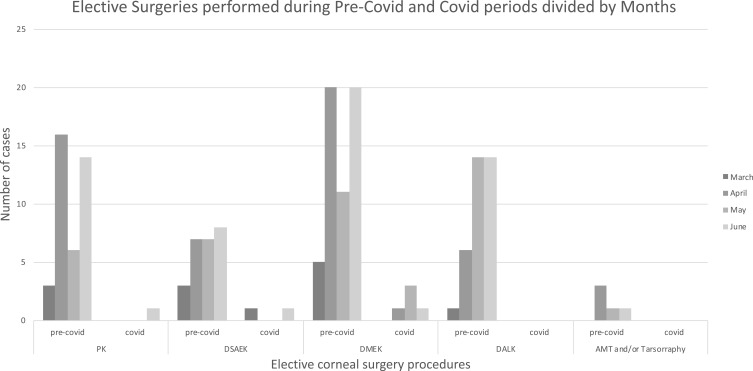
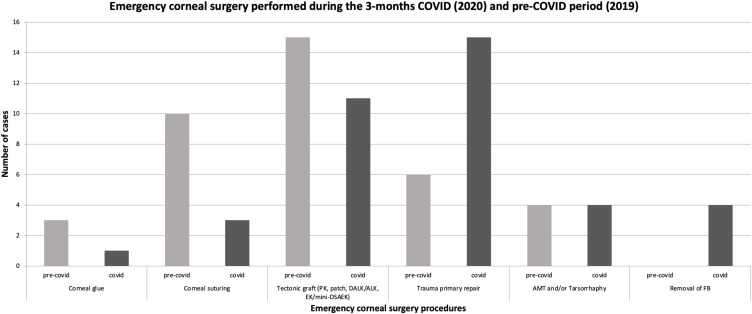
A 92% reduction in corneal elective work was observed during the lockdown period compared with an identical period in 2019, with only 10 elective cases in total being performed. In addition, 91 corneal cross-linking and 76 therapeutic lasers were cancelled. There were 15 cases of primary repair for anterior segment trauma compared with 6 cases pre-COVID-19. A similar scenario occurs with removal of foreign body (4 cases during COVID-19 period versus no cases during pre-COVID-19 era) and with traumatic lens aspirations (6 cases during COVID-19 compared with 2 pre-COVID-19). Interestingly, a statistical difference (p=0.03) was found in the time interval from presentation of symptoms to emergency corneal surgery. During the COVID-19 period, a delay of 1.5 days ± 2.29 (range 0-10 days) occurred compared with 0.8 days ± 1.54 (range 0-6 days) pre-COVID-19.
Stringent risk stratification reduced elective corneal surgery capacity during the lockdown thereby preserving social distancing requirements. However, an apparent increase in emergency corneal surgery seen is likely attributed to centralisation of ophthalmic services during the pandemic crisis, alongside increased domestic injuries. Despite the challenges posed, successful delivery of corneal surgery occurred whilst helping to identify lessons in preparations for future pandemics and current inefficiencies in healthcare delivery.
穆尔菲尔德眼科医院是英国主要的三级眼科护理中心,在新冠疫情期间成为为伦敦及周边地区提供安全有效眼科护理的核心枢纽。我们探讨了疫情第一波期间对急性和择期角膜服务的影响。
对2020年3月23日至7月1日期间角膜移植和眼前节创伤修复的比例进行回顾性分析,并与2019年同期进行比较。数据来自我们内部的电子病历。
与2019年同期相比,封锁期间角膜择期手术量减少了92%,总共仅进行了10例择期手术。此外,91例角膜交联手术和76例治疗性激光手术被取消。眼前节创伤一期修复有15例,而新冠疫情前为6例。取出异物的情况类似(新冠疫情期间4例,新冠疫情前无病例),外伤性晶状体摘除也是如此(新冠疫情期间6例,新冠疫情前2例)。有趣的是,在从出现症状到进行紧急角膜手术的时间间隔上发现了统计学差异(p=0.03)。新冠疫情期间,延迟时间为1.5天±2.29天(范围0-10天),而新冠疫情前为0.8天±1.54天(范围0-6天)。
严格的风险分层在封锁期间降低了角膜择期手术量,从而满足了保持社交距离的要求。然而,急诊角膜手术明显增加,这可能归因于疫情危机期间眼科服务的集中化以及家庭伤害的增加。尽管面临挑战,但角膜手术仍成功进行,同时有助于总结未来疫情防范的经验教训以及当前医疗服务中的低效问题。