Bachelor of Human Biology, Fourth Grade Student, Life and Health Sciences Faculty, Universitat Pompeu Fabra, Barcelona, Spain.
ISGlobal Hospital Clínic-Universitat de Barcelona, Barcelona, Spain.
Front Public Health. 2021 Apr 27;9:592500. doi: 10.3389/fpubh.2021.592500. eCollection 2021.
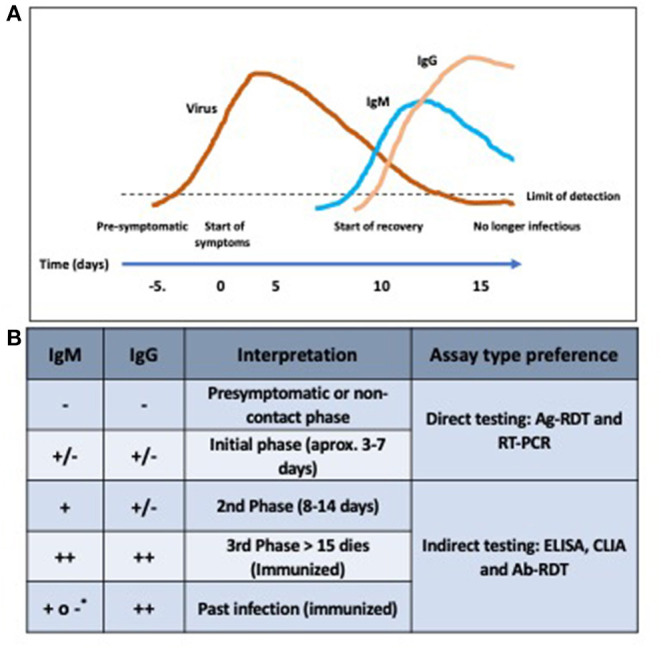
On March 12, the World Health Organization declared a pandemic following the exponential increase of SARS-CoV-2 cases. The rapid spread of the virus is due to both its high infectivity and the free circulation of unrecognized infectious cases. Thus, diagnostic testing is a key element to prevent further dissemination of the virus. Urged by WHO's call, laboratories worldwide have been working on nucleic acid tests protocols and immunoassays that became available, albeit poorly validated, within a comparatively short time. Since then, external studies evaluating these diagnostic tests have been published. The present study is a review of the COVID-19 diagnostic approaches, discussing both direct and indirect microbiological diagnoses. A compendium of the literature on commercial assays kits available to date is provided together with the conclusions drawn as well as RT-PCR protocols published by the WHO. Briefly, diagnostic accuracy varies according to time elapsed since symptom onset and evolves together with understanding of the COVID-19 disease. Taking into account all these variables will allow determining the most adequate diagnostic test to use and how to optimize diagnostic testing for COVID-19.
3 月 12 日,世界卫生组织宣布 COVID-19 疫情构成“大流行”,这是由于 SARS-CoV-2 病例呈指数级增长。病毒的快速传播是由于其高传染性和未被识别的传染性病例的自由传播。因此,诊断检测是防止病毒进一步传播的关键要素。在世界卫生组织的呼吁下,全球实验室一直在研究核酸检测方案和免疫分析,这些方案和分析在相对较短的时间内得到了应用,尽管验证程度较差。此后,评估这些诊断测试的外部研究已经发表。本研究回顾了 COVID-19 的诊断方法,讨论了直接和间接的微生物学诊断。本文还提供了迄今为止可用于商业检测试剂盒的文献摘要,以及世界卫生组织公布的 RT-PCR 方案,并得出了结论。简而言之,诊断准确性取决于症状出现后的时间,并随着对 COVID-19 疾病的认识而发展。考虑到所有这些变量,将有助于确定最合适的诊断测试,并优化 COVID-19 的诊断检测。