Cheng Chen, Cao Yi, Ma Sun-Xiang, Cheng Kai-Xiang, Zhang Ying-Fan, Liu Yang
Department of Plastic and Reconstructive Surgery, Shanghai Ninth People's Hospital, Shanghai Jiao Tong University School of Medicine, Shanghai, China.
Ann Transl Med. 2021 Apr;9(7):604. doi: 10.21037/atm-20-5655.
Vaginal laxity may result from trauma to the pelvic floor muscle, which may affect patients' sensation and quality of life. Vaginal rejuvenation, including surgical or nonsurgical interventions, aims to improve laxity. In this study, we aimed to establish a strategy for vaginal rejuvenation by comparing surgical and nonsurgical methods.
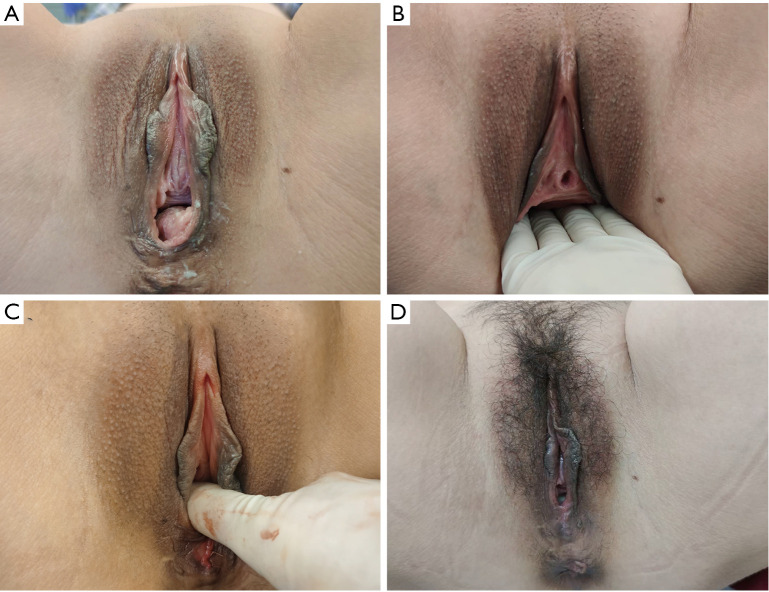
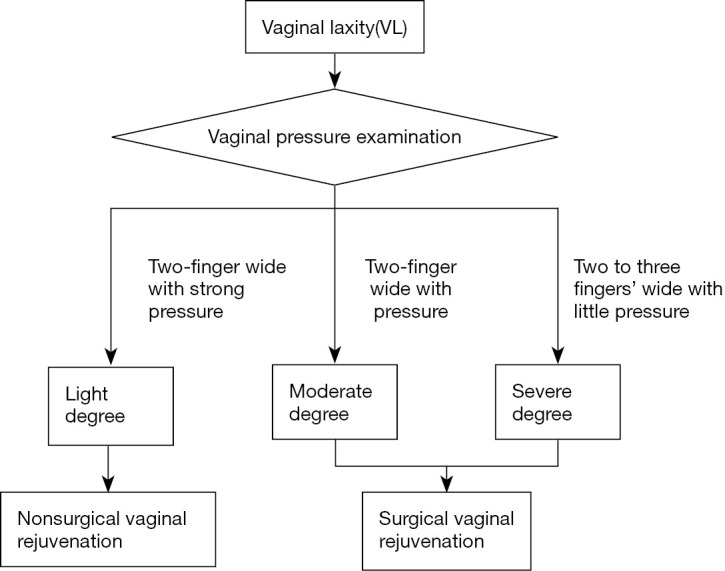
A retrospective clinical study was performed on patients who complained about vaginal laxity from 2017 to 2019. The degree of vaginal laxity severity was evaluated by vaginal examination in each patient. The patients were categorized as having a light, moderate or severe degree of vaginal laxity, and different correction methods were chosen accordingly. The Female Sexual Function Index (FSFI) questionnaire was administered to the patients preoperatively and at three months and one year after treatment.
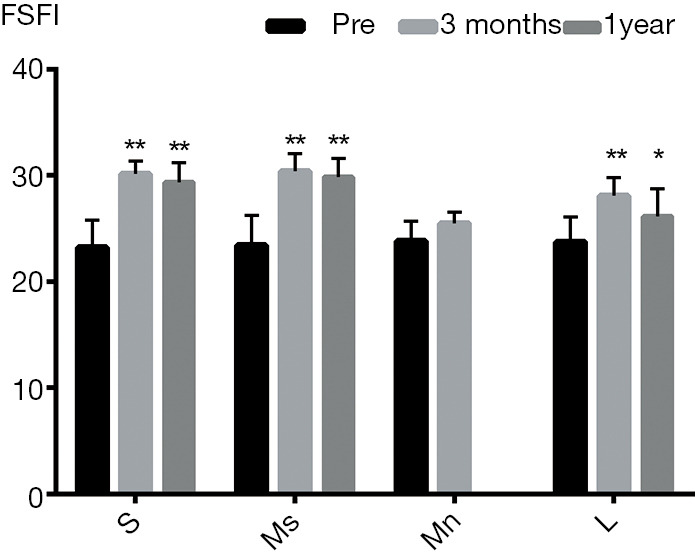
Seventeen patients with severe-degree vaginal laxity were treated with vaginoplasty. The total FSFI score was 23.21±2.57 before the operation and significantly increased to 29.36±1.84 (P<0.01) at one year after surgery. Eleven patients with moderate-degree vaginal laxity were treated with vaginoplasty and had a significant improvement in the total FSFI score at one year after surgery (29.86±1.74, P<0.01) compared with the FSFI score before surgery (23.41±2.84). Three patients with moderate-degree vaginal laxity were treated with a CO laser and tended to have increased FSFI scores but did not show significant improvement after the operation. CO laser treatment was performed on 16 patients with light-degree vaginal laxity. The total FSFI score improved from 23.76±2.35 to 26.16±2.58 at one year (P<0.05).
The strategy for vaginal rejuvenation should be selected based on the degree of vaginal laxity severity. Surgical treatment is suitable for severe- and moderate-degree vaginal laxity while nonsurgical treatment is suitable for light-degree vaginal laxity.
阴道松弛可能由盆底肌肉创伤引起,这可能会影响患者的感觉和生活质量。阴道年轻化,包括手术或非手术干预,旨在改善松弛状况。在本研究中,我们旨在通过比较手术和非手术方法来建立一种阴道年轻化策略。
对2017年至2019年抱怨阴道松弛的患者进行了一项回顾性临床研究。通过对每位患者进行阴道检查来评估阴道松弛严重程度。将患者分为轻度、中度或重度阴道松弛,并相应选择不同的矫正方法。在术前以及治疗后三个月和一年对患者进行女性性功能指数(FSFI)问卷调查。
17例重度阴道松弛患者接受了阴道成形术治疗。术前FSFI总评分23.21±2.57,术后一年显著提高至29.36±1.84(P<0.01)。11例中度阴道松弛患者接受了阴道成形术治疗,术后一年FSFI总评分(29.86±1.74)与术前(23.41±2.84)相比有显著改善(P<0.01)。3例中度阴道松弛患者接受了CO2激光治疗,FSFI评分有升高趋势,但术后未显示出显著改善。16例轻度阴道松弛患者接受了CO2激光治疗。一年时FSFI总评分从23.76±2.35提高到26.16±2.58(P<0.05)。
阴道年轻化策略应根据阴道松弛严重程度来选择。手术治疗适用于重度和中度阴道松弛,而非手术治疗适用于轻度阴道松弛。