Wang Xiaohong, Liu Yonggang, Meng Zhiying, Wu Yun, Wang Shubin, Jin Gaowa, Qin Yingchun, Wang Fengyun, Wang Jing, Zhou Haifei, Su Xiaoxing, Fu Xiuhua, Wang Xiaolan, Shi Xiaoyu, Wen Zhenping, Jia Xiaoqiong, Qin Qiong, Gao Yongqiang, Guo Weidong, Lu Shun
Chest Oncology Medicine, Baotou Cancer Hospital, Baotou, China.
Department of Oncology, Baotou Central Hospital, Baotou, China.
Ann Transl Med. 2021 Apr;9(8):635. doi: 10.21037/atm-20-7155.
Activated epidermal growth factor receptor () mutation is the main pathogenic cause of non-small cell lung cancer (NSCLC) in Asia. However, the impact of plasma mutation abundance, especially of the ultra-low abundance of mutation detected by highly sensitive techniques on clinical outcomes of first-line EGFR tyrosine kinase inhibitors (TKIs) for advanced NSCLC patients remains unclear.
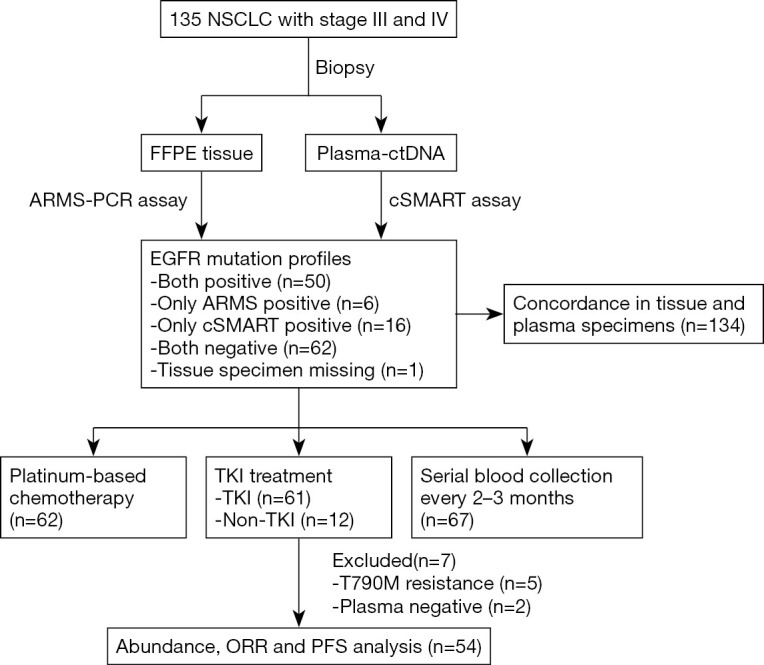
We qualitatively detected baseline status of NSCLC tissues using amplification-refractory mutation system and quantified the plasma abundance of mutations through next-generation sequencing (NGS). Every 8-12 weeks, we performed dynamic detection of plasma mutation abundance and imaging evaluation. We analyzed the association between plasma abundance of sensitizing mutations, tumor size, tumor shrinkage percentage, concomitant mutations, and clinical response to TKIs.
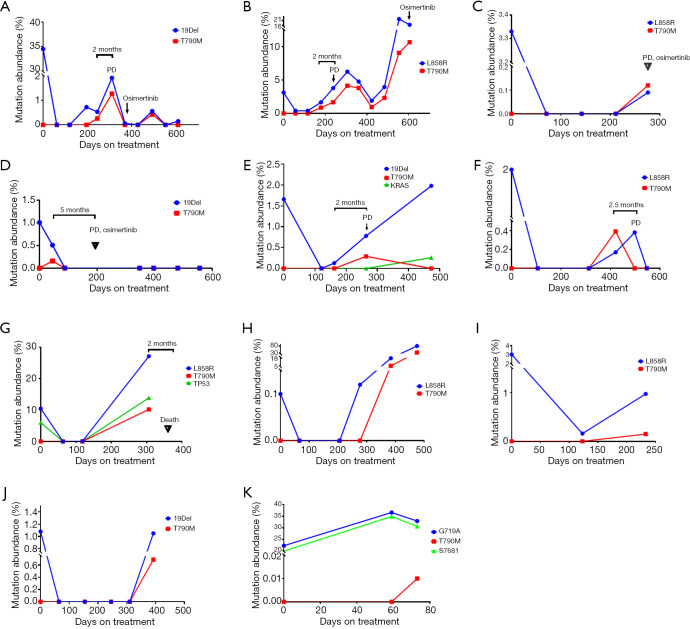
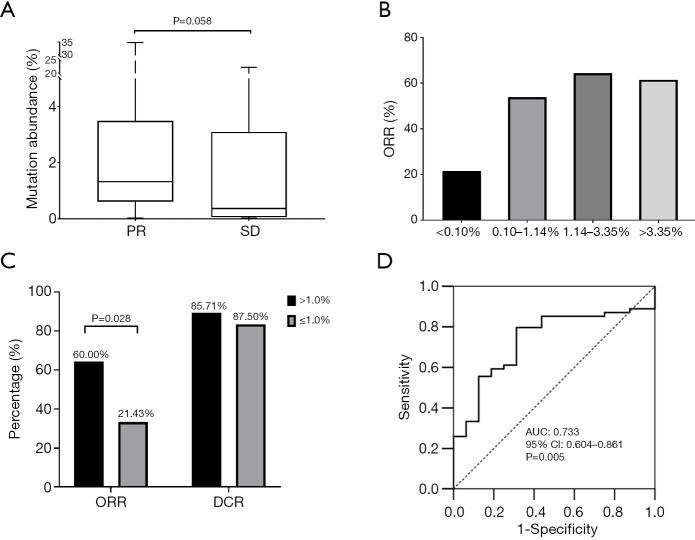
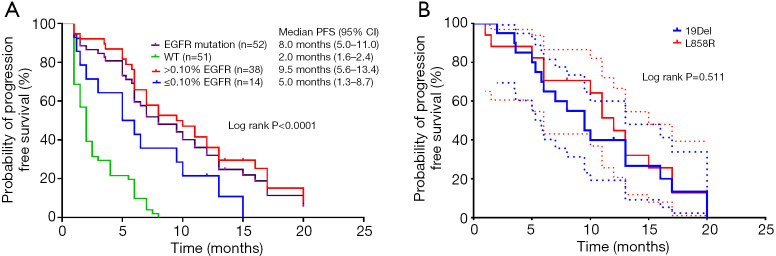
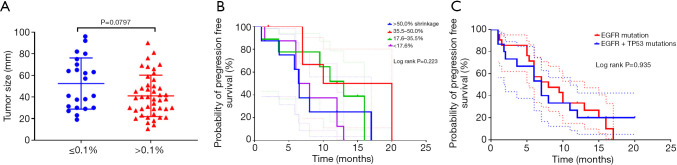
This prospective study enrolled 135 patients with advanced NSCLC. The objective response rate (ORR) and disease control rate (DCR) for mutation-positive patients were 50.0% and 87.0%, respectively. When the cutoff value of plasma mutation abundance was 0.1%, the ORRs of TKI-treated patients were significantly different (60.0% for the >0.1% group 21.4% for the ≤0.1% group, P=0.028). Median progression-free survival (PFS) was significantly longer for participants with a mutation abundance above 0.1% compared to those with a 0.01-0.1% abundance (log rank, P=0.0115). There was no significant association between plasma abundance of sensitizing mutations and tumor size, tumor shrinkage percentage, or concomitant mutations. Cox multivariate analysis demonstrated that plasma mutation abundance was an independent predictive factor for PFS [hazard ratio (HR) 2.41, 95% confidence interval (CI): 1.12-5.20; P=0.025]. We identified 11 participants with the acquired T790M resistance mutation according to serial dynamic plasma samples.
Liquid biopsy screening based on highly sensitive NGS is reliable for detecting drug resistance and actionable somatic mutations. The plasma abundance of the driver mutation affected clinical response to EGFR-TKIs in advanced NSCLC patients; prolongation of PFS was also observed in patients with an ultra-low abundance of sensitizing mutations.
表皮生长因子受体(EGFR)激活突变是亚洲非小细胞肺癌(NSCLC)的主要致病原因。然而,血浆EGFR突变丰度,尤其是通过高灵敏度技术检测到的超低丰度EGFR突变对晚期NSCLC患者一线EGFR酪氨酸激酶抑制剂(TKIs)临床结局的影响仍不明确。
我们使用扩增阻滞突变系统对NSCLC组织的基线EGFR状态进行定性检测,并通过下一代测序(NGS)对血浆EGFR突变丰度进行定量。每8 - 12周,我们进行血浆突变丰度的动态检测和影像学评估。我们分析了血浆EGFR敏感突变丰度、肿瘤大小、肿瘤缩小百分比、伴随的T790M突变与TKIs临床反应之间的关联。
这项前瞻性研究纳入了135例晚期NSCLC患者。EGFR突变阳性患者的客观缓解率(ORR)和疾病控制率(DCR)分别为50.0%和87.0%。当血浆EGFR突变丰度的临界值为0.1%时,接受TKI治疗患者的ORR有显著差异(>0.1%组为60.0%,≤0.1%组为21.4%,P = 0.028)。与突变丰度在0.01 - 0.1%的参与者相比,突变丰度高于0.1%的参与者的无进展生存期(PFS)显著更长(对数秩检验,P = 0.0115)。血浆EGFR敏感突变丰度与肿瘤大小、肿瘤缩小百分比或伴随的T790M突变之间无显著关联。Cox多因素分析表明,血浆突变丰度是PFS的独立预测因素[风险比(HR)2.41,95%置信区间(CI):1.12 - 5.20;P = 0.025]。根据系列动态血浆样本,我们鉴定出11例获得性T790M耐药突变的参与者。
基于高灵敏度NGS的液体活检筛查对于检测耐药性和可操作的体细胞突变是可靠的。EGFR驱动突变的血浆丰度影响晚期NSCLC患者对EGFR - TKIs的临床反应;在超低丰度EGFR敏感突变的患者中也观察到了PFS的延长。