Wang Sichao, Zhou Zihao, Tian Dan, Huang Shujie, Wang Ce, Gao Zhen, Ben Xiaosong, Tang Jiming, Xie Liang, Zhou Haiyu, Zhang Dongkun, Shi Ruiqing, Deng Cheng, Zhuang Weitao, Ding Yu, Qiao Guibin
Department of Thoracic Surgery, Guangdong Provincial People's Hospital, Guangdong Academy of Medical Sciences, Guangzhou, China.
Shantou University Medical College, Shantou, China.
Ann Transl Med. 2021 Apr;9(8):703. doi: 10.21037/atm-21-1628.
The prognoses for advanced Esophageal squamous cell cancer (ESCC) was very poor. Neoadjuvant therapy was shown to improve overall survival of ESCC patients. However, there is still no effective indicator to predict the efficacy of neoadjuvant therapy. The present study intended to investigate the correlation between hematological parameters and the efficacy of neoadjuvant therapy so as to provide a reference for the prediction of cancer response to neoadjuvant therapy.
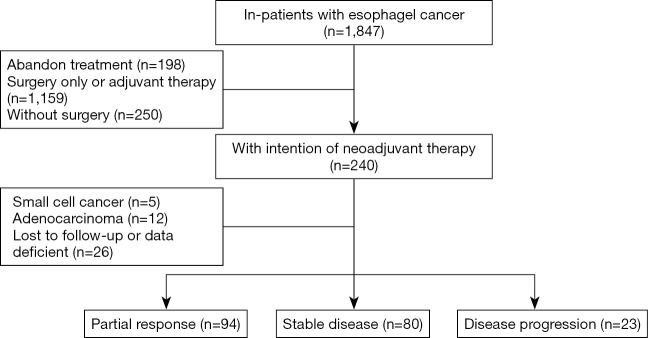
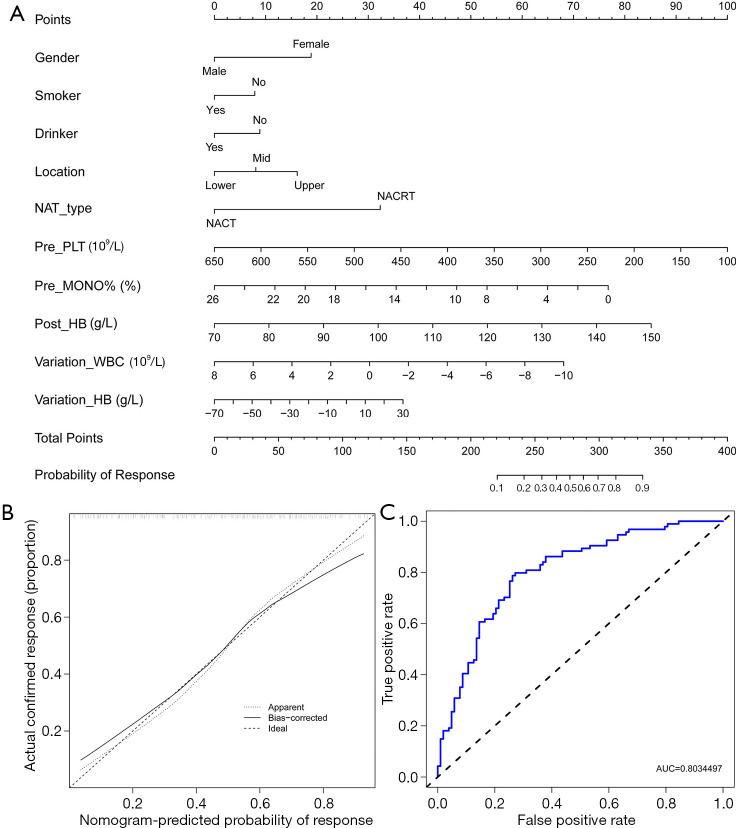
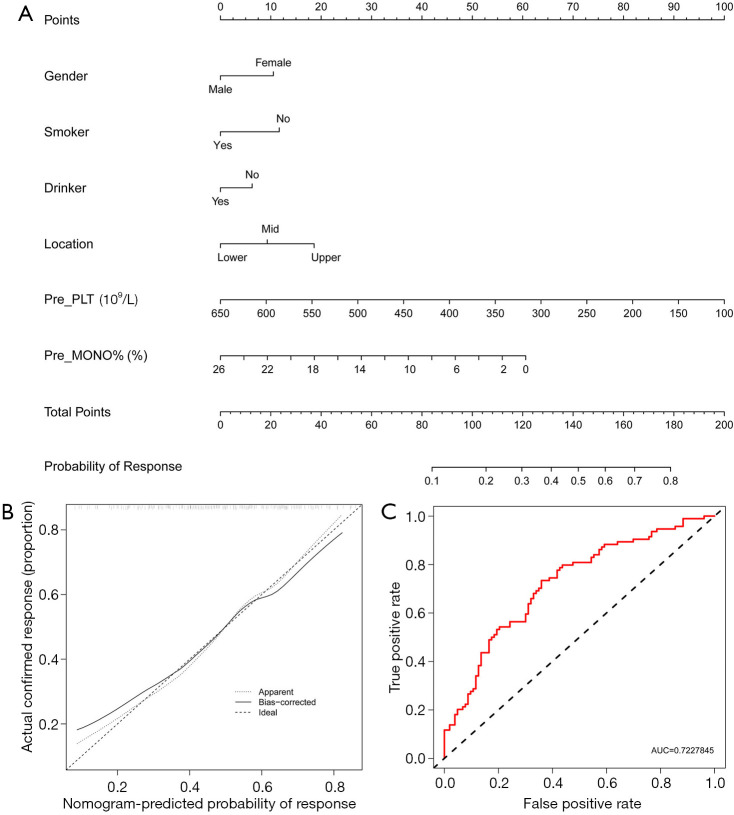
This study included 197 ESCC patients in our center from January 2010 to December 2018. Response evaluation criteria in solid tumors (RECIST) criteria were used for the treatment evaluation. The results of univariate and multivariate logistic regression analysis were used to select independent factors for construction of the prediction model. The concordance index (C-index), receiver operating characteristic (ROC) curve, and calibration curve were used to evaluate the robustness of the model, while the bootstrap method was used for internal validation.
Among the 197 included ESCC patients, 94 patients achieved partial remission, 80 patients were in stable condition, and 23 patients had disease progression, 123 of whom underwent surgery. The comparisons of the dynamic hematological test results before and after treatment show that pre-PLT, pre-MONO%, post-Hb, △WBC, and the option of undergoing neoadjuvant chemoradiation were the potential predictors for the effectiveness of neoadjuvant therapy. The model in which the C-index was 0.803 (95% confidence interval: 0.742-0.864) showed good prediction performance, and still reach a C-index of 0.764 when internally validated.
For the neoadjuvant treatment of ESCC, hematological indexes are closely related to the efficacy of neoadjuvant therapy. The nomogram can be used to easily predict the efficacy of neoadjuvant therapy in patients.
晚期食管鳞状细胞癌(ESCC)的预后很差。新辅助治疗已被证明可提高ESCC患者的总生存率。然而,目前仍没有有效的指标来预测新辅助治疗的疗效。本研究旨在探讨血液学参数与新辅助治疗疗效之间的相关性,为预测癌症对新辅助治疗的反应提供参考。
本研究纳入了2010年1月至2018年12月在本中心接受治疗的197例ESCC患者。采用实体瘤疗效评价标准(RECIST)对治疗效果进行评估。通过单因素和多因素逻辑回归分析结果来选择构建预测模型的独立因素。采用一致性指数(C指数)、受试者工作特征(ROC)曲线和校准曲线来评估模型的稳健性,同时采用自助法进行内部验证。
在纳入研究的197例ESCC患者中,94例患者达到部分缓解,80例患者病情稳定,23例患者疾病进展,其中123例患者接受了手术治疗。治疗前后动态血液学检测结果的比较显示,治疗前血小板计数(pre-PLT)、治疗前单核细胞百分比(pre-MONO%)、治疗后血红蛋白(post-Hb)、白细胞变化量(△WBC)以及接受新辅助放化疗这一选择是新辅助治疗疗效的潜在预测因素。C指数为0.803(95%置信区间:0.742-0.864)的模型显示出良好的预测性能,内部验证时C指数仍达到0.764。
对于ESCC的新辅助治疗,血液学指标与新辅助治疗疗效密切相关。列线图可用于轻松预测患者新辅助治疗的疗效。