Division of Gastroenterology and Hepatology, Department of Internal Medicine, Maastricht University Medical Centre, Maastricht, The Netherlands.
School of Nutrition and Translational Research in Metabolism (NUTRIM), Maastricht University, Maastricht, The Netherlands.
PLoS One. 2021 May 14;16(5):e0251822. doi: 10.1371/journal.pone.0251822. eCollection 2021.
Neuregulin 4 (Nrg4), a novel adipokine enriched in brown adipose tissue has been observed to negatively regulate de novo hepatic lipogenesis and limit nonalcoholic fatty liver disease (NAFLD) progression to nonalcoholic steatohepatitis (NASH) in rodents. However, the role of Nrg4 in human NAFLD remains unclear to date. We analysed Nrg4 plasma levels and its association with liver disease severity together with the transcriptional profile of the Nrg4 pathway in liver and visceral adipose tissue (VAT) of NAFLD patients.
Plasma Nrg4 levels were measured in 65 NAFLD patients and 43 healthy controls (HC). Hepatic steatosis and fibrosis were diagnosed and quantified with chemical shift MRI and transient elastography respectively. Furthermore, blood lipid levels, HOMA-IR and systemic pro-inflammatory cytokines (TNF-α, IL-6 and IFN-γ) were analysed. Microarray analyses to assess differences in the Nrg4 and its receptor family ErbB pathway in liver and VAT from an independent patient group with biopsy proven NAFL (simple steatosis) (n = 4), NASH (n = 5) and normal liver (n = 6) were performed.
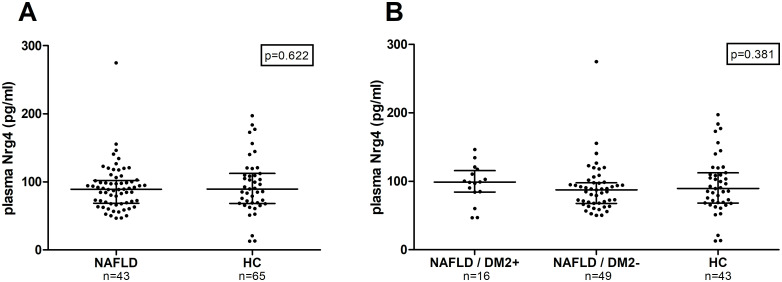
Plasma Nrg4 levels were not significantly different between NAFLD patients and HC (p = 0.622). Furthermore, plasma Nrg4 levels did not correlate with the hepatic fat fraction (r = -0.028, p = 0.829) and were not significantly different between NAFLD patients with or without hepatic fibrosis (p = 0.087). Finally, the expression profile of 82 genes related to the Nrg4-ErbB pathway in liver and VAT was not significantly different between NAFL, NASH or obese controls.
Our study does not support a role for Nrg4 in the pathophysiology of human NAFLD.
神经调节蛋白 4(Nrg4)是一种在棕色脂肪组织中丰富的新型脂肪因子,已被观察到可负调节肝内新生脂肪生成,并限制非酒精性脂肪性肝病(NAFLD)向非酒精性脂肪性肝炎(NASH)的进展。然而,到目前为止,Nrg4 在人类 NAFLD 中的作用尚不清楚。我们分析了 Nrg4 血浆水平及其与肝脏疾病严重程度的关系,以及 Nrg4 通路在 NAFLD 患者肝和内脏脂肪组织(VAT)中的转录谱。
在 65 名 NAFLD 患者和 43 名健康对照者(HC)中测量了血浆 Nrg4 水平。通过化学位移 MRI 和瞬时弹性成像分别诊断和量化肝脂肪变性和纤维化。此外,分析了血脂水平、HOMA-IR 和全身促炎细胞因子(TNF-α、IL-6 和 IFN-γ)。对来自另一组经活检证实的 NAFL(单纯性脂肪变性)(n = 4)、NASH(n = 5)和正常肝脏(n = 6)的患者的肝和 VAT 中 Nrg4 及其受体家族 ErbB 通路差异进行了微阵列分析。
NAFLD 患者与 HC 之间的血浆 Nrg4 水平无显著差异(p = 0.622)。此外,血浆 Nrg4 水平与肝脂肪分数之间无相关性(r = -0.028,p = 0.829),且在有或无肝纤维化的 NAFLD 患者之间无显著差异(p = 0.087)。最后,肝和 VAT 中与 Nrg4-ErbB 通路相关的 82 个基因的表达谱在 NAFL、NASH 或肥胖对照组之间无显著差异。
我们的研究不支持 Nrg4 在人类 NAFLD 病理生理学中的作用。