Department of Emergency and Reparative Medicine, Karolinska University Hospital, Huddinge, Karolinska Universitetssjukhuset, Stockholm, Sweden
Department of Medicine Solna, Karolinska Institute, Stockholm, Sweden.
Open Heart. 2021 May;8(1). doi: 10.1136/openhrt-2021-001682.
Several high-sensitivity cardiac troponin (hs-cTn)-based strategies exist for rule-out of myocardial infarction (MI). It is unknown whether historical hs-cTnT concentrations can be used. This study aim to evaluate the performance of a rule-out strategy based on the European Society of Cardiology (ESC) 0/1-hour algorithm, using historical hs-cTnT concentrations.
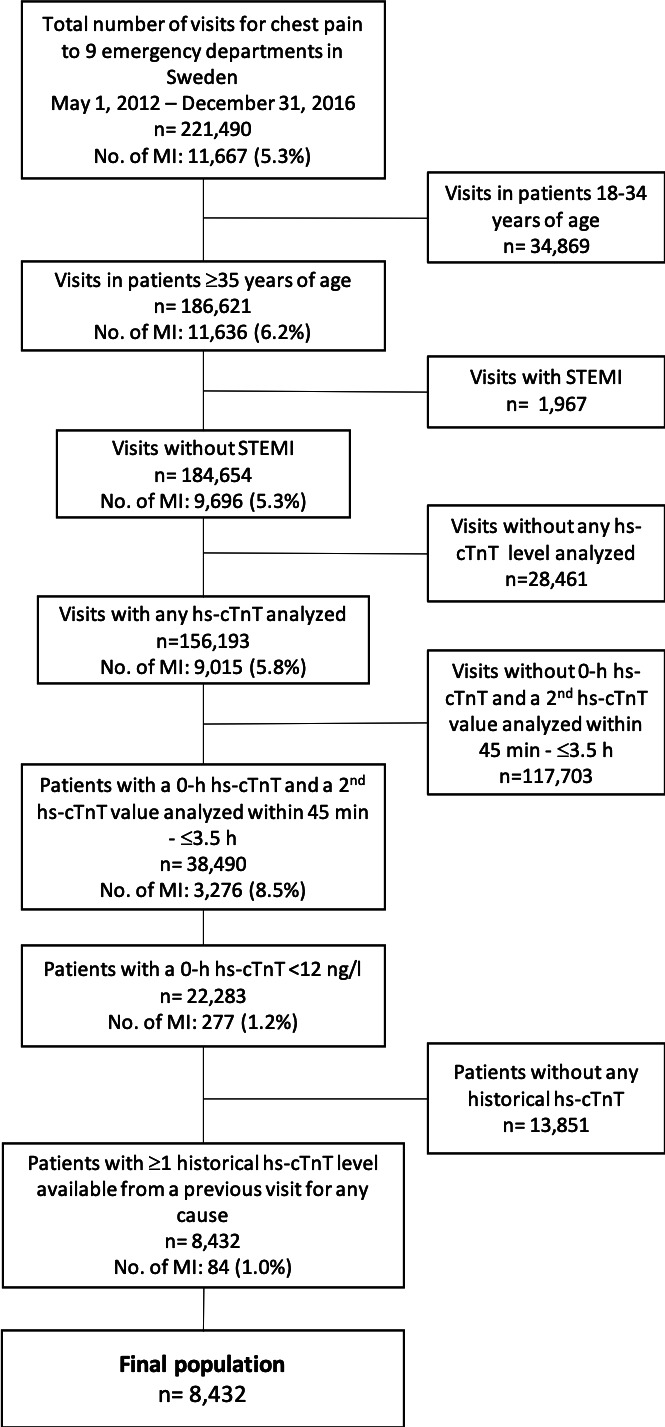
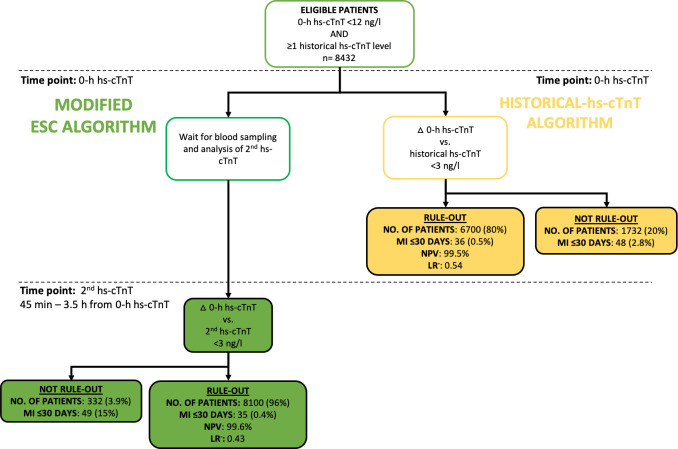
All visits among patients with chest pain in the emergency department at nine different hospitals in Sweden from 2012 to 2016 were eligible (221 490 visits). We enrolled patients with a 0-hour hs-cTnT of <12 ng/L, a second hs-cTnT measured within 3.5 hours, and ≥1 historical hs-cTnT available. We calculated the risks of MI and all-cause mortality using two rule-out strategies: (1) a delta hs-cTnT of <3 ng/L between the 0-hour hs-cTnT and the second hs-cTnT (modified ESC algorithm) and (2) a historical hs-cTnT <12 ng/L and a delta hs-cTnT of <3 ng/L in relation to the 0-hour hs-cTnT (historical-hs-cTnT algorithm).
A total of 8432 patients were included, of whom 84 (1.0%) had an MI. The modified ESC algorithm triaged 8100 (96%) patients toward ruled-out, for whom 30-day MI risk and negative predictive value (NPV) for MI (95% CI) were 0.4% (0.3% to 0.6%) and 99.6% (99.4% to 99.7%), respectively. The historical-hs-cTnT algorithm ruled out 6700 (80%) patients, with a 30-day MI risk of 0.5% (0.4% to 0.8%) and NPV of 99.5% (99.2% to 99.6%).
The application of algorithm resulted in similar MI risk and NPV to an established algorithm. The usefulness of historical hs-cTnT concentrations should merit further attention.
目前有几种基于高敏心肌肌钙蛋白(hs-cTn)的策略可用于排除心肌梗死(MI)。尚不清楚是否可以使用历史 hs-cTnT 浓度。本研究旨在评估基于欧洲心脏病学会(ESC)0/1 小时算法的排除策略的性能,该策略使用历史 hs-cTnT 浓度。
2012 年至 2016 年期间,瑞典 9 家不同医院急诊科胸痛患者的所有就诊均符合入选条件(221490 次就诊)。我们纳入了 hs-cTnT 0 小时<12ng/L、在 3.5 小时内再次测量 hs-cTnT 且有≥1 次 hs-cTnT 可用的患者。我们使用两种排除策略计算 MI 和全因死亡率的风险:(1)0 小时 hs-cTnT 与第二次 hs-cTnT 之间的 delta hs-cTnT <3ng/L(改良 ESC 算法)和(2)历史 hs-cTnT <12ng/L 且与 0 小时 hs-cTnT 相比 delta hs-cTnT <3ng/L(历史 hs-cTnT 算法)。
共纳入 8432 例患者,其中 84 例(1.0%)发生 MI。改良 ESC 算法将 8100 例(96%)患者分诊为排除病例,其 30 天 MI 风险和 MI 的阴性预测值(NPV)(95%CI)分别为 0.4%(0.3%至 0.6%)和 99.6%(99.4%至 99.7%)。历史 hs-cTnT 算法排除了 6700 例(80%)患者,30 天 MI 风险为 0.5%(0.4%至 0.8%),NPV 为 99.5%(99.2%至 99.6%)。
算法的应用导致 MI 风险和 NPV 与既定算法相似。历史 hs-cTnT 浓度的有用性值得进一步关注。