Orthopedic Department, Sir Gangaram Hospital, New Delhi 11006, India.
Central Institute of Orthopedics, Vardhman Mahavir Medical College and Safdarjung Hospital, New Delhi 110029, India.
Chin J Traumatol. 2021 Sep;24(5):301-305. doi: 10.1016/j.cjtee.2021.04.005. Epub 2021 Apr 20.
Comminuted intraarticular distal radial fractures are difficult to treat conservatively and require operative treatment. This study compared the functional outcomes between variable angle volar plating and external fixator with K-wire augmentation in open reduction and internal fixation.
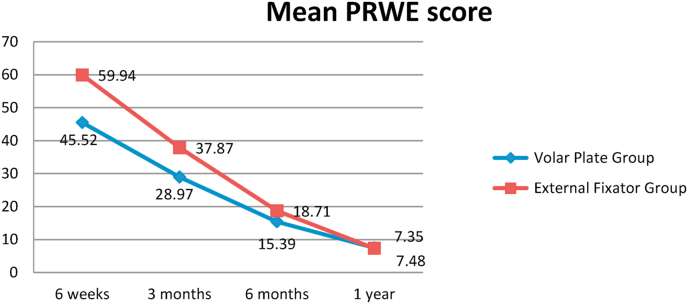
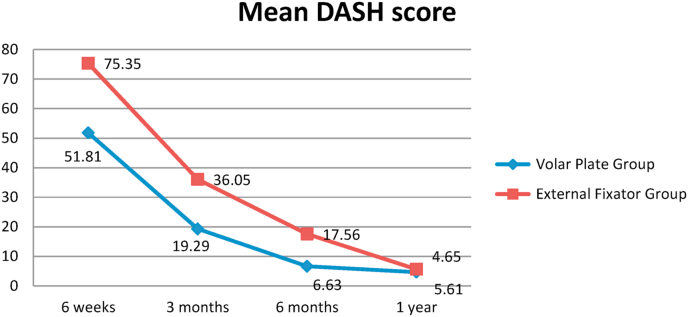
A total of 62 adult patients with comminuted intraarticular distal radius fracture were randomized into 2 groups: volar plate group and external fixator group. These patients aged between 18 and 60 years had unilateral fractures, and agreed to be included in the study. Patients with a history of fracture, bilateral fracture, associated other injuries, delayed injury for more than 2 weeks, open fracture, pre-existing arthrosis or disability, psychiatric illness and pathological fracture were excluded. Patients were followed up at 6 weeks, 3 months, 6 months and 1 year. The assessment of pain, functional activity, range of motion and grip strength was done at each stage of follow-up. The pain and functional activities were assessed by patient rated wrist evaluation (PRWE) score and disabilities of the arm, shoulder and hand (DASH) score.
Patients in volar plate group had superior PRWE score and DASH score at each stage of follow-up. At 1 year follow-up, the mean PRWE score were 7.48 for volar plate group and 7.35 for external fixator group; while the mean DASH score was 4.65 for volar plate group and 5.61 for external fixator group. They had better flexion and extension range of movement. They also had better pronation and supination range of motion at initial follow-up, however the difference get attenuated by 1 year. Volar plate group had significantly better grip strength than external fixator group. Complication rates were higher in external fixation group.
Fixation with variable angle volar plate results in early wrist mobilization, better range of movement, less pain and disability and early return of function.
粉碎性关节内桡骨远端骨折难以保守治疗,需要手术治疗。本研究比较了切开复位内固定中角度掌侧钢板和外固定架联合克氏针增强的功能结果。
共纳入 62 例成人粉碎性关节内桡骨远端骨折患者,随机分为掌侧钢板组和外固定架组。这些年龄在 18 至 60 岁之间的单侧骨折患者同意参与本研究。排除有骨折病史、双侧骨折、合并其他损伤、受伤超过 2 周、开放性骨折、预先存在关节炎或残疾、精神疾病和病理性骨折的患者。患者在 6 周、3 个月、6 个月和 1 年时进行随访。在每次随访时评估疼痛、功能活动、活动范围和握力。疼痛和功能活动通过患者自评腕关节评估(PRWE)评分和手臂、肩部和手部残疾(DASH)评分进行评估。
掌侧钢板组患者在每个随访阶段的 PRWE 评分和 DASH 评分均较高。在 1 年随访时,掌侧钢板组的平均 PRWE 评分为 7.48,外固定架组为 7.35;而掌侧钢板组的平均 DASH 评分为 4.65,外固定架组为 5.61。他们的屈伸活动范围更好。他们在初始随访时的旋前和旋后活动范围也更好,但在 1 年后差异减弱。掌侧钢板组的握力明显优于外固定架组。外固定架组的并发症发生率较高。
角度掌侧钢板固定可早期活动腕关节,改善活动范围,减轻疼痛和残疾,恢复功能更早。