Zhang Chengchen, Spence O'Mareen, Reeves Gloria, DosReis Susan
Department of Pharmaceutical Health Services Research, University of Maryland School of Pharmacy, Baltimore, MD, United States.
Division of Child and Adolescent Psychiatry, University of Maryland School of Medicine, Baltimore, MD, United States.
Front Psychiatry. 2021 Apr 29;12:640244. doi: 10.3389/fpsyt.2021.640244. eCollection 2021.
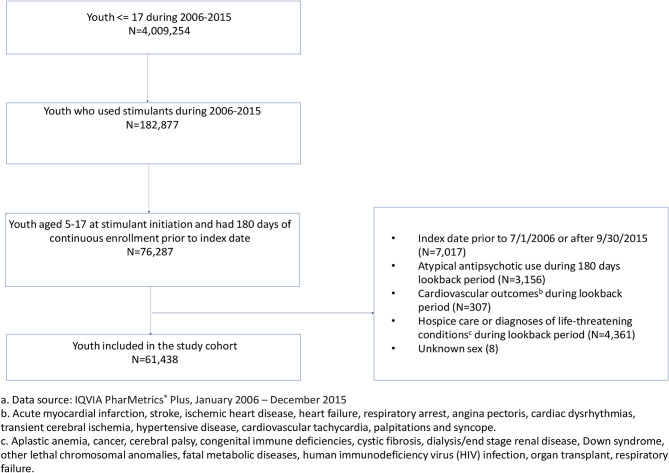
To investigate the risk of cardiovascular events associated with concomitant use of stimulants and atypical antipsychotics (AAPs) among youth and evaluate whether AAP dose and duration of concomitant use modifies the risk. We used IQVIA PharMetrics® Plus data from 2006 to 2015 to construct a retrospective cohort of commercially-insured youth aged 5-17 years old who initiated a stimulant medication. Time-varying concomitant stimulant/AAP use was defined as current, past and no concomitant use based on person months. The primary time-varying Cox proportional hazard regression analysis evaluated the risk of cardiovascular events comparing current concomitant use with past and no concomitant use, adjusted for baseline cardiovascular risk. A secondary analysis assessed the risk of cardiovascular events comparing AAP daily doses (<1, 1-2, >2 mg) and duration (<3, 3-6, >6 months) of current concomitant use to no concomitant use. Cardiovascular outcomes included severe (i.e., stroke, acute myocardial infarction, ischemic heart disease) and less severe (i.e., angina pectoris, cardiac dysrhythmias, transient cerebral ischemia, hypertensive disease, tachycardia, palpitations, syncope). For this cohort of 61,438 youths, the incidence rate of severe cardiovascular events was 0.18 per 10,000 person-months, and all events occurred in no concomitant use months. The risk of less severe cardiovascular events was significantly higher in current concomitant users compared with no [HR: 2.59 (95%CI: 1.72, 3.90)] and past [HR: 1.89 (95%CI: 1.10, 3.24)] concomitant users. Compared to no concomitant use, the risk of less severe cardiovascular events was significantly higher at all AAP daily doses [HR: <1 mg: 2.82 (95%CI: 1.72, 4.61); 1-2 mg: 2.22 (95%CI: 1.16, 4.25); >2 mg: 2.65 (95%CI: 1.50, 4.71)]. The risk of less severe cardiovascular events significantly elevated for all duration of use and was higher for <3 months of concomitant use [HR: <3 months: 3.45 (95%CI: 2.17, 5.47) relative to 3-6 months: 2.60 (95%CI: 1.29, 5.25) or >6 months: 2.61 (95%CI: 1.59, 4.30)]. Severe cardiovascular events are rare. Concomitant stimulant/AAP use elevates the risk of less severe cardiovascular events. Periodic heart rate or blood pressure monitoring for youth on stimulant/AAP treatment may be warranted.
调查青少年同时使用兴奋剂和非典型抗精神病药物(AAPs)与心血管事件风险之间的关联,并评估AAP剂量和同时使用的持续时间是否会改变该风险。我们使用了IQVIA PharMetrics® Plus 2006年至2015年的数据,构建了一个回顾性队列,纳入了开始使用兴奋剂药物的5至17岁商业保险青少年。根据人月数,将随时间变化的同时使用兴奋剂/AAP定义为当前使用、过去使用和未同时使用。主要的随时间变化的Cox比例风险回归分析评估了将当前同时使用与过去和未同时使用进行比较时心血管事件的风险,并对基线心血管风险进行了调整。一项次要分析评估了将当前同时使用的AAP每日剂量(<1、1 - 2、>2毫克)和持续时间(<3、3 - 6、>6个月)与未同时使用进行比较时心血管事件的风险。心血管结局包括严重的(即中风、急性心肌梗死、缺血性心脏病)和不太严重的(即心绞痛、心律失常、短暂性脑缺血、高血压疾病、心动过速、心悸、晕厥)。对于这个61438名青少年的队列,严重心血管事件的发病率为每10000人月0.18例,所有事件均发生在未同时使用的月份。与未同时使用[风险比(HR):2.59(95%置信区间:1.72,3.90)]和过去同时使用[HR:1.89(95%置信区间:1.10,3.24)]的使用者相比,当前同时使用者发生不太严重心血管事件的风险显著更高。与未同时使用相比,所有AAP每日剂量下发生不太严重心血管事件的风险均显著更高[HR:<1毫克:2.82(95%置信区间:1.72,4.61);1 - 2毫克:2.22(95%置信区间:1.16,,4.25);>2毫克:2.65(95%置信区间:1.50,4.71)]。在所有使用持续时间内,发生不太严重心血管事件的风险均显著升高,且在同时使用<3个月时更高[HR:<3个月:3.45(95%置信区间:2.17,5.47)相对于3 - 6个月:2.60(95%置信区间:1.29,5.25)或>6个月:2.61(95%置信区间:1.59,4.30)]。严重心血管事件很少见。同时使用兴奋剂/AAP会增加发生不太严重心血管事件的风险。对于接受兴奋剂/AAP治疗的青少年,可能有必要定期进行心率或血压监测。