Xu Mu, Wu Qibin, Cai Liangzhi, Sun Xiaoqi, Xie Xiaoyan, Sun Pengming
Department of Gynecology, Fujian Maternity and Child Health Hospital, Affiliated Hospital of Fujian Medical University, Fuzhou, China.
Laboratory of Gynecologic Oncology, Fujian Maternal and Child Health Hospital, Affiliated Hospital of Fujian Medical University, Fuzhou, China.
J Cancer. 2021 Apr 30;12(12):3671-3677. doi: 10.7150/jca.56170. eCollection 2021.
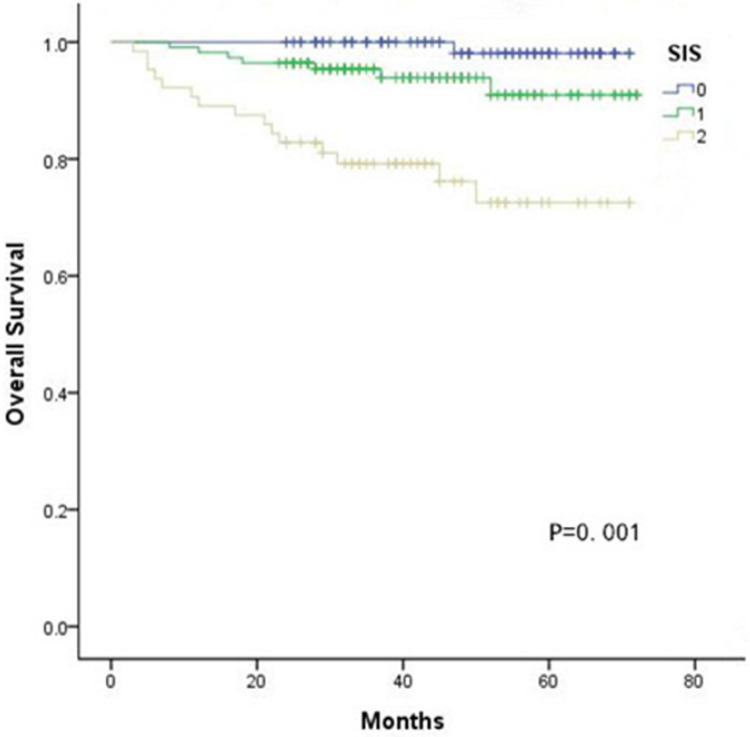
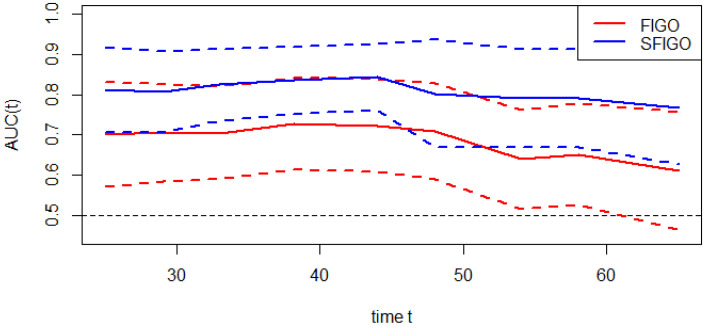
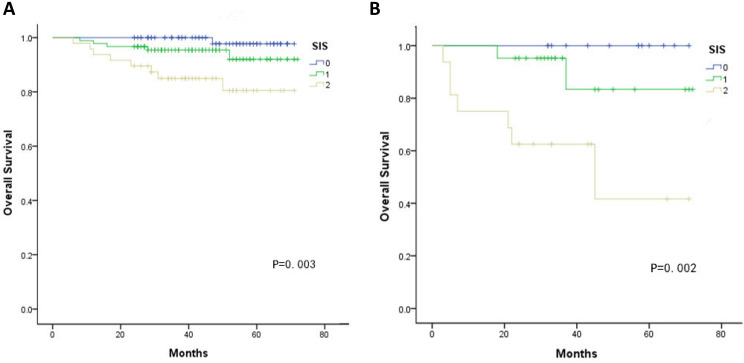
To evaluate the prognostic value of the systemic inflammatory score (SIS) in cervical cancer patients. A total of 264 patients with FIGO stage (2009) IB-IIA cervical cancer undergoing radical resection from January 2014 to December 2017 were recruited. The optimal cutoff values for inflammatory biomarkers were calculated by X-tile software. The prognostic factors were investigated using univariate and multivariate Cox analyses. Time-dependent receiver operating characteristic (time-ROC) analysis and the concordance index (C-index) were used to compare the prognostic impact of factors. In total, 264 patients with cervical cancer were included in the study. The optimal cutoff value for lymphocyte-to-monocyte ratio (LMR) was 4.1. In multivariate analysis, FIGO stage, lymphovascular invasion, lymph node metastasis, preoperative serum albumin (Alb), and LMR were independent prognostic factors (P<0.05). Then, we combined preoperative Alb and LMR to establish the SIS. Multivariate analysis showed that the SIS was an independent factor that affected survival (P<0.05). When stratified by FIGO stage, significant differences in survival were also found for patients with different SISs (P<0.05). When the SIS and FIGO stage were combined, the time-ROC curve was superior to that of FIGO stage only. The C-index of the model combining the SIS and FIGO stage was 0.786 (95% CI 0.699-0.873), which was significantly higher than that of the model with FIGO stage only (0.676, 95% CI 0.570-0.782, P=0.0049). The preoperative SIS is a simple and useful prognostic factor for postoperative survival in patients with cervical cancer. It might assist in the identification of high-risk patients among patients with the same FIGO stage.
评估全身炎症评分(SIS)在宫颈癌患者中的预后价值。纳入了2014年1月至2017年12月期间接受根治性切除术的264例国际妇产科联盟(FIGO,2009年)IB-IIA期宫颈癌患者。通过X-tile软件计算炎症生物标志物的最佳截断值。采用单因素和多因素Cox分析研究预后因素。使用时间依赖性受试者工作特征(time-ROC)分析和一致性指数(C-index)比较各因素的预后影响。本研究共纳入264例宫颈癌患者。淋巴细胞与单核细胞比值(LMR)的最佳截断值为4.1。多因素分析显示,FIGO分期、脉管浸润、淋巴结转移、术前血清白蛋白(Alb)和LMR是独立的预后因素(P<0.05)。然后,我们将术前Alb和LMR相结合建立SIS。多因素分析表明,SIS是影响生存的独立因素(P<0.05)。按FIGO分期分层时,不同SIS的患者在生存方面也存在显著差异(P<0.05)。当将SIS和FIGO分期相结合时,time-ROC曲线优于仅使用FIGO分期的曲线。联合SIS和FIGO分期的模型的C-index为0.786(95%CI 0.699-0.873),显著高于仅使用FIGO分期的模型(0.676,95%CI 0.570-0.782,P=0.0049)。术前SIS是宫颈癌患者术后生存的一个简单且有用的预后因素。它可能有助于在相同FIGO分期的患者中识别高危患者。