Zhang Yong, Shi Shi-Ming, Yang Hua, Yang Liu-Xiao, Wang Zheng, Li Xue-Dong, Yin Dan, Shi Ying-Hong, Cao Ya, Dai Zhi, Zhou Jian, Chen Qing
Department of General Surgery, Zhongshan Hospital (South), Fudan University, Shanghai Public Health Clinical Center, Fudan University, Shanghai 200083, China.
Liver Cancer Institute, Zhongshan Hospital, Fudan University, Key Laboratory of Carcinogenesis and Cancer Invasion, Ministry of Education, Shanghai 200032, China.
J Cancer. 2019 Jan 1;10(2):494-503. doi: 10.7150/jca.26890. eCollection 2019.
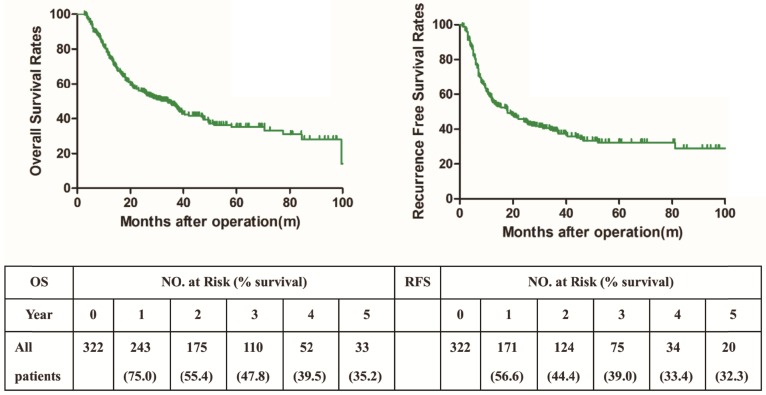
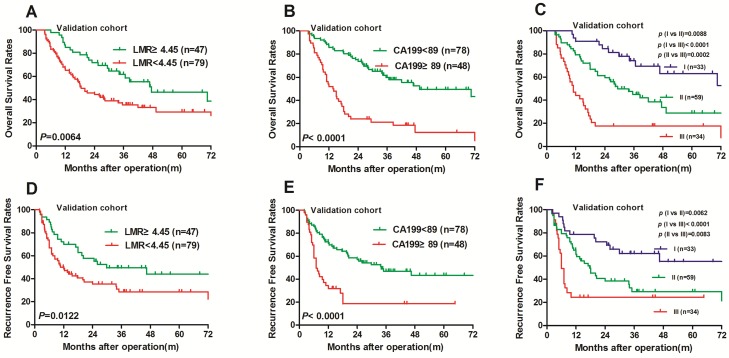
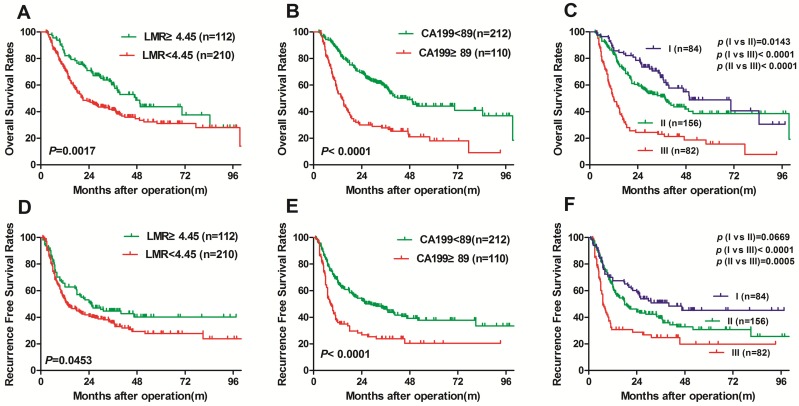
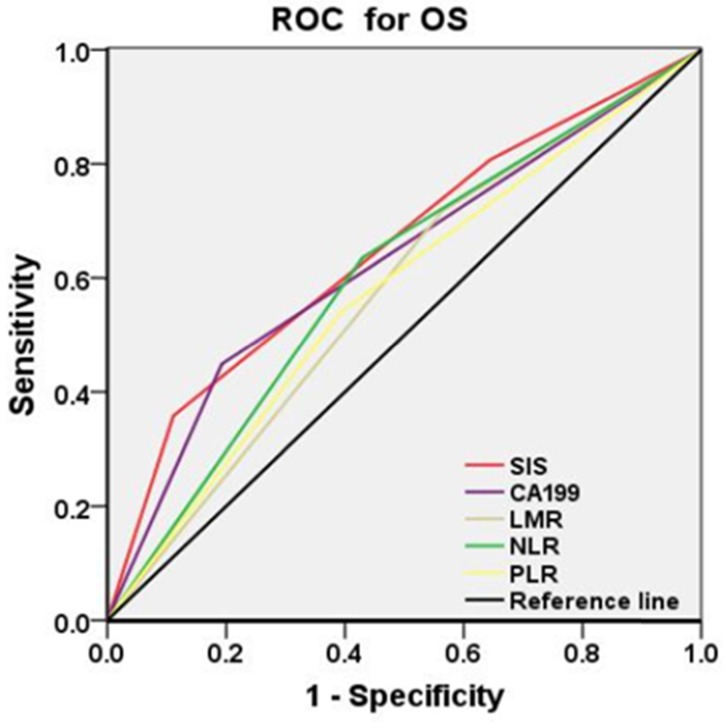
Inflammation has a critical role in the development and progression of cancers. We developed a novel systemic inflammation score (SIS) based on lymphocyte, monocyte, and CA19-9 and explored its prognostic value in intrahepatic cholangiocarcinoma (ICC). From January 2005 to December 2011, 322 consecutive ICC patients who underwent curative resection in our center were included in this study, and validated in a retrospective study of 126 patients enrolled from 2012 to 2014. Clinicopathological variables including preoperative serum CA19-9 and LMR were analyzed. The cutoff values of CA19-9 and LMR were determined based on receiver operating characteristics curve analysis in the primary cohort. Kaplan-Meier curves and multivariate Cox-regression analyses were calculated for time to recurrence (TTR) and overall survival (OS). In univariate analysis of all patients, all three inflammatory and tumor marker including NLR ≥ 2.49 (0.001), LMR ≤ 4.45 (=0.002), and CA19-9≥89 (0.001) were associated with poor prognoses. When omitting SIS in multivariate analysis, preoperative LMR ( =0.006) and serum CA19-9 (<0.001) were independent predictors of OS. In addition, elevated CA19-9 (=0.001), multiple tumors (<0.001), and lymph node metastasis (<0.001) were significant predictors of worse recurrence free survival. Moreover, high SIS was significantly associated with aggressive tumor behaviours including large tumor size (<0.001), multiple tumors (=0.033), lymphonodus node metastasis (=0.001), and high TNM stage (<0.0001). Finally, univariate and multivariate analyses revealed the SIS was an independent predictor for TTR (HR=2.077, 95% CI, 1.365-3.162, =0.001) and OS (HR=3.133 95% CI, 2.058-4.769, <0.001). These results were further confirmed in the validation cohort. In conclusions, our findings demonstrate that the SIS as a potentially powerful prognostic biomarker in ICC that predicts poor clinical outcomes and is a promising tool for ICC treatment strategy decisions.
炎症在癌症的发生和发展中起着关键作用。我们基于淋巴细胞、单核细胞和CA19-9开发了一种新型的全身炎症评分(SIS),并探讨了其在肝内胆管癌(ICC)中的预后价值。2005年1月至2011年12月,本研究纳入了在我们中心接受根治性切除的322例连续ICC患者,并在一项对2012年至2014年纳入的126例患者的回顾性研究中进行了验证。分析了包括术前血清CA19-9和LMR在内的临床病理变量。根据主要队列中的受试者工作特征曲线分析确定CA19-9和LMR的临界值。计算复发时间(TTR)和总生存期(OS)的Kaplan-Meier曲线和多因素Cox回归分析。在所有患者的单因素分析中,包括NLR≥2.49(P = 0.001)、LMR≤4.45(P = 0.002)和CA19-9≥89(P = 0.001)在内的所有三种炎症和肿瘤标志物均与预后不良相关。在多因素分析中排除SIS后,术前LMR(P = 0.006)和血清CA19-9(P < 0.001)是OS的独立预测因素。此外,CA19-9升高(P = 0.001)、多发肿瘤(P < 0.001)和淋巴结转移(P < 0.001)是无复发生存期较差的显著预测因素。此外,高SIS与侵袭性肿瘤行为显著相关,包括肿瘤体积大(P < 0.001)、多发肿瘤(P = 0.033)、淋巴结转移(P = 0.001)和高TNM分期(P < 0.0001)。最后,单因素和多因素分析显示SIS是TTR(HR = 2.077,95%CI,1.365 - 3.162,P = 0.001)和OS(HR = 3.133,95%CI,2.058 - 4.769,P < 0.001)的独立预测因素。这些结果在验证队列中得到进一步证实。总之,我们的研究结果表明,SIS作为ICC中一种潜在强大的预后生物标志物,可预测不良临床结局,是ICC治疗策略决策的一个有前景的工具。