Wang Hongshuang, Dawber Robert S, Zhang Peiyu, Walko Martin, Wilson Andrew J, Wang Xiaohui
Laboratory of Chemical Biology, Changchun Institute of Applied Chemistry, Chinese Academy of Sciences 5625 Renmin St. Changchun 130022 Jilin China
State Key Laboratory of Pharmaceutical Biotechnology, Nanjing University Nanjing 210023 Jiangsu China.
Chem Sci. 2021 Mar 25;12(17):5977-5993. doi: 10.1039/d1sc00165e.
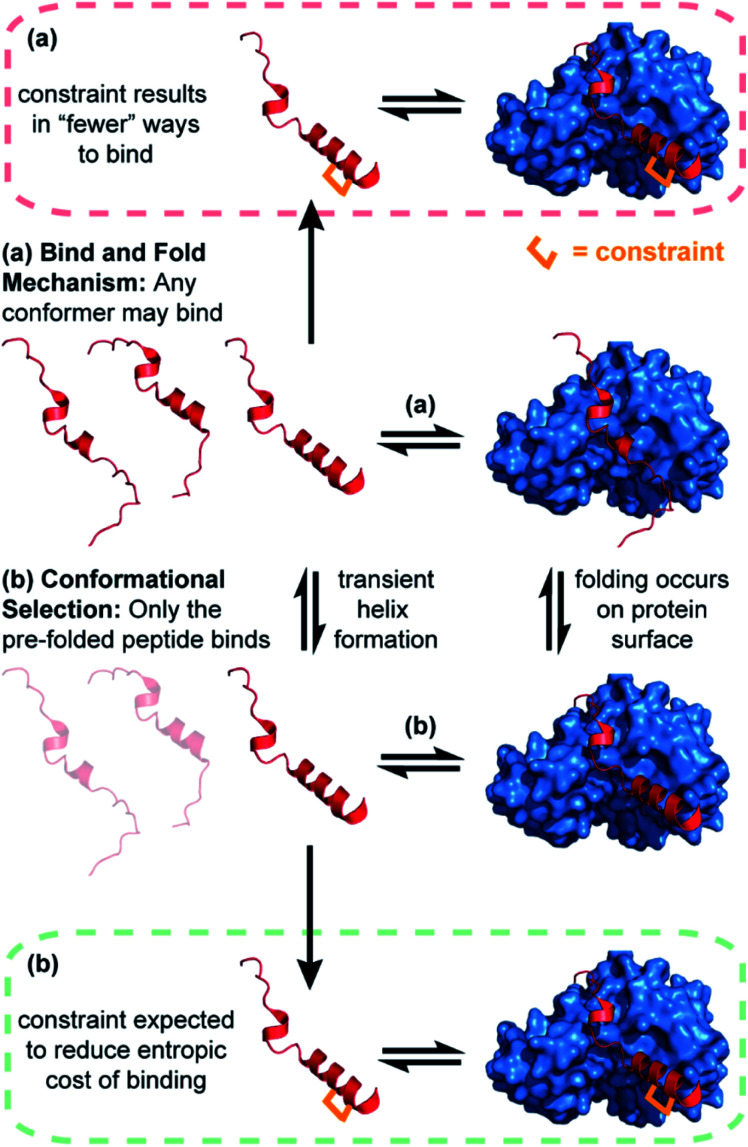
Protein-protein interactions (PPIs) are implicated in the majority of cellular processes by enabling and regulating the function of individual proteins. Thus, PPIs represent high-value, but challenging targets for therapeutic intervention. The development of constrained peptides represents an emerging strategy to generate peptide-based PPI inhibitors, typically mediated by α-helices. The approach can confer significant benefits including enhanced affinity, stability and cellular penetration and is ingrained in the premise that pre-organization simultaneously pays the entropic cost of binding, prevents a peptide from adopting a protease compliant β-strand conformation and shields the hydrophilic amides from the hydrophobic membrane. This conceptual blueprint for the empirical design of peptide-based PPI inhibitors is an exciting and potentially lucrative way to effect successful PPI inhibitor drug-discovery. However, a plethora of more subtle effects may arise from the introduction of a constraint that include changes to binding dynamics, the mode of recognition and molecular properties. In this review, we summarise the influence of inserting constraints on biophysical, conformational, structural and cellular behaviour across a range of constraining chemistries and targets, to highlight the tremendous success that has been achieved with constrained peptides alongside emerging design opportunities and challenges.
蛋白质-蛋白质相互作用(PPIs)通过赋予和调节单个蛋白质的功能,参与了大多数细胞过程。因此,PPIs是具有高价值但具有挑战性的治疗干预靶点。构建受限肽是一种新兴策略,用于生成基于肽的PPI抑制剂,通常由α-螺旋介导。这种方法可以带来显著的益处,包括增强亲和力、稳定性和细胞穿透性,其依据的前提是预组织同时承担结合的熵成本,防止肽采取符合蛋白酶作用的β-链构象,并使亲水性酰胺基团免受疏水膜的影响。这种基于经验设计基于肽的PPI抑制剂的概念蓝图,是实现成功的PPI抑制剂药物发现的一种令人兴奋且可能有利可图的方式。然而,引入限制可能会产生大量更细微的影响,包括结合动力学的变化、识别模式和分子性质的改变。在本综述中,我们总结了在一系列限制化学和靶点中插入限制对生物物理、构象、结构和细胞行为的影响,以突出受限肽所取得的巨大成功以及新出现的设计机会和挑战。