Feng Mei, Song Yi, Chen Serena H, Zhang Yuanzhao, Zhou Ruhong
Institute of Quantitative Biology, Shanghai Institute for Advanced Study, College of Life Sciences, Department of Physics, Zhejiang University Hangzhou 310027 China
Lanzhou Center for Theoretical Physics, Key Laboratory of Theoretical Physics of Gansu Province, Lanzhou University Lanzhou Gansu 730000 China.
Chem Sci. 2021 Mar 16;12(17):6107-6116. doi: 10.1039/d0sc06946a.
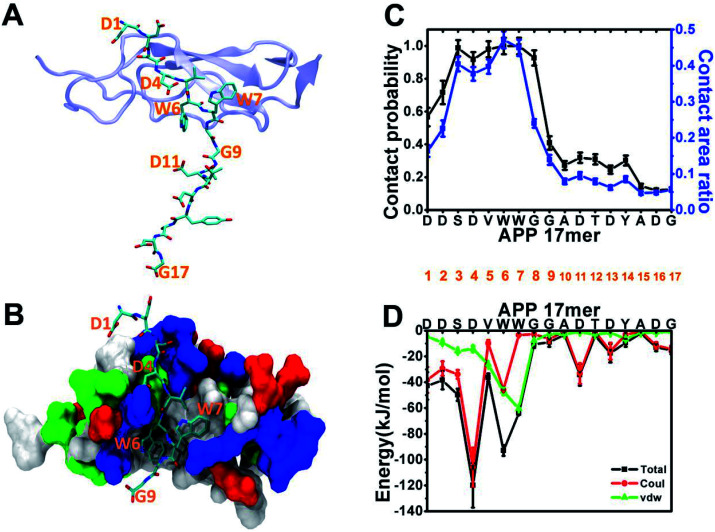
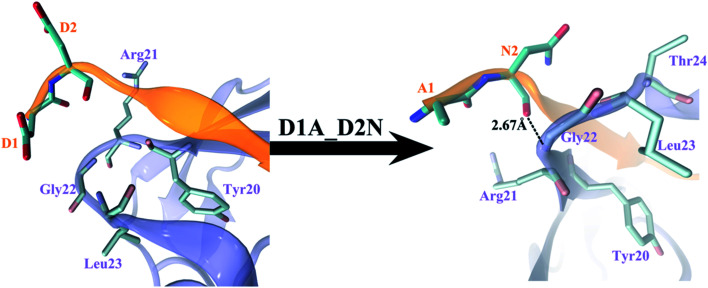
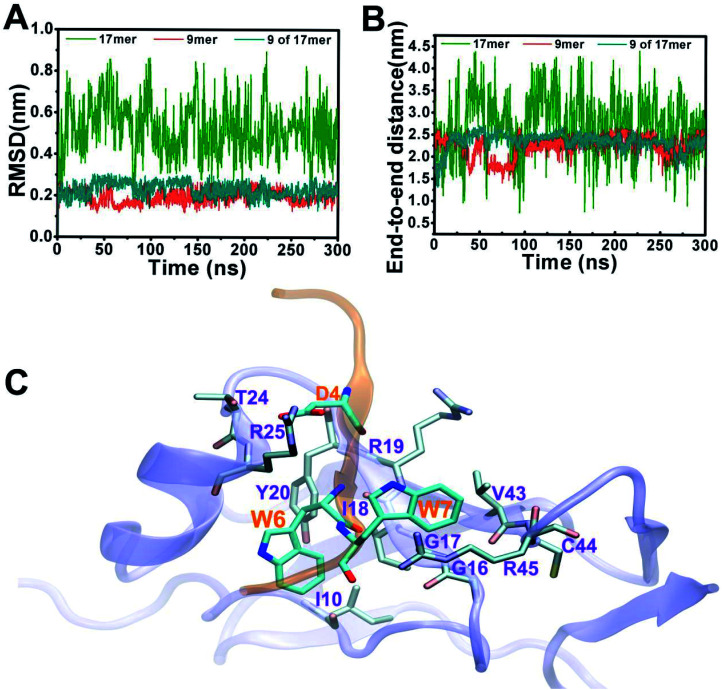
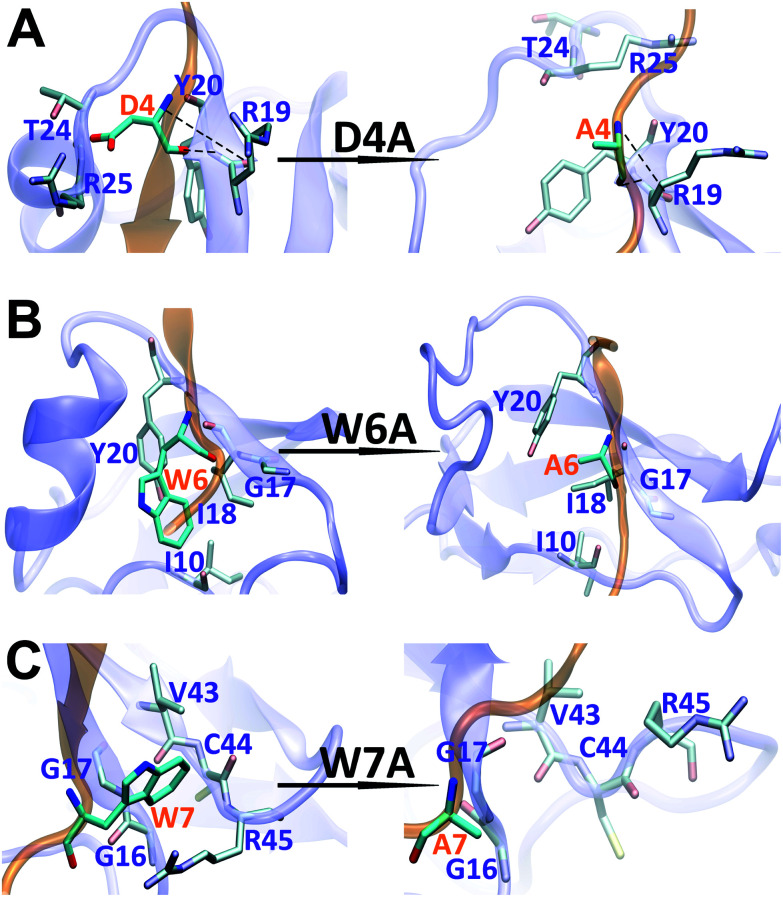
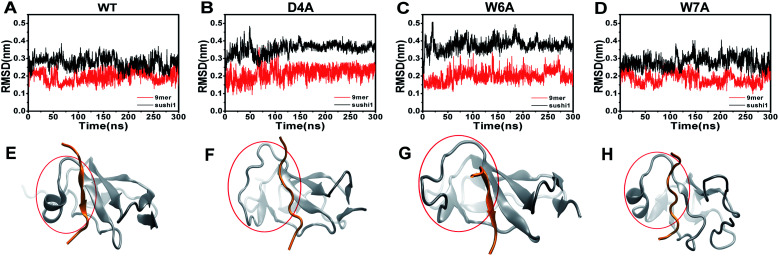
A recent phenomenal study discovered that the extension domain of secreted amyloid-β precursor protein (sAPP) can bind to the intrinsically disordered sushi 1 domain of the γ-aminobutyric acid type B receptor subunit 1a (GABAR1a) and modulate its synaptic transmission. The work provided an important structural foundation for the modulation of GABAR1a; however, the detailed molecular interaction mechanism, crucial for future drug design, remains elusive. Here, we further investigated the dynamical interactions between sAPP peptides and the natively unstructured sushi 1 domain using all-atom molecular dynamics simulations, for both the 17-residue sAPP peptide (APP 17-mer) and its minimally active 9 residue segment (APP 9-mer). We then explored mutations of the APP 9-mer with rigorous free energy perturbation (FEP) calculations. Our mutagenesis studies revealed key residues (D4, W6, and W7) responsible for the binding with the sushi 1 domain. More importantly, one double mutation based on different vertebrate APP sequences from evolution exhibited a stronger binding (ΔΔ = -1.91 ± 0.66 kcal mol), indicating a potentially enhanced GABAR1a modulator. These large-scale simulations may provide new insights into the binding mechanism between sAPP and the sushi 1 domain, which could open new avenues in the development of future GABAR1a-specific therapeutics.
最近一项引人注目的研究发现,分泌型淀粉样前体蛋白(sAPP)的延伸结构域可以与γ-氨基丁酸B型受体亚基1a(GABAR1a)的内在无序寿司1结构域结合,并调节其突触传递。这项工作为GABAR1a的调节提供了重要的结构基础;然而,对于未来药物设计至关重要的详细分子相互作用机制仍然不清楚。在这里,我们使用全原子分子动力学模拟,进一步研究了sAPP肽与天然无结构的寿司1结构域之间的动态相互作用,研究对象包括17个残基的sAPP肽(APP 17聚体)及其活性最低的9个残基片段(APP 9聚体)。然后,我们通过严格的自由能扰动(FEP)计算探索了APP 9聚体的突变。我们的诱变研究揭示了与寿司1结构域结合的关键残基(D4、W6和W7)。更重要的是,基于进化过程中不同脊椎动物APP序列的一个双突变表现出更强的结合能力(ΔΔ = -1.91 ± 0.66 kcal/mol),表明可能是一种增强的GABAR1a调节剂。这些大规模模拟可能为sAPP与寿司1结构域之间的结合机制提供新的见解,这可能为未来开发GABAR1a特异性疗法开辟新途径。