Liu Zhi, Fan Panpan, Chen Ming, Xu Yueshi, Zhao Dongchi
Department of Pediatrics, Children's Digital Health and Data Center, Zhongnan Hospital of Wuhan University, Wuhan, China.
Xiangyang Central Hospital, Affiliated Hospital of Hubei University of Arts and Science, Xiangyang, China.
Front Pediatr. 2021 Apr 29;9:602195. doi: 10.3389/fped.2021.602195. eCollection 2021.
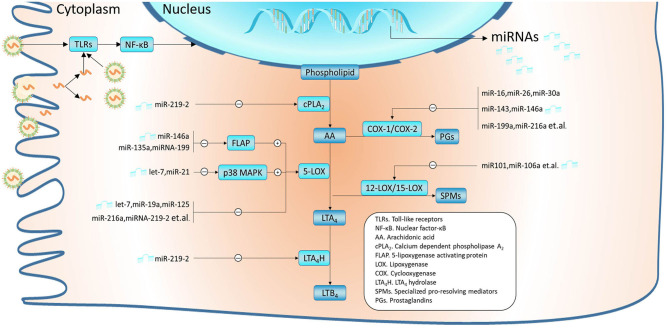
MicroRNAs (miRNAs) are small, non-coding RNAs that regulate posttranscription by binding to 3'-untranslated regions of target mRNAs. Recent functional studies have elucidated mechanisms that miRNAs regulate leukotriene synthesis by perturbing arachidonic acid metabolism. Both microarrays and high-throughput sequencing revealed distinct differential expression of miRNAs in children with respiratory syncytial virus (RSV) infection compared with healthy controls. Abnormal miRNA expression may contribute to higher leukotriene levels, which is associated with airway hyperreactivity. Targeting miRNAs may benefit to restore the homeostasis of inflammatory reaction and provide new strategies to alleviate airway hyperreactivity induced by RSV. In this article, we provide an overview of the current knowledge about miRNAs modulating leukotrienes through regulation of arachidonic acid metabolism with a special focus on miRNAs aberrantly expressed in children with RSV infection.
微小RNA(miRNA)是一类小的非编码RNA,通过与靶mRNA的3'非翻译区结合来调控转录后过程。最近的功能研究阐明了miRNA通过干扰花生四烯酸代谢来调节白三烯合成的机制。微阵列和高通量测序均显示,与健康对照相比,呼吸道合胞病毒(RSV)感染儿童体内的miRNA存在明显的差异表达。miRNA表达异常可能导致白三烯水平升高,而这与气道高反应性有关。靶向miRNA可能有助于恢复炎症反应的稳态,并为缓解RSV诱导的气道高反应性提供新策略。在本文中,我们概述了目前关于miRNA通过调节花生四烯酸代谢来调控白三烯的相关知识,特别关注了RSV感染儿童中异常表达的miRNA。