Waldie Sarah, Sebastiani Federica, Moulin Martine, Del Giudice Rita, Paracini Nicolò, Roosen-Runge Felix, Gerelli Yuri, Prevost Sylvain, Voss John C, Darwish Tamim A, Yepuri Nageshwar, Pichler Harald, Maric Selma, Forsyth V Trevor, Haertlein Michael, Cárdenas Marité
Department of Biomedical Science and Biofilms-Research Center for Biointerfaces, Malmö University, Malmö, Sweden.
Institut Laue-Langevin, Grenoble, France.
Front Chem. 2021 Apr 29;9:630152. doi: 10.3389/fchem.2021.630152. eCollection 2021.
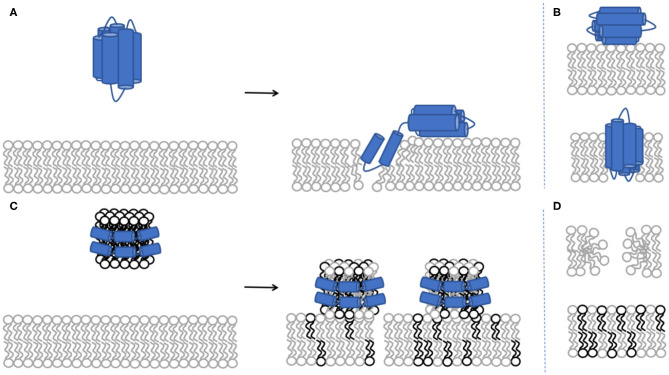
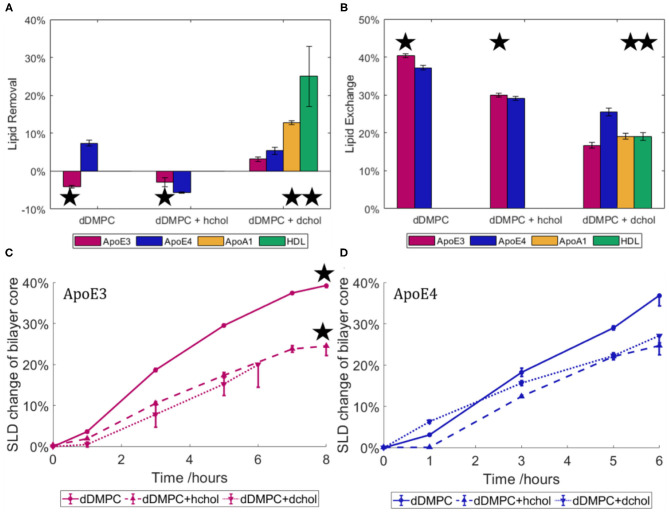
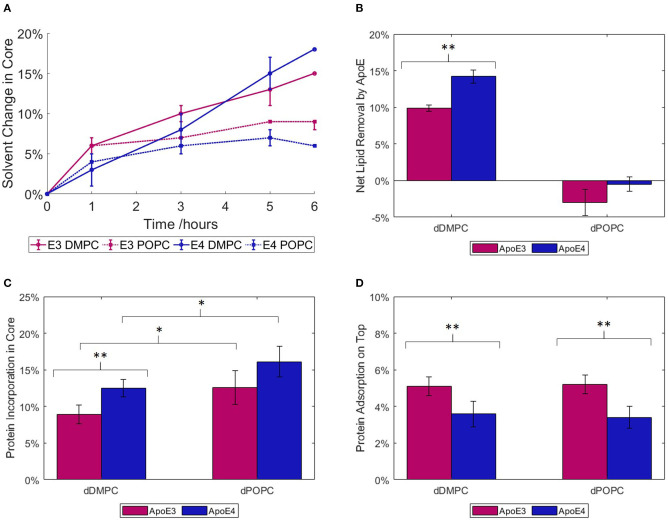
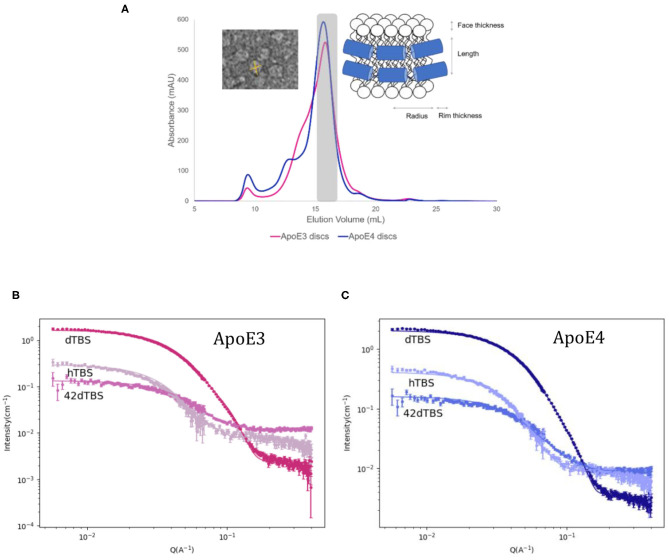
Apolipoprotein E (ApoE), an important mediator of lipid transportation in plasma and the nervous system, plays a large role in diseases such as atherosclerosis and Alzheimer's. The major allele variants ApoE3 and ApoE4 differ only by one amino acid. However, this difference has major consequences for the physiological behaviour of each variant. In this paper, we follow (i) the initial interaction of lipid-free ApoE variants with model membranes as a function of lipid saturation, (ii) the formation of reconstituted High-Density Lipoprotein-like particles (rHDL) and their structural characterisation, and (iii) the rHDL ability to exchange lipids with model membranes made of saturated lipids in the presence and absence of cholesterol [1,2-dimyristoyl-sn-glycero-3-phosphocholine (DMPC) or 1-palmitoyl-2-oleoyl-glycero-3-phosphocholine (POPC) with and without 20 mol% cholesterol]. Our neutron reflection results demonstrate that the protein variants interact differently with the model membranes, adopting different protein conformations. Moreover, the ApoE3 structure at the model membrane is sensitive to the level of lipid unsaturation. Small-angle neutron scattering shows that the ApoE containing lipid particles form elliptical disc-like structures, similar in shape but larger than nascent or discoidal HDL based on Apolipoprotein A1 (ApoA1). Neutron reflection shows that ApoE-rHDL do not remove cholesterol but rather exchange saturated lipids, as occurs in the brain. In contrast, ApoA1-containing particles remove and exchange lipids to a greater extent as occurs elsewhere in the body.
载脂蛋白E(ApoE)是血浆和神经系统中脂质运输的重要介质,在动脉粥样硬化和阿尔茨海默病等疾病中起重要作用。主要等位基因变体ApoE3和ApoE4仅相差一个氨基酸。然而,这种差异对每个变体的生理行为有重大影响。在本文中,我们研究了:(i)无脂ApoE变体与模型膜的初始相互作用,作为脂质饱和度的函数;(ii)重组高密度脂蛋白样颗粒(rHDL)的形成及其结构表征;以及(iii)在存在和不存在胆固醇的情况下,rHDL与由饱和脂质制成的模型膜交换脂质的能力[1,2-二肉豆蔻酰-sn-甘油-3-磷酸胆碱(DMPC)或1-棕榈酰-2-油酰-甘油-3-磷酸胆碱(POPC),含或不含20 mol%胆固醇]。我们的中子反射结果表明,蛋白质变体与模型膜的相互作用不同,采用不同的蛋白质构象。此外,模型膜处的ApoE3结构对脂质不饱和度水平敏感。小角中子散射表明,含ApoE的脂质颗粒形成椭圆盘状结构,形状与基于载脂蛋白A1(ApoA1)的新生或盘状HDL相似,但更大。中子反射表明,ApoE-rHDL不像在大脑中那样去除胆固醇,而是交换饱和脂质。相反,含ApoA1的颗粒在更大程度上去除和交换脂质,就像在身体其他部位发生的那样。