Feng Sijia, Chen Mo, Chen Jun, Li Hong, Chen Jiwu, Chen Shiyi
Sports Medicine Institute of Fudan University, Department of Orthopaedic Sports Medicine, Huashan Hospital, Fudan University, Shanghai, China.
Orthop J Sports Med. 2021 Apr 29;9(4):23259671211001775. doi: 10.1177/23259671211001775. eCollection 2021 Apr.
Although Bankart repair with remplissage is commonly performed to treat anterior shoulder instability, there is limited information on specific outcomes or patients' fears regarding return to sports (RTS).
To study recurrence rates, pain, shoulder function, active range of motion (ROM), RTS rate, and patients' fears and expectations for RTS after arthroscopic Bankart repair with remplissage for anterior shoulder instability. We compared these outcomes with those after Bankart repair alone.
Cohort study; Level of evidence, 3.
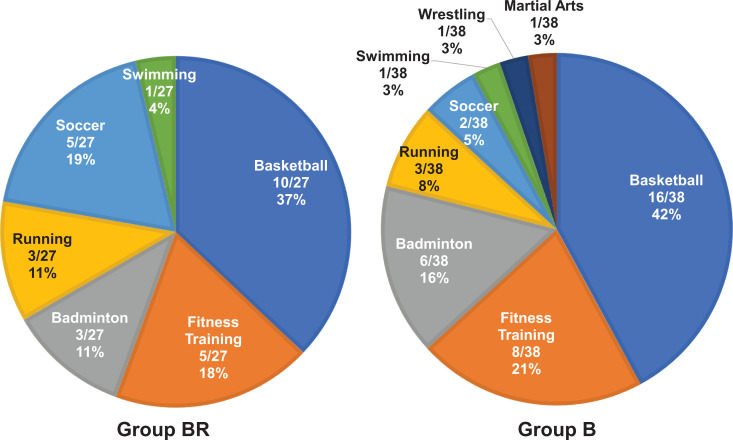
A retrospective cohort study was carried out between 2007 and 2017 among patients who underwent arthroscopic Bankart repair with remplissage (group BR) and Bankart repair alone (group B). At the final follow-up, outcomes including recurrence, pain, shoulder function, active ROM, RTS rate, and fear toward RTS were assessed. The specific outcomes for RTS were evaluated based on 3 levels: return to normal life, RTS at any level (RTSA), and RTS at previous level (RTSP).
A total of 70 patients were included (29 in group BR and 41 in group B) with a mean 67.2 months of follow-up. Group BR demonstrated a significantly lower recurrence rate than did group B (0 vs 22.0%, respectively; = .007) as well as higher postoperative Rowe score (92.8 ± 7.1 vs 83.3 ± 16.2, respectively; = .005). There were no differences between the groups in postoperative visual analog scale for pain score, American Shoulder and Elbow Surgeons score, Oxford Shoulder Instability Score, or active ROM. The rates of RTSA (100% vs 84.2%; = .03) and RTSP (77.8% vs 50.0%; = .02) were higher in group BR than in group B, respectively, and significantly fewer patients in group BR reported fear of RTS (40.7% vs 63.2%; = .04).
In this study, recurrence rate, pain, shoulder function, active ROM, and RTS rate were satisfactory after arthroscopic Bankart repair with remplissage. Patients who underwent this procedure reported less fear toward RTS and higher rates of RTSA and RTSP than did those who undergo Bankart repair alone.
尽管采用充填式Bankart修复术治疗前肩不稳较为常见,但关于其具体疗效或患者对恢复运动(RTS)的担忧的信息有限。
研究采用关节镜下充填式Bankart修复术治疗前肩不稳后的复发率、疼痛、肩部功能、主动活动范围(ROM)、RTS率以及患者对RTS的恐惧和期望。我们将这些结果与单纯Bankart修复术后的结果进行了比较。
队列研究;证据等级,3级。
对2007年至2017年间接受关节镜下充填式Bankart修复术(BR组)和单纯Bankart修复术(B组)的患者进行了一项回顾性队列研究。在末次随访时,评估了包括复发、疼痛、肩部功能、主动ROM、RTS率以及对RTS的恐惧等结果。基于三个水平评估RTS的具体结果:恢复正常生活、任何水平恢复运动(RTSA)以及恢复至先前水平运动(RTSP)。
共纳入70例患者(BR组29例,B组41例),平均随访67.2个月。BR组的复发率显著低于B组(分别为0%和22.0%;P = 0.007),术后Rowe评分也更高(分别为92.8±7.1和83.3±16.2;P = 0.005)。两组在术后疼痛视觉模拟量表评分、美国肩肘外科医师评分、牛津肩部不稳评分或主动ROM方面无差异。BR组的RTSA率(100%对84.2%;P = 0.03)和RTSP率(77.8%对50.0%;P = 0.02)均高于B组,且BR组报告害怕RTS的患者明显更少(40.7%对63.2%;P = 0.04)。
在本研究中,关节镜下充填式Bankart修复术后的复发率、疼痛、肩部功能、主动ROM和RTS率均令人满意。接受该手术的患者对RTS的恐惧较少,RTSA和RTSP率高于单纯接受Bankart修复术的患者。