Johnson Mitchell A, Halloran Kenny, Carpenter Connor, Pascual-Leone Nicolas, Parambath Andrew, Sharma Jigyasa, Seltzer Ryan, Ellis Henry B, Shea Kevin G, Ganley Theodore J
The Children's Hospital of Philadelphia, Philadelphia, Pennsylvania, USA.
Texas Scottish Rite Hospital for Children, Dallas, Texas, USA.
Orthop J Sports Med. 2021 Apr 28;9(4):23259671211010826. doi: 10.1177/23259671211010826. eCollection 2021 Apr.
The current coronavirus 2019 (COVID-19) pandemic has prompted a multitude of public health response measures including social distancing, school cancellations, and cessation of organized sports.
To examine the impact of COVID-19 and corresponding public health measures on the characteristics of common pediatric musculoskeletal injuries associated with sports.
Cohort study; Level of evidence, 3.
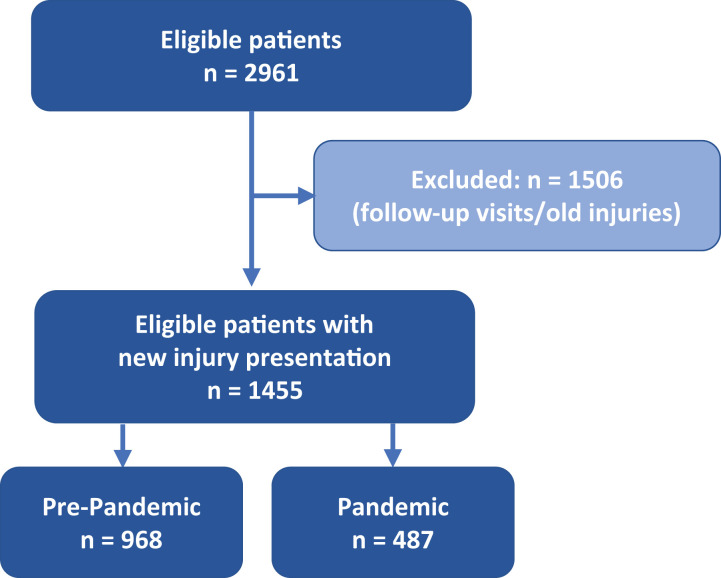
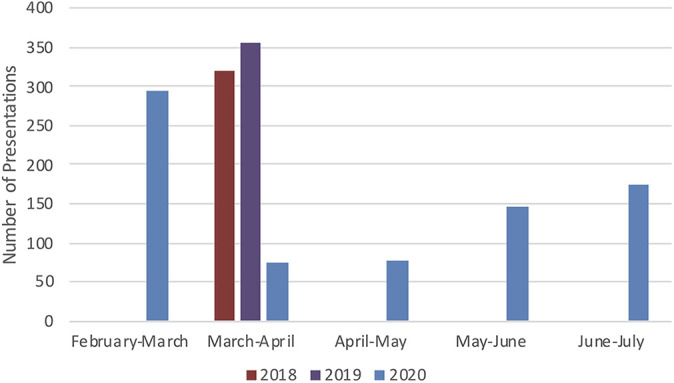
This was a multicenter retrospective cohort study comparing patients with sports injuries presenting to 3 geographically diverse level I pediatric trauma hospitals and outpatient orthopaedic surgery clinics in the United States during the COVID-19 pandemic and a prepandemic period at the same institutions. Patients were included if they presented for care between February 15 and July 15 in 2020 (pandemic cohort) or between March 15 and April 15 in 2018 and 2019 (prepandemic cohort).
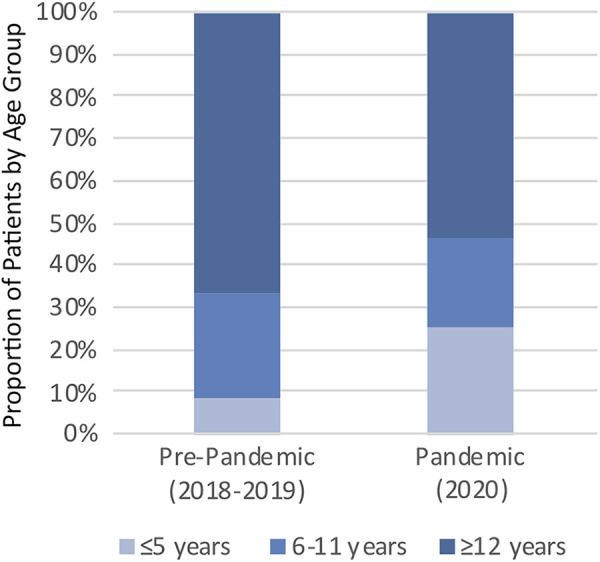
Included were 1455 patients with an average age of 12.1 ± 4.5 years. When comparing patients presenting in 2018 and 2019 with those presenting in 2020, we observed a decrease in mean age during the pandemic (12.6 ± 4.0 vs 11.0 ± 5.2 years; = .048). Additionally, a decrease in the proportion of injuries attributed to sports (48.8% vs 33.3%; < .001) and those occurring at school (11.9% vs 4.0%; = .001) was observed. The proportion of injuries attributable to clavicle fractures increased during the early stages of the pandemic (13.2% vs 34.7%; < .001). There was no statistically significant delay to care in injuries presenting during the pandemic (41.5 ± 141.2 vs 19.23 ± 79.1 days; = .175).
Across 3 tertiary care institutions, patients were seen without significant delay during the pandemic. We observed a significant decline in pediatric musculoskeletal injuries associated with sports during the COVID-19 pandemic. This decrease has been accompanied by a shift in both injury type and mechanism.
当前的2019冠状病毒病(COVID-19)大流行促使采取了众多公共卫生应对措施,包括保持社交距离、取消学校课程以及停止有组织的体育活动。
研究COVID-19及相应公共卫生措施对与运动相关的常见小儿肌肉骨骼损伤特征的影响。
队列研究;证据等级,3级。
这是一项多中心回顾性队列研究,比较了在COVID-19大流行期间以及同一机构大流行前时期,前往美国3家地理位置不同的I级小儿创伤医院和门诊骨科手术诊所就诊的运动损伤患者。纳入标准为在2020年2月15日至7月15日期间就诊的患者(大流行队列),或在2018年和2019年3月15日至4月15日期间就诊的患者(大流行前队列)。
共纳入1455例患者,平均年龄为12.1±4.5岁。将2018年和2019年就诊的患者与2020年就诊的患者进行比较时,我们观察到在大流行期间平均年龄有所下降(12.6±4.0岁对11.0±5.2岁;P = 0.048)。此外,观察到归因于运动的损伤比例下降(48.8%对33.3%;P < 0.001),以及在学校发生的损伤比例下降(11.9%对4.0%;P = 0.001)。在大流行早期,锁骨骨折所致损伤的比例有所增加(13.2%对34.7%;P < 0.001)。在大流行期间就诊的损伤患者在接受治疗方面没有统计学上的显著延迟(41.5±141.2天对19.23±79.1天;P = 0.175)。
在3家三级医疗机构中,大流行期间患者就诊未出现显著延迟。我们观察到在COVID-疫情期间与运动相关的小儿肌肉骨骼损伤显著减少。这种减少伴随着损伤类型和机制的转变。