Sun Tianai, Chi Jen-Tsan
Department of Molecular Genetics and Microbiology, Duke University School of Medicine, Durham, NC, 27710, USA.
Center for Genomic and Computational Biology, Duke University School of Medicine, Durham, NC, 27710, USA.
Genes Dis. 2020 May 18;8(3):241-249. doi: 10.1016/j.gendis.2020.05.004. eCollection 2021 May.
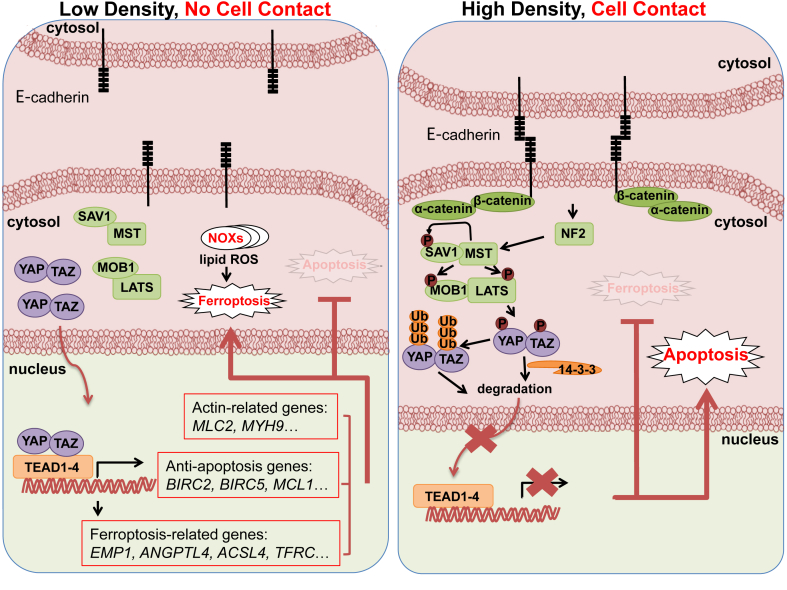
Ferroptosis is a novel form of iron-dependent cell death characterized by lipid peroxidation. While the importance and disease relevance of ferroptosis is gaining recognition, much remains unknown about various genetic and non-genetic determinants of ferroptosis. Hippo signaling pathway is an evolutionarily conserved pathway that responds to various environmental cues and controls organ size, cell proliferation, death, and self-renewal capacity. In cancer biology, Hippo pathway is a potent tumor suppressing mechanism and its dysregulation contributes to apoptosis evasion, cancer development, metastasis, and treatment resistance. Hippo dysregulation leads to aberrant activation of YAP and TAZ, the two major transcription co-activators of TEADs, that induce the expression of genes triggering tumor-promoting phenotypes, including enhanced cell proliferation, self-renewal and apoptosis inhibition. The Hippo pathway is regulated by the cell-cell contact and cellular density/confluence. Recently, ferroptosis has also been found being regulated by the cellular contact and density. The YAP/TAZ activation under low density, while confers apoptosis resistance, renders cancer cells sensitivity to ferroptosis. These findings establish YAP/TAZ and Hippo pathways as novel determinants of ferroptosis. Therefore, inducing ferroptosis may have therapeutic potential for YAP/TAZ-activated chemo-resistant and metastatic tumor cells. Reciprocally, various YAP/TAZ-targeting treatments under clinical development may confer ferroptosis resistance, limiting the therapeutic efficacy.
铁死亡是一种以脂质过氧化为特征的新型铁依赖性细胞死亡形式。虽然铁死亡的重要性和与疾病的相关性正逐渐得到认可,但关于铁死亡的各种遗传和非遗传决定因素仍有许多未知之处。Hippo信号通路是一条进化上保守的通路,它对各种环境信号作出反应,并控制器官大小、细胞增殖、死亡和自我更新能力。在癌症生物学中,Hippo通路是一种强大的肿瘤抑制机制,其失调会导致细胞凋亡逃避、癌症发展、转移和治疗耐药性。Hippo失调会导致YAP和TAZ这两种TEADs的主要转录共激活因子异常激活,从而诱导触发肿瘤促进表型的基因表达,包括增强细胞增殖、自我更新和抑制细胞凋亡。Hippo通路受细胞间接触和细胞密度/汇合度的调节。最近,人们还发现铁死亡也受细胞接触和密度的调节。低密度下YAP/TAZ的激活虽然赋予了细胞抗凋亡能力,但却使癌细胞对铁死亡敏感。这些发现确立了YAP/TAZ和Hippo通路是铁死亡的新决定因素。因此,诱导铁死亡可能对YAP/TAZ激活的化疗耐药和转移性肿瘤细胞具有治疗潜力。相反,目前正在临床开发的各种靶向YAP/TAZ的治疗方法可能会赋予铁死亡抗性,从而限制治疗效果。