Dzaye Omar, Berning Philipp, Adelhoefer Siegfried, Duebgen Matthias, Blankstein Ron, Mahesh Mahadevappa, Nasir Khurram, Blumenthal Roger S, Mortensen Martin Bødtker, Blaha Michael J
Johns Hopkins Ciccarone Center for the Prevention of Cardiovascular Disease, Johns Hopkins University School of Medicine, Baltimore, MD.
Russell H. Morgan Department of Radiology and Radiological Science, Johns Hopkins University School of Medicine, Baltimore, MD.
Mayo Clin Proc Innov Qual Outcomes. 2021 Apr 8;5(2):456-465. doi: 10.1016/j.mayocpiqo.2021.02.010. eCollection 2021 Apr.
To evaluate interest in coronary artery calcium (CAC) among the general public during the past 17 years and to compare trends with real-world data on number of CAC procedures performed.
We used Google Trends, a publicly available database, to access search query data in a systematic and quantitative fashion to search for CAC-related key terms. Search terms included , , , , and . We accessed Google Trends in January 2021 and analyzed data from 2004 to 2020.
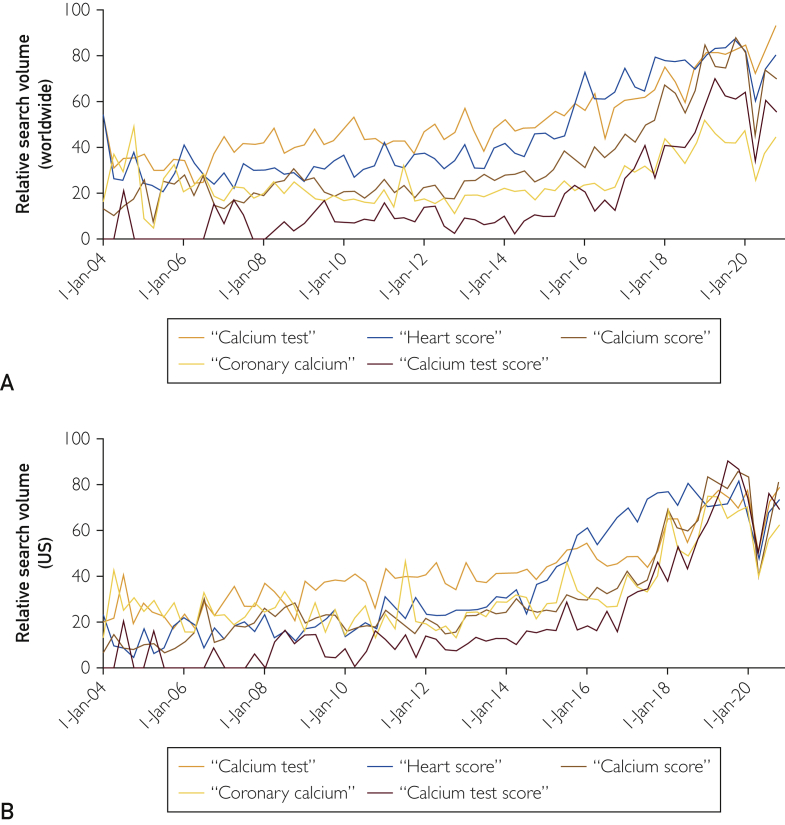
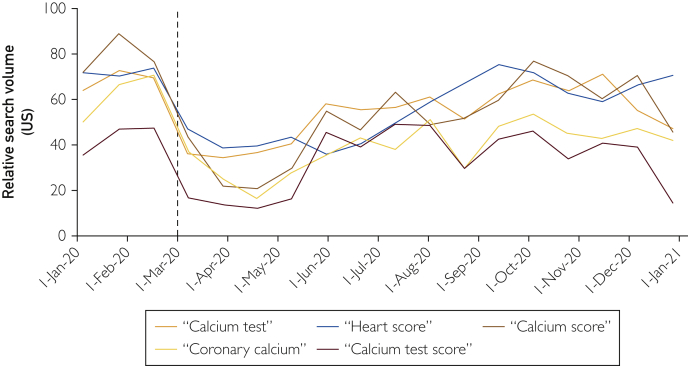
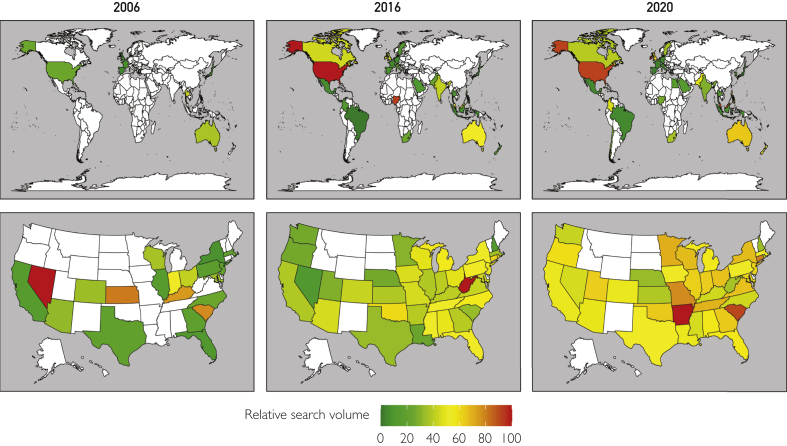
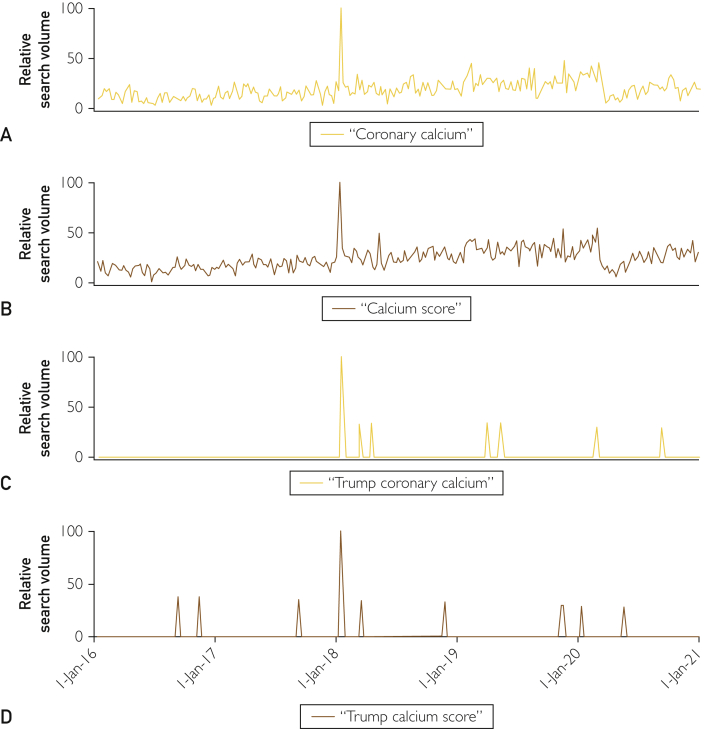
From 2004 to December 31, 2020, CAC-related search interest (in relative search volume) increased continually worldwide (+201.9%) and in the United States (+354.8%). Three main events strongly influenced search interest in CAC: reports of a CAC scan of the president of the United States led to a transient 10-fold increase in early January 2018. American College of Cardiology/American Heart Association guideline release led to a sustained increase, and lockdown after the global pandemic due to COVID-19 led to a transient decrease. Real-world data on performed CAC scans showed an increase between 2006 and 2017 (+200.0%); during the same time period, relative search volume for CAC-related search terms increased in a similar pattern (+70.6%-1511.1%). For the search term , a potential representative of active online search for CAC scanning, we found a +28.8% increase in 2020 compared with 2017.
Google Trends, a valuable tool for assessing public interest in health-related topics, suggests increased overall interest in CAC during the last 17 years that mirrors real-world usage data. Increased interest is seemingly linked to reports of CAC testing in world leaders and endorsement in major guidelines.
评估过去17年公众对冠状动脉钙化(CAC)的关注程度,并将其趋势与实际进行的CAC检查数量的真实数据进行比较。
我们使用公开可用的数据库谷歌趋势,以系统和定量的方式获取搜索查询数据,以搜索与CAC相关的关键词。搜索词包括 、 、 、 和 。我们于2021年1月访问了谷歌趋势,并分析了2004年至2020年的数据。
从2004年到2020年12月31日,全球范围内与CAC相关的搜索兴趣(以相对搜索量衡量)持续上升(增长201.9%),在美国增长幅度更大(增长354.8%)。有三件主要事件对CAC的搜索兴趣产生了强烈影响:美国总统进行CAC扫描的报道导致2018年1月初搜索量短暂增长了10倍。美国心脏病学会/美国心脏协会指南的发布导致搜索量持续增加,以及因新冠疫情导致的全球大流行后的封锁措施使搜索量短暂下降。实际进行的CAC扫描的真实数据显示,2006年至2017年期间有所增加(增长200.0%);在同一时期,与CAC相关搜索词的相对搜索量以类似模式增加(增长70.6%-1511.1%)。对于搜索词 (可作为对CAC扫描进行积极在线搜索的一个潜在代表),我们发现与2017年相比,2020年增长了28.8%。
谷歌趋势是评估公众对健康相关话题兴趣的一个有价值的工具,表明在过去17年中公众对CAC的总体兴趣有所增加,这与实际使用数据相符。兴趣的增加似乎与世界领导人进行CAC检测的报道以及主要指南中的认可有关。