Division of Infectious Diseases, Massachusetts General Hospital, Boston, USA.
Medical Practice Evaluation Center, Massachusetts General Hospital, Boston, USA.
AIDS Behav. 2021 Dec;25(12):3967-3977. doi: 10.1007/s10461-021-03307-8. Epub 2021 May 17.
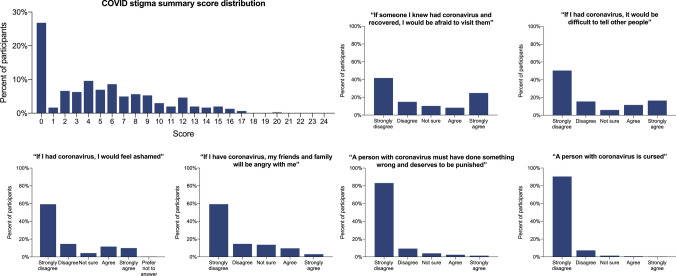
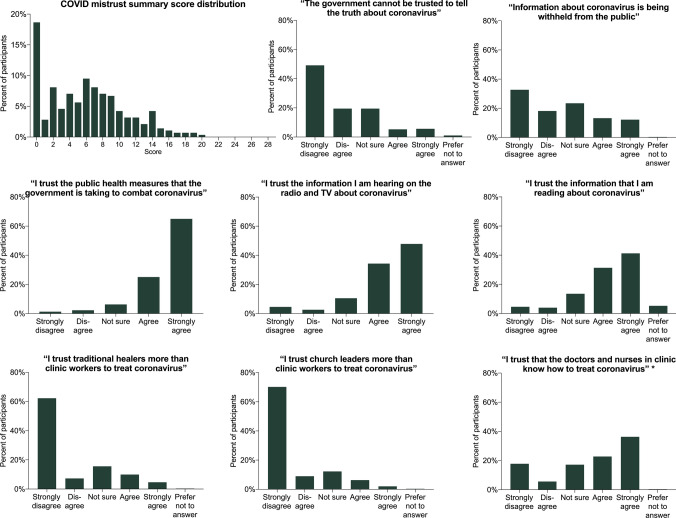
We evaluated COVID-19 stigma and medical mistrust among people living with HIV in South Africa. We conducted telephone interviews with participants in a prospective study of a decentralized antiretroviral therapy program. Scales assessing medical mistrust, conspiracy beliefs, anticipated and internalized stigma, and stereotypes specific to COVID-19 were adapted primarily from the HIV literature, with higher scores indicating more stigma or mistrust. Among 303 participants, the median stigma summary score was 4 [interquartile range (IQR) 0-8; possible range 0-24] and 6 (IQR 2-9) for mistrust (possible range 0-28). A substantial proportion of participants agreed or strongly agreed with at least one item assessing stigma (54%) or mistrust (43%). Higher COVID-19 stigma was associated with female gender and antecedent HIV stigma, and lower stigma with reporting television as a source of information on COVID-19. Further efforts should focus on effects of stigma and mistrust on protective health behaviors and vaccine hesitancy.
我们评估了南非艾滋病毒感染者中与 COVID-19 相关的污名化和对医疗的不信任。我们对一项去中心化抗逆转录病毒治疗计划的前瞻性研究中的参与者进行了电话访谈。评估对医疗的不信任、阴谋论信仰、预期和内化污名以及与 COVID-19 相关的刻板印象的量表主要改编自 HIV 文献,得分越高表示污名化或不信任程度越高。在 303 名参与者中,污名化总评分中位数为 4 [四分位距 (IQR) 0-8;可能范围 0-24],对医疗的不信任评分为 6 (IQR 2-9)(可能范围 0-28)。相当一部分参与者至少对一项评估污名化 (54%) 或不信任 (43%) 的项目表示同意或强烈同意。较高的 COVID-19 污名化与女性性别和先前的 HIV 污名化有关,而报告电视是 COVID-19 信息来源则与较低的污名化有关。应进一步努力关注污名化和不信任对保护健康行为和疫苗犹豫的影响。