Department of Epidemiology, Erasmus MC University Medical Center, PO Box 2040, 3000 CA, Rotterdam, The Netherlands.
Department of Radiology and Nuclear Medicine, Erasmus MC University Medical Center, Rotterdam, The Netherlands.
Eur J Epidemiol. 2021 May;36(5):497-506. doi: 10.1007/s10654-021-00755-3. Epub 2021 May 17.
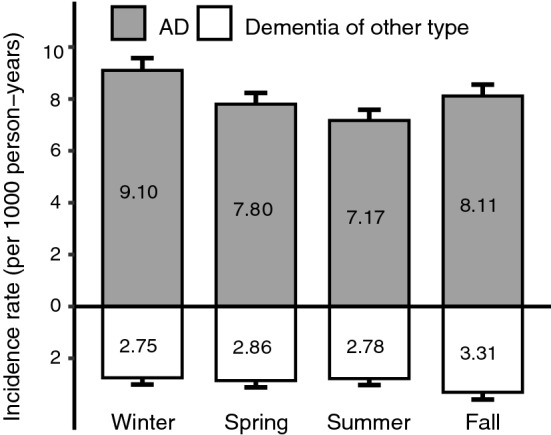
Early-life environmental factors have been suggested in the pathophysiology of dementia. Season of birth has previously been used as a proxy for these external exposures. We investigated the link between season of birth and the risk of dementia and further explored underlying pathways by studying structural brain changes on MRI. From the Dutch, population-based Rotterdam Study, 12,964 participants born between 1887 and 1960 were followed between 1990 and 2018 for dementia. Cox regression was conducted to assess the association between season of birth and dementia. In addition, we distinguished between mild and cold winters. The association of season of birth with structural brain markers on MRI was examined in 5237 participants. The risk of dementia in participants born in winter and fall was higher than of those born in summer (hazard ratio (HR) 1.15 [95% confidence interval (CI) 1.01-1.31] for winter and HR 1.17 [95% CI 1.01-1.33] for fall), especially for Alzheimer's disease (HR 1.23 [1.06-1.43] for winter and HR 1.15 [95% CI 0.99-1.35] for fall). The risk was particularly increased for participants born in a cold winter. Except for slightly lower hippocampus in fall born participants (β - 0.03; 95% CI - 0.06 to 0.00), we did not find associations with brain imaging markers. In conclusion, winter and fall births were associated with a higher incidence of dementia, especially of AD. We did not find evidence for structural brain changes as an underlying mechanism.
早期生活环境因素被认为与痴呆的病理生理学有关。出生季节以前被用作这些外部暴露的替代指标。我们通过研究 MRI 上的结构脑变化,调查了出生季节与痴呆风险之间的联系,并进一步探讨了潜在的途径。在荷兰基于人群的鹿特丹研究中,1887 年至 1960 年之间出生的 12964 名参与者在 1990 年至 2018 年期间接受了痴呆症的随访。使用 Cox 回归评估了出生季节与痴呆症之间的关联。此外,我们还区分了冬季和冬季的寒冷程度。在 5237 名参与者中,检查了出生季节与 MRI 上结构脑标志物之间的关联。与夏季出生的参与者相比,冬季和秋季出生的参与者患痴呆症的风险更高(冬季的危险比(HR)为 1.15 [95%置信区间(CI)1.01-1.31],秋季的 HR 为 1.17 [95% CI 1.01-1.33]),尤其是阿尔茨海默病(冬季的 HR 为 1.23 [1.06-1.43],秋季的 HR 为 1.15 [95% CI 0.99-1.35])。对于出生在寒冷冬季的参与者,风险尤其增加。除了秋季出生的参与者的海马体略低(β-0.03;95%CI-0.06 至 0.00)外,我们没有发现与脑成像标志物相关的结果。总之,冬季和秋季出生与痴呆症,尤其是 AD 的发病率较高有关。我们没有发现结构脑变化是潜在机制的证据。