Department of Orthopaedic Surgery, Third Hospital of Hebei Medical University, Shijiazhuang, People's Republic of China.
Key Laboratory of Biomechanics of Hebei Province, Shijiazhuang, People's Republic of China.
Drug Des Devel Ther. 2021 May 11;15:1981-1992. doi: 10.2147/DDDT.S293876. eCollection 2021.
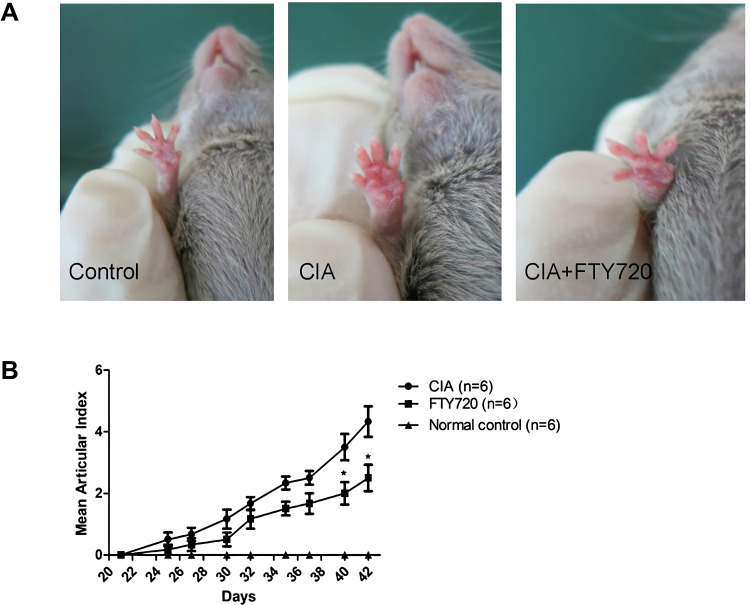
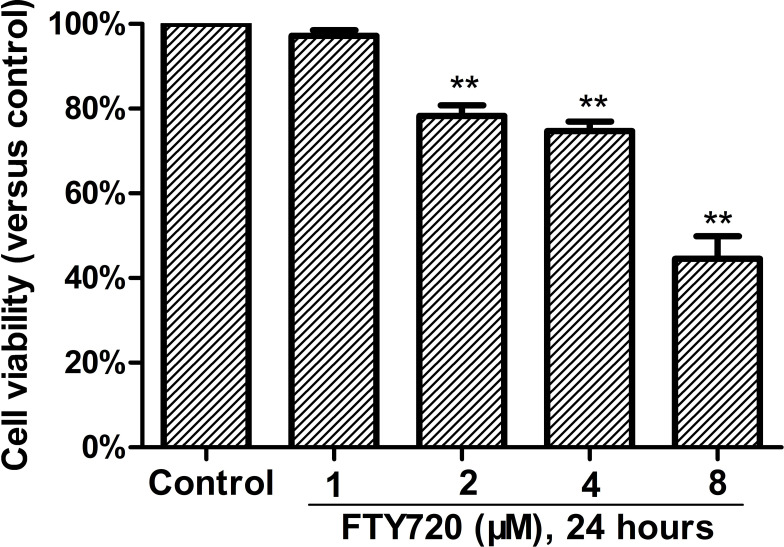
Fingolimod (FTY720), a novel immunomodulator, was found to suppress the severity of collagen-induced arthritis (CIA) in mice. However, the potential molecular mechanisms are still unknown, and the effect of FTY720 on the recruitment of immune cells in the affected joints in the CIA model is not clear.
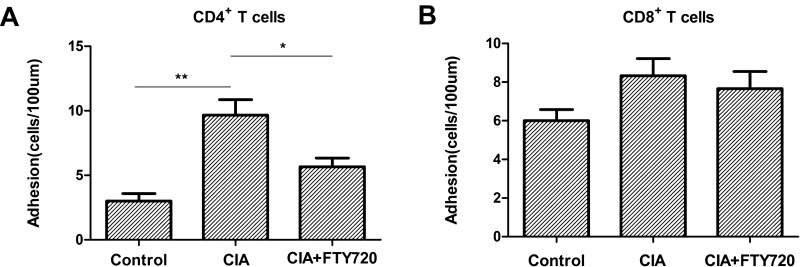
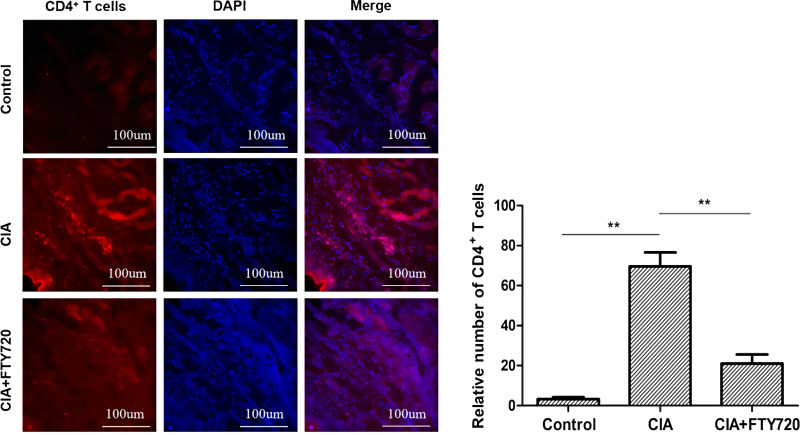
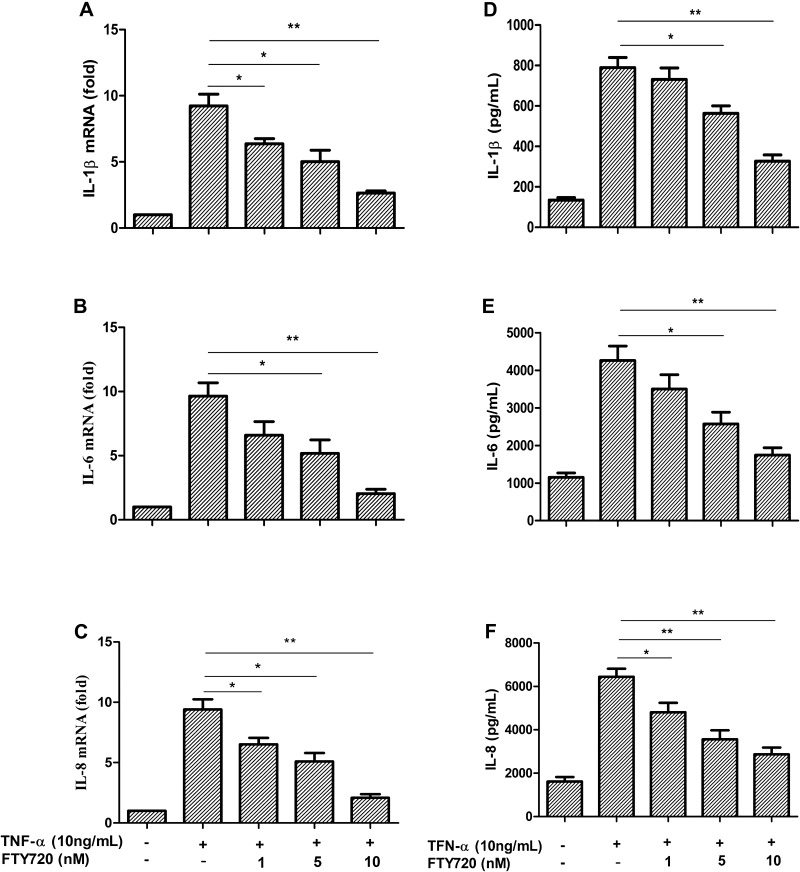
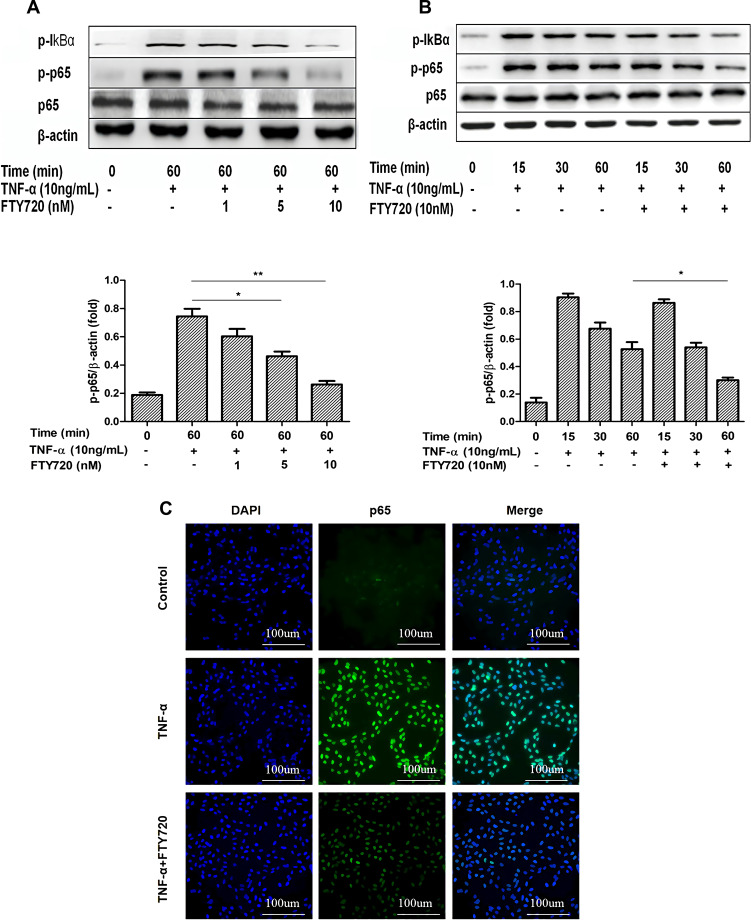
Following the oral administration of FTY720 (2 mg/kg) was treated into CIA mice per day for 35 days, intravital microscopy and immunofluorescence assays were performed to examine immune cell recruitment in the affected joints. Human MH7A synoviocytes were stimulated with tumour necrosis factor (TNF)-α and incubated with FTY720. Interleukin-1β (IL-1β), interleukin-6 (IL-6), and interleukin-8 (IL-8) mRNA and protein expression were evaluated using RT-PCR and enzyme-linked immunosorbent assay, respectively. Signal transduction pathway protein expression was measured by Western blotting. Nuclear translocation of nuclear factor (NF)-κB was also analyzed by fluorescence microscopy.
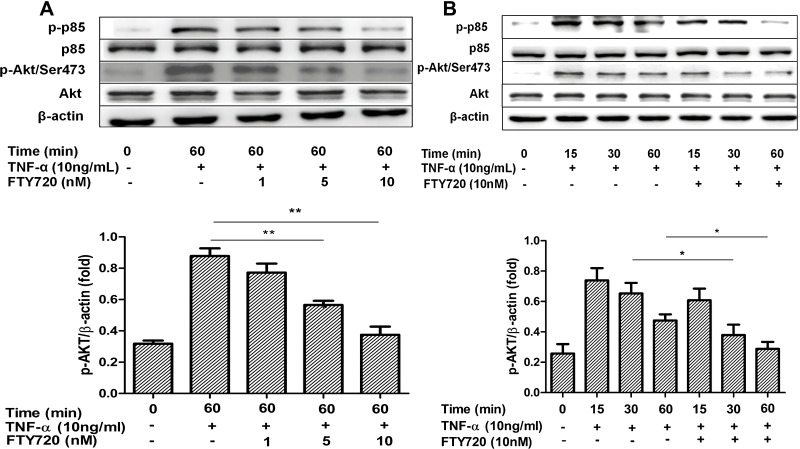
In vivo experiments showed that FTY720 inhibited the recruitment of CD4 lymphocytes in the affected joints of CIA mice. FTY720 reduced the secretion of IL-1β, IL-6, and IL-8 from TNF-α-stimulated MH7A cells in a dose-dependent manner. FTY720 also inhibited TNF-α-induced phosphorylation of NF-κBp65 and IκBα, as well as NF-κBp65 nuclear translocation, in a dose- and time-dependent manner. Interestingly, FTY720 blocked PI3K/Akt, the upstream targets of the NF-κB pathway.
Our findings demonstrated that oral administration of FTY720 exerted beneficial effects in CIA mice by inhibiting CD4 T lymphocyte recruitment to the affected joints. Our data also indicated that FTY720 inhibited TNF-α-induced inflammation by suppressing the AKT/PI3K/NF-κB pathway in MH7A cells.
芬戈莫德(FTY720),一种新型免疫调节剂,被发现可抑制胶原诱导性关节炎(CIA)小鼠的严重程度。然而,其潜在的分子机制尚不清楚,FTY720 对 CIA 模型中受影响关节中免疫细胞募集的影响也不清楚。
每天口服 FTY720(2mg/kg)治疗 CIA 小鼠 35 天,通过活体显微镜和免疫荧光检测评估受影响关节中的免疫细胞募集。用肿瘤坏死因子(TNF)-α刺激人 MH7A 滑膜细胞,并与 FTY720 孵育。采用 RT-PCR 和酶联免疫吸附试验分别评估白细胞介素-1β(IL-1β)、白细胞介素-6(IL-6)和白细胞介素-8(IL-8)mRNA 和蛋白表达。通过 Western 印迹测量信号转导途径蛋白表达。还通过荧光显微镜分析核因子(NF)-κB 的核易位。
体内实验表明,FTY720 抑制 CIA 小鼠受影响关节中 CD4 淋巴细胞的募集。FTY720 以剂量依赖的方式减少 TNF-α 刺激的 MH7A 细胞中 IL-1β、IL-6 和 IL-8 的分泌。FTY720 还以剂量和时间依赖的方式抑制 TNF-α 诱导的 NF-κBp65 和 IκBα磷酸化以及 NF-κBp65 核易位。有趣的是,FTY720 阻断了 NF-κB 通路的上游靶点 PI3K/Akt。
我们的研究结果表明,口服 FTY720 通过抑制 CD4 T 淋巴细胞募集到受影响的关节,对 CIA 小鼠产生有益的作用。我们的数据还表明,FTY720 通过抑制 MH7A 细胞中的 AKT/PI3K/NF-κB 通路抑制 TNF-α 诱导的炎症。