Shen Jie, Wu Yiling, Feng Xiaoshuang, Liang Fei, Mo Miao, Cai Binxin, Zhou Changming, Wang Zezhou, Zhu Meiying, Cai Guoxiang, Zheng Ying
Department of Cancer Prevention, Fudan University Shanghai Cancer Center, Shanghai, People's Republic of China.
Department of Oncology, Shanghai Medical College, Fudan University, Shanghai, People's Republic of China.
Cancer Manag Res. 2021 May 12;13:3867-3878. doi: 10.2147/CMAR.S301185. eCollection 2021.
To identify people with high-risk early colorectal neoplasm is highly desirable for pre-selection in colorectal cancer (CRC) screening in low-resource countries. We aim to build and validate a risk-based model so as to improve compliance and increase the benefits of screening.
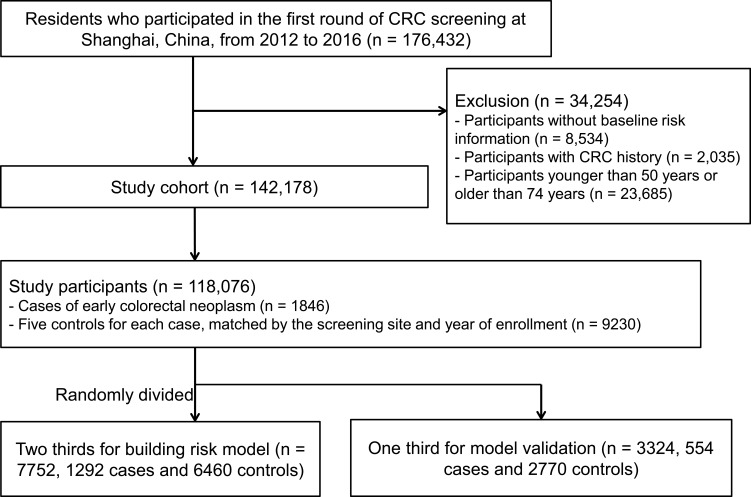
Using data from the Shanghai CRC screening cohort, we conducted a population-based nested case-control study to build a risk-based model. Cases of early colorectal neoplasm were extracted as colorectal adenomas and stage 0-I CRC. Each case was matched with five individuals without neoplasm (controls) by the screening site and year of enrollment. Cases and controls were then randomly divided into two groups, with two thirds for building the risk prediction model and the other one third for model validation. Known risk factors were included for risk prediction models using logistic regressions. The area under the receiver operating characteristic curve (AUC) and Hosmer-Lemeshow chi-square statistics were used to evaluate model discrimination and calibration. The predicted individual risk probability was calculated under the risk regression equation.
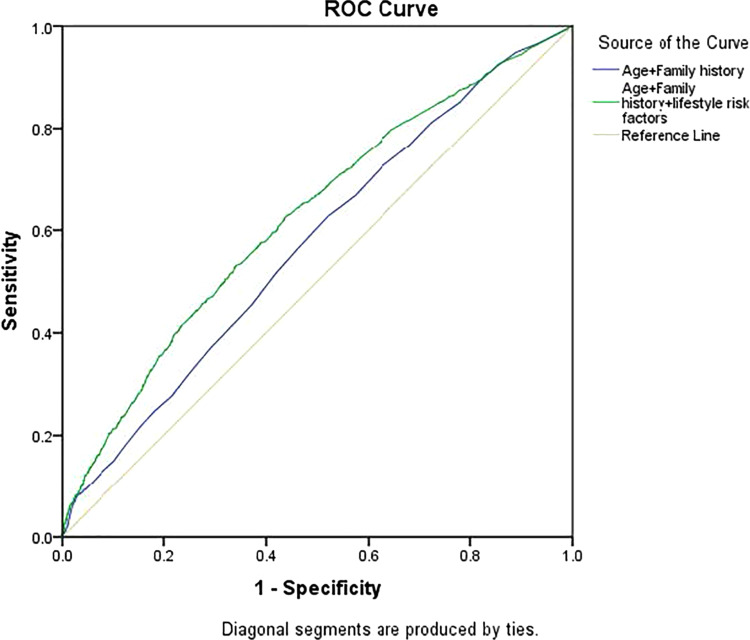
The model incorporating age, sex, family history and lifestyle factors including body mass index (BMI), smoking status, alcohol, regular moderate-to-intensity physical activity showed good calibration and discrimination. When the risk cutoff threshold was defined as 17%, the sensitivity and specificity of the model were 63.99% and 53.82%, respectively. The validation data analysis also showed well discrimination.
A risk prediction model combining personal and lifestyle factors was developed and validated for high-risk early colorectal neoplasm among the Chinese population. This risk-based model could improve the pre-selection for screening and contribute a lot to efficient population-based screening in low-resource countries.
识别具有高危早期结直肠肿瘤的人群对于资源匮乏国家的结直肠癌(CRC)筛查预选择非常必要。我们旨在建立并验证一个基于风险的模型,以提高筛查的依从性并增加筛查效益。
利用上海CRC筛查队列的数据,我们开展了一项基于人群的巢式病例对照研究来建立基于风险的模型。早期结直肠肿瘤病例被提取为结直肠腺瘤和0-I期CRC。每个病例按筛查地点和入组年份与五名无肿瘤个体(对照)匹配。然后将病例和对照随机分为两组,三分之二用于建立风险预测模型,另外三分之一用于模型验证。使用逻辑回归将已知风险因素纳入风险预测模型。采用受试者工作特征曲线(AUC)下面积和Hosmer-Lemeshow卡方统计量来评估模型的区分度和校准度。根据风险回归方程计算个体预测风险概率。
纳入年龄、性别、家族史和生活方式因素(包括体重指数(BMI)、吸烟状况、饮酒、规律的中度至强度体育活动)的模型显示出良好的校准度和区分度。当风险截断阈值定义为17%时,模型的灵敏度和特异度分别为63.99%和53.82%。验证数据分析也显示出良好的区分度。
开发并验证了一个结合个人和生活方式因素的风险预测模型,用于中国人群中高危早期结直肠肿瘤的预测。这个基于风险的模型可以改善筛查的预选择,并为资源匮乏国家基于人群的高效筛查做出很大贡献。