Paoletti Andrea, Rosati Adolfo, Famiani Franco
Dipartimento di Scienze Agrarie, Alimentari e Ambientali, Università degli Studi di Perugia, Borgo XX Giugno 74, 06121, Perugia, Italy.
Consiglio per la ricerca in agricoltura e l'analisi dell'economia agraria, Centro di ricerca Olivicoltura, Frutticoltura e Agrumicoltura, via Nursina 2, 06049, Spoleto, PG, Italy.
Heliyon. 2021 May 3;7(5):e06949. doi: 10.1016/j.heliyon.2021.e06949. eCollection 2021 May.
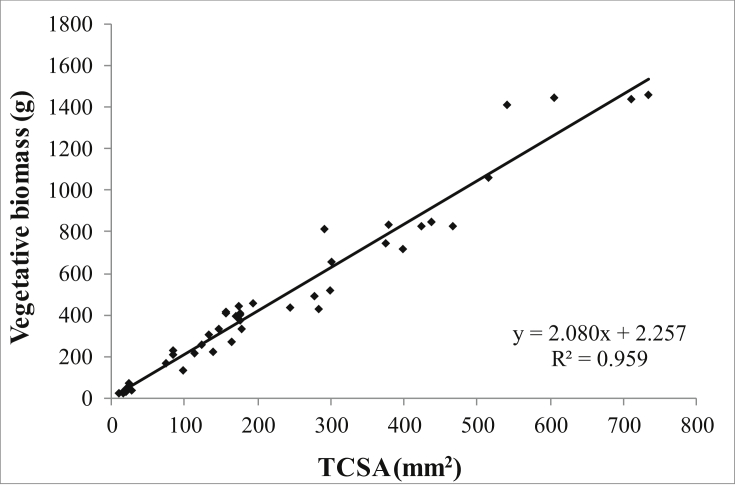
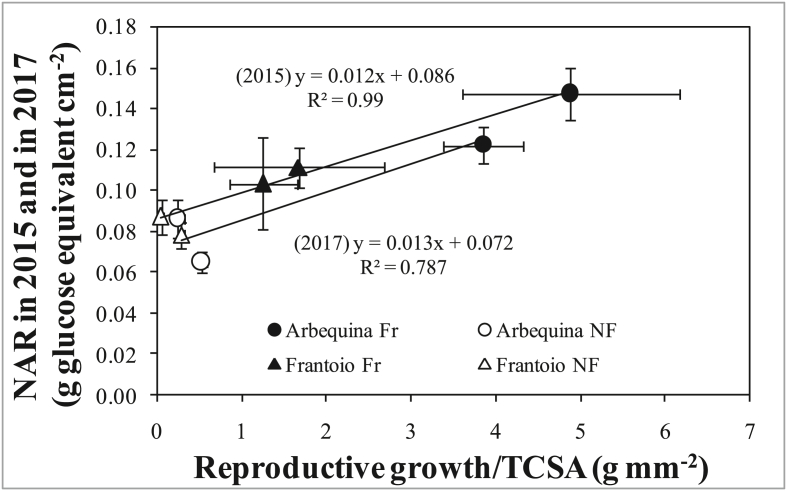
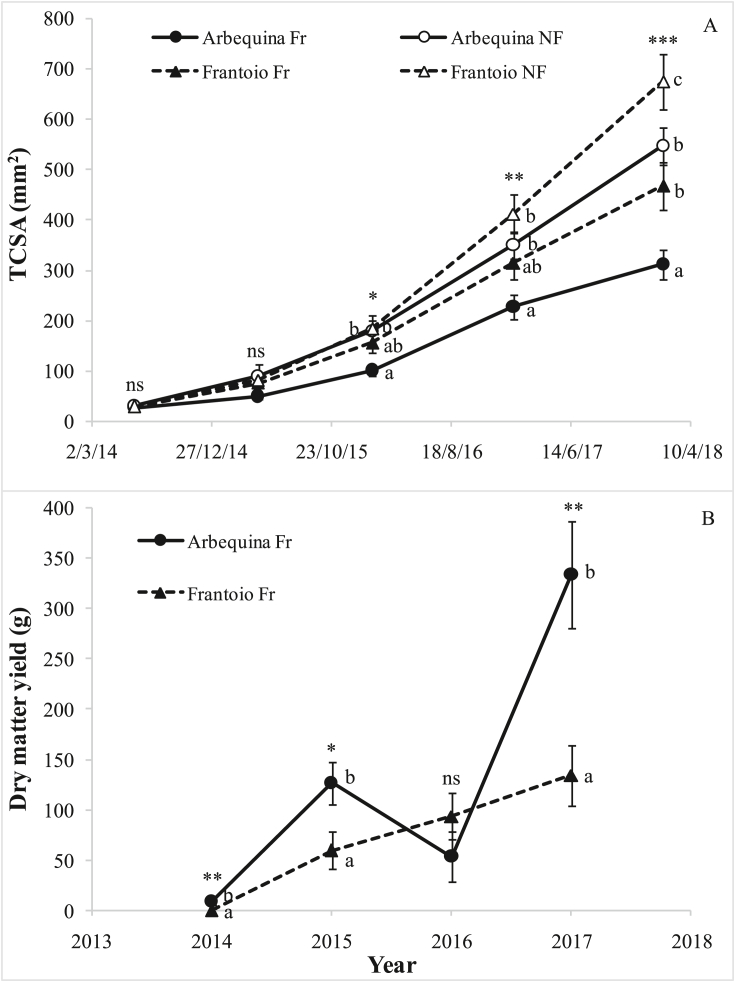
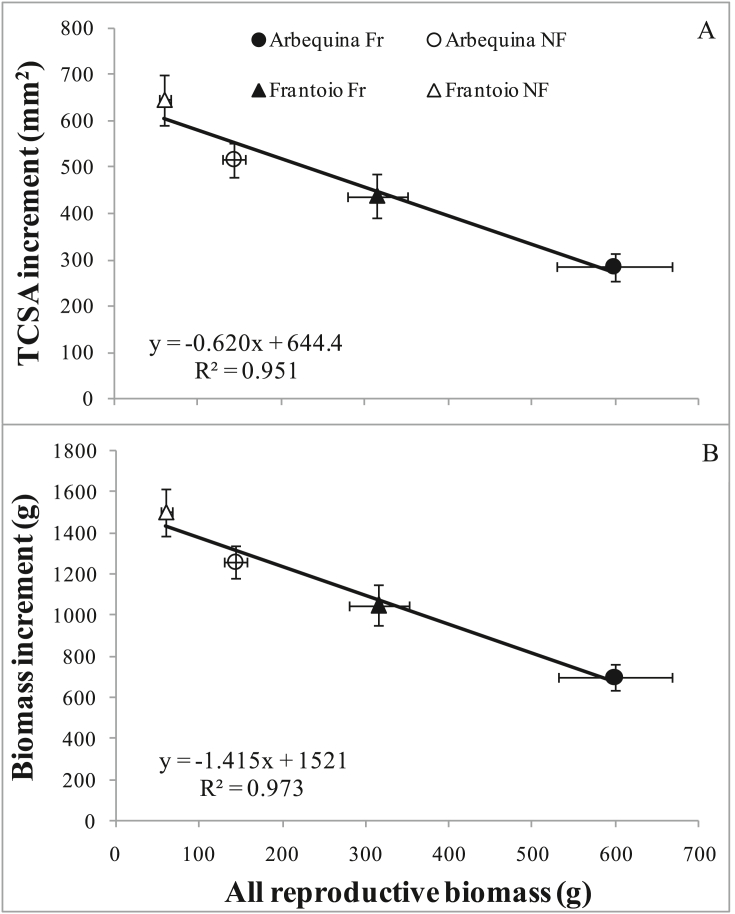
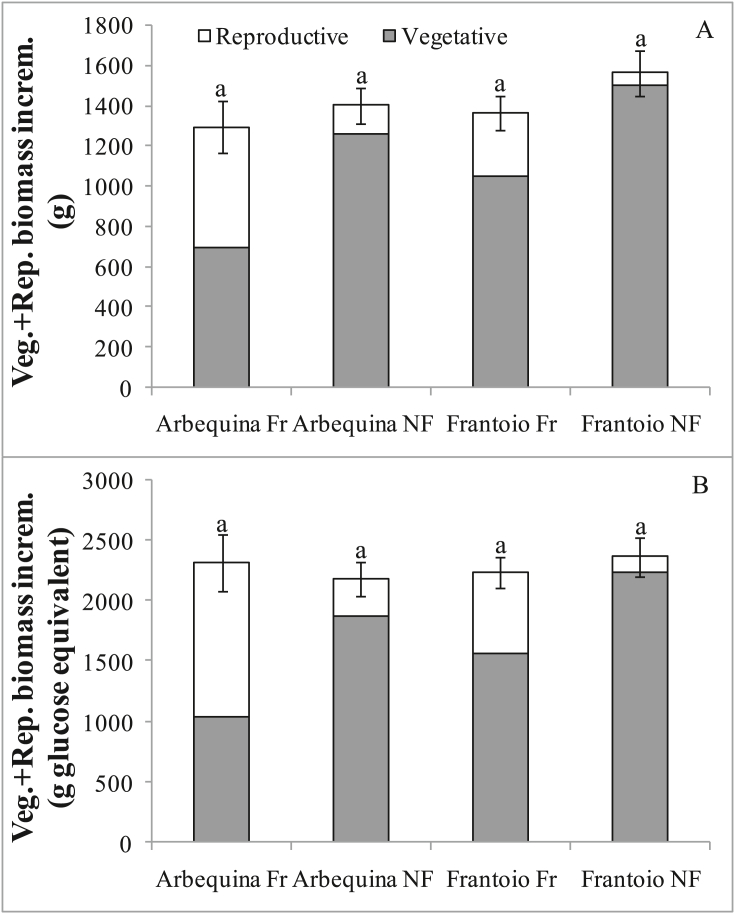
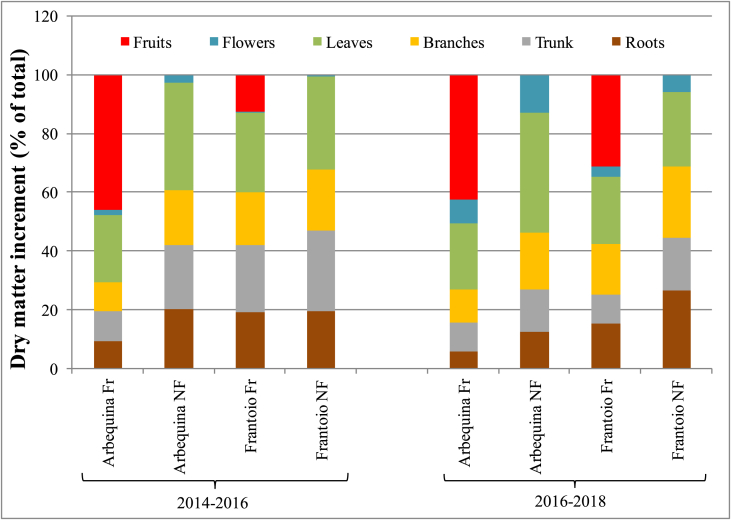
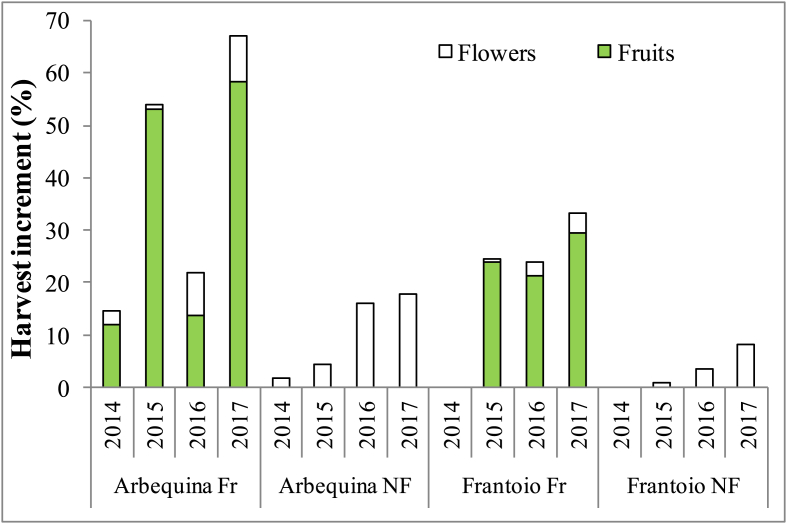
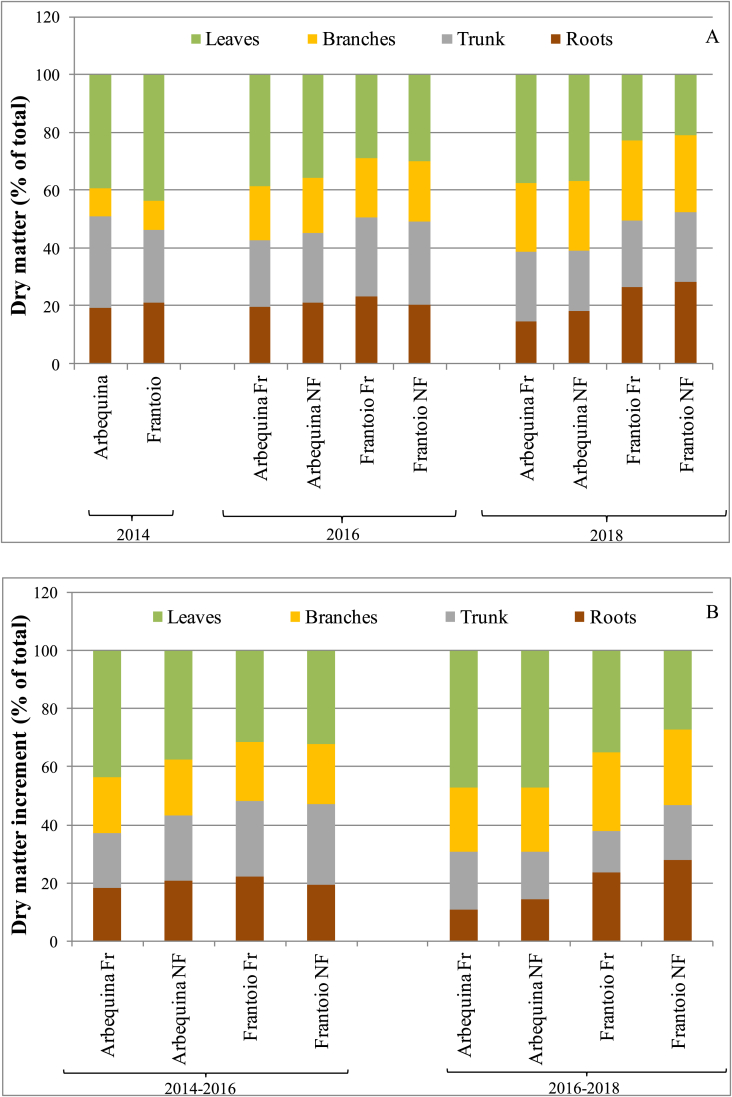
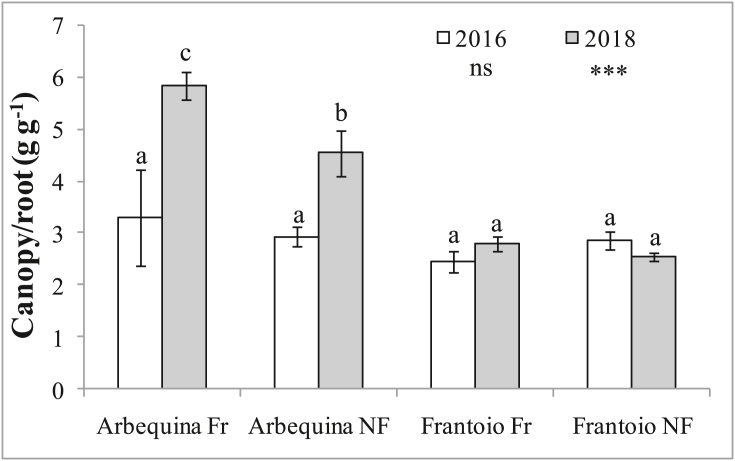
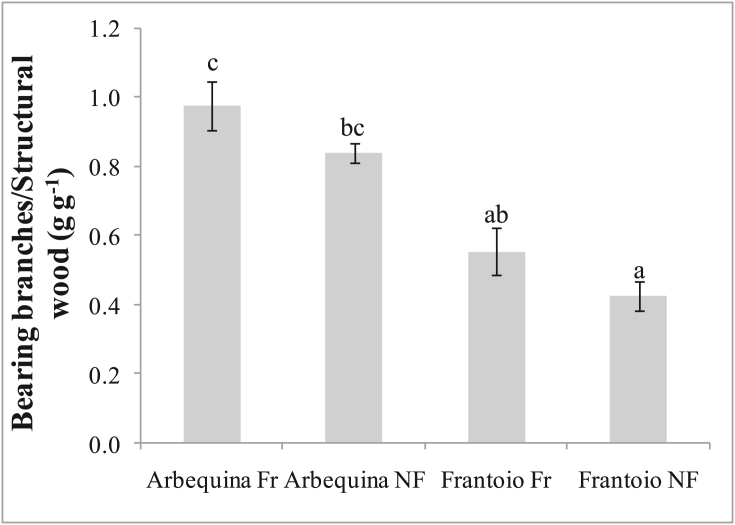
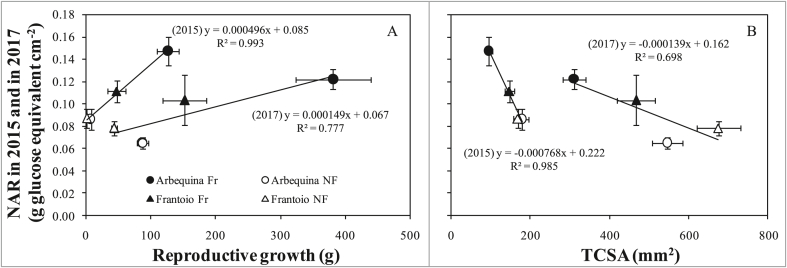
This study investigated the effects of cultivar, fruit presence and tree age on whole-plant partitioning of dry matter and energy equivalents (i.e., glucose equivalents). Young trees of two cultivars characterized by different vigor (i.e., Arbequina, low vigor and Frantoio, high vigor) were either completely deflowered from 2014 to 2017 or never, providing two contrasting levels of cumulated reproductive growth over the following 4 years. Total vegetative dry matter growth over the 4 years was assessed by destructive samplings (whole tree). Plant growth was inversely correlated to reproductive efforts, with Arbequina producing more and growing less than Frantoio. Deflowered trees grew similarly across cultivars, although deflowered Arbequina grew statistically less than deflowered Frantoio by the fourth year, due to abundant flower production. Total reproductive (flowers + fruit) and vegetative biomass production were the same for all cultivars and treatments. Arbequina had a greater distribution of dry matter in directly productive structures (current and one-year-old shoots) and in leaves. This allows it to increase the number of current and following-year production sites, and to save in the resources invested in non-productive sinks (roots, trunk and branches), thus liberating resources for reproductive growth. Greater investments in leaves allow it to intercept more light and thus to increase assimilation. Increased assimilation and increased partitioning towards productive structures, and decreased competition by non-productive structures might contribute to explain the greater early bearing attitude of this cultivar.
本研究调查了品种、是否有果实以及树龄对干物质和能量当量(即葡萄糖当量)在整株植物中分配的影响。以不同活力为特征的两个品种的幼树(即活力低的阿贝基纳和活力高的佛朗托io)在2014年至2017年期间要么完全去花,要么从未去花,在接下来的4年里提供了两个对比鲜明的累积生殖生长水平。通过破坏性采样(整株树)评估了4年期间总的营养干物质生长。植物生长与生殖努力呈负相关,阿贝基纳比佛朗托io结果更多但生长更少。去花的树在不同品种间生长情况相似,不过到第四年时,由于花量丰富,去花的阿贝基纳在统计学上比去花的佛朗托io生长得少。所有品种和处理的总生殖(花+果实)和营养生物量产量相同。阿贝基纳在直接生产性结构(当年生和一年生枝条)和叶片中的干物质分配更多。这使其能够增加当年和次年生产部位的数量,并节省投入到非生产性库(根、树干和树枝)的资源,从而为生殖生长释放资源。对叶片的更多投入使其能够截获更多光照,进而增加同化作用。同化作用的增加、向生产性结构的分配增加以及非生产性结构竞争的减少,可能有助于解释该品种更强的早结果习性。