Division of Nephrology and Infectious Diseases, AZ Sint-Jan Brugge, Brugge, Belgium.
Department of Internal Medicine, Ghent University, Ghent, Belgium.
Nat Rev Nephrol. 2021 Sep;17(9):619-630. doi: 10.1038/s41581-021-00427-1. Epub 2021 May 20.
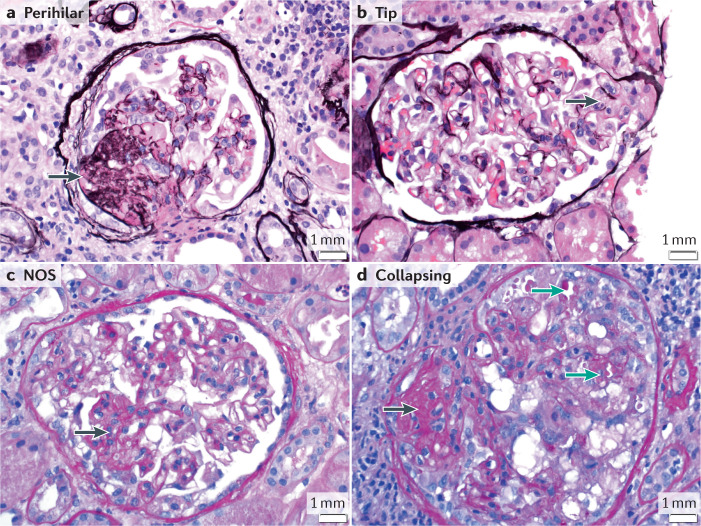
Focal segmental glomerulosclerosis (FSGS) is not a specific disease entity but a lesion that primarily targets the podocyte. In a broad sense, the causes of the lesion can be divided into those triggered by a presumed circulating permeability factor, those that occur secondary to a process that might originate outside the kidneys, those caused by a genetic mutation in a podocyte or glomerular basement membrane protein, and those that arise through an as yet unidentifiable process, seemingly unrelated to a circulating permeability factor. A careful attempt to correctly stratify patients with FSGS based on their clinical presentation and pathological findings on kidney biopsy is essential for sound treatment decisions in individual patients. However, it is also essential for the rational design of therapeutic trials in FSGS. Greater recognition of the pathophysiology underlying podocyte stress and damage in FSGS will increase the likelihood that the cause of an FSGS lesion is properly identified and enable stratification of patients in future interventional trials. Such efforts will facilitate the identification of effective therapeutic agents.
局灶节段性肾小球硬化症(FSGS)不是一种特定的疾病实体,而是主要针对足细胞的病变。广义而言,病变的原因可分为推测由循环通透性因子触发的原因、继发于可能起源于肾脏以外的过程的原因、由足细胞或肾小球基底膜蛋白中的基因突变引起的原因,以及通过目前尚无法识别的过程引起的原因,似乎与循环通透性因子无关。根据患者的临床表现和肾活检的病理发现,仔细尝试正确分层 FSGS 患者对于个体患者的合理治疗决策至关重要。然而,这对于 FSGS 治疗试验的合理设计也很重要。对 FSGS 中足细胞应激和损伤的病理生理学有更深入的认识,将增加正确识别 FSGS 病变原因的可能性,并能够对未来的介入试验中的患者进行分层。这些努力将有助于确定有效的治疗药物。