Guo Dan, Liu Jianfang, Zhang Peizhen, Yang Xiaoyu, Liu Deying, Lin Jiayang, Wei Xueyun, Xu Bingyan, Huang Chensihan, Zhou Xuan, Teng Fei, Zhu Hong, Zhang Huijie
Department of Endocrinology and Metabolism, Nanfang Hospital, Southern Medical University, Guangzhou, China.
Department of Endocrinology and Diabetes, The First Affiliated Hospital, Xiamen University, Xiamen, China.
Front Physiol. 2021 May 4;12:667330. doi: 10.3389/fphys.2021.667330. eCollection 2021.
Adiposity and adipokines are associated with metabolic disorders, but little is known regarding that whether adiposity measurements link metabolic syndrome (MetS) through circulating neuregulin 4 (Nrg4) and adipsin levels.
A total of 1212 subjects with a waist circumference greater than 90 cm for men or 80 cm for women were enrolled from a Chinese community. Circulating Nrg4 and adipsin levels were measured using commercial kits. Mediation analyses of circulating Nrg4 and adipsin were performed in the study using linear and logistic regression.
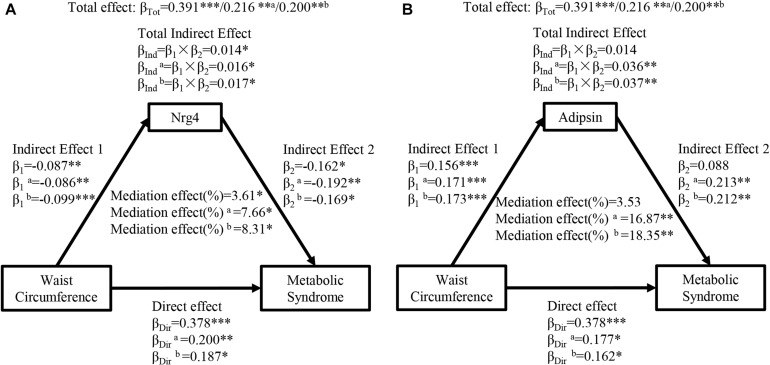
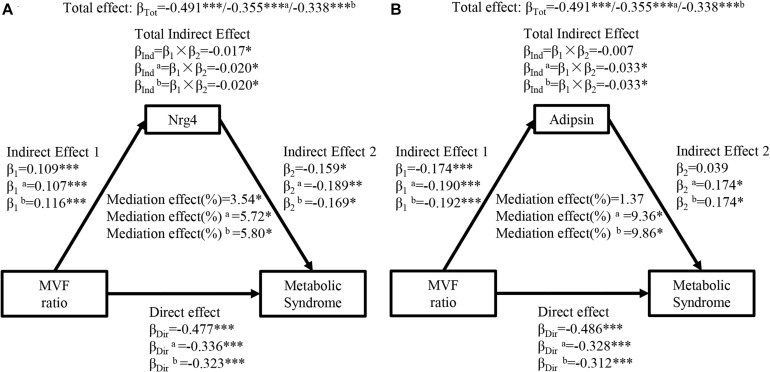
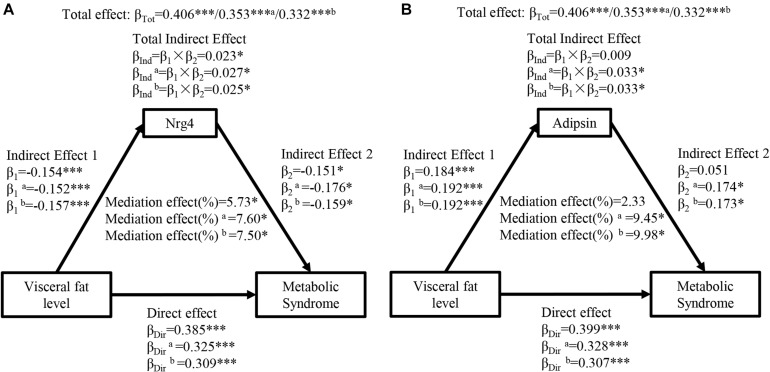
Subjects with MetS had higher waist circumference, visceral fat level, and circulating adipsin level, and lower levels of circulating Nrg4 and muscle mass to visceral fat (MVF) ratio (all < 0.05). In multivariable logistic regression analyses, after adjusting for confounding variables, per standard deviation (SD) increase in waist circumference and visceral fat level were significantly associated with increased odds of MetS [OR (95% CI), 1.42 (1.22-1.64); 2.20 (1.62-2.99); respectively]; and per SD reduction in MVF ratio was significantly associated with reduced odds of MetS [OR (95% CI), 0.65 (0.55-0.77)]. In the mediation analyses, both circulating Nrg4 and adipsin levels mediated the association between waist circumference (8.31% and 18.35%, respectively), visceral fat level (7.50% and 9.98%, respectively), and MVF ratio (5.80% and 9.86%, respectively) and MetS after adjustments.
These findings indicate that adiposity measurements and MetS are linked through circulating Nrg4 and adipsin levels in obese adults, suggesting that circulating Nrg4 and adipsin levels might be potential predictors for management of MetS.
肥胖和脂肪因子与代谢紊乱有关,但关于肥胖测量指标是否通过循环神经调节蛋白4(Nrg4)和脂肪酶水平与代谢综合征(MetS)相关,人们知之甚少。
从一个中国社区招募了总共1212名腰围男性大于90厘米或女性大于80厘米的受试者。使用商业试剂盒测量循环Nrg4和脂肪酶水平。在该研究中,采用线性和逻辑回归对循环Nrg4和脂肪酶进行中介分析。
患有代谢综合征的受试者腰围、内脏脂肪水平和循环脂肪酶水平较高,而循环Nrg4水平和肌肉量与内脏脂肪(MVF)比值较低(均P<0.05)。在多变量逻辑回归分析中,调整混杂变量后,腰围和内脏脂肪水平每增加一个标准差(SD),与代谢综合征发生几率增加显著相关[比值比(95%置信区间)分别为1.42(1.22 - 1.64);2.20(1.62 - 2.99)];MVF比值每降低一个标准差,与代谢综合征发生几率降低显著相关[比值比(95%置信区间)为0.65(0.55 - 0.77)]。在中介分析中,调整后循环Nrg4和脂肪酶水平均介导了腰围(分别为8.31%和18.35%)、内脏脂肪水平(分别为7.50%和9.98%)以及MVF比值(分别为5.80%和9.86%)与代谢综合征之间的关联。
这些发现表明,在肥胖成年人中,肥胖测量指标与代谢综合征通过循环Nrg4和脂肪酶水平相关联,提示循环Nrg4和脂肪酶水平可能是代谢综合征管理的潜在预测指标。