Loucas Marios, Loucas Rafael, Akhavan Nico Safa, Fries Patrick, Dietrich Michael
Department of Orthopedic Surgery, Handsurgery and Traumatology at City Hospital Waid and Triemli, Zurich, Switzerland.
Department of Orthopedics, Balgrist University Hospital, University of Zurich, Zurich, Switzerland.
Geriatr Orthop Surg Rehabil. 2021 May 4;12:21514593211013790. doi: 10.1177/21514593211013790. eCollection 2021.
Total hip (THA) and total knee arthroplasty (TKA) are becoming an increasingly standard procedure in the whole world. In conjunction with an aging population and increased prevalence of osteoporosis, proper management of periprosthetic, and interprosthetic fractures is of great interest to orthopedic surgeons. This study aims to report the clinical and radiographic outcomes, complications and reoperations of IFFs in geriatric patients.
A retrospective single-institution case series study was conducted. Between 2011 and 2019, 83 patients underwent surgical treatment for periprosthetic femoral fractures. Thirteen fractures were identified as IFFs. Patient demographics and comorbidities were collected preoperatively, and fractures were classified with the Vancouver and AO unified classification system (AO-UCS).
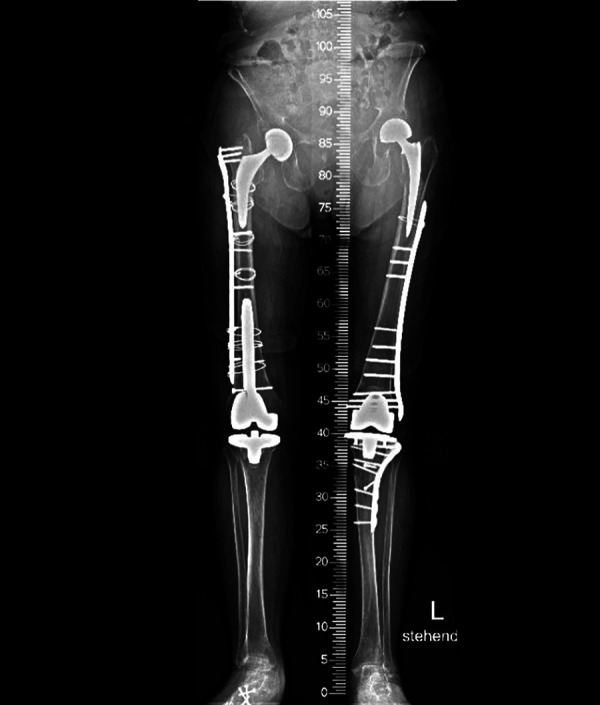
We included 12 patients (13 hips) with IFFs (AO-UCS type IV.3 B (2/13) type IV.3 C (3/13), type IV.3 D (8/13)). The average patient age was 86.54 (range, 79-89) years. There were 10 females and 2 males. Perioperative morbidity has been identified in 10 of the 12 patients, and the 3-month and 1-year mortality were reported in 2 and 3 patients, respectively. Cerclage cables were used in 9 of 12 patients. One of 12 patients showed a local complication, with no documented implant failure or revision. Patients achieved complete union and returned to their preoperative ambulatory status, and full weight-bearing at an average of 5 (range, 2 to 7) months later.
Management of IFF can be challenging because these fractures require extensive surgical expertise. Locking plate seems to be a valuable treatment option for geriatric patients with IFFs. Despite the complexity of this type of fracture, the overall complication and revision rate, as well as the radiographic outcome are good to excellent.
Level III, Therapeutic study.
全髋关节置换术(THA)和全膝关节置换术(TKA)在全球范围内正日益成为一种标准手术。随着人口老龄化和骨质疏松症患病率的增加,骨科医生对假体周围骨折和假体间骨折的妥善处理非常关注。本研究旨在报告老年患者假体间骨折的临床和影像学结果、并发症及再次手术情况。
进行了一项回顾性单机构病例系列研究。2011年至2019年期间,83例患者接受了假体周围股骨骨折的手术治疗。其中13例骨折被确定为假体间骨折。术前收集患者的人口统计学和合并症信息,并根据温哥华和AO统一分类系统(AO-UCS)对骨折进行分类。
我们纳入了12例(13髋)假体间骨折患者(AO-UCS分型:IV.3 B型2例(2/13),IV.3 C型3例(3/13),IV.3 D型8例(8/13))。患者平均年龄为86.54岁(范围79 - 89岁)。女性10例,男性2例。12例患者中有10例出现围手术期并发症,分别有2例和3例患者报告了3个月和1年死亡率。12例患者中有9例使用了环扎钢丝。12例患者中有1例出现局部并发症,无植入物失败或翻修记录。患者均实现了完全愈合,并恢复到术前的行走状态,平均在5个月(范围2至7个月)后恢复完全负重。
假体间骨折的处理具有挑战性,因为这些骨折需要广泛的手术专业知识。锁定钢板似乎是老年假体间骨折患者的一种有价值的治疗选择。尽管这类骨折较为复杂,但总体并发症和翻修率以及影像学结果良好至优秀。
III级,治疗性研究。