Department of Human Anatomy, Shandong First Medical University & Shandong Academy of Medical Sciences, Taian, China.
J Neuroinflammation. 2021 May 21;18(1):117. doi: 10.1186/s12974-021-02168-1.
Calcitonin gene-related peptide (CGRP) as a mediator of microglial activation at the transcriptional level may facilitate nociceptive signaling. Trimethylation of H3 lysine 27 (H3K27me3) by enhancer of zeste homolog 2 (EZH2) is an epigenetic mark that regulates inflammatory-related gene expression after peripheral nerve injury. In this study, we explored the relationship between CGRP and H3K27me3 in microglial activation after nerve injury, and elucidated the underlying mechanisms in the pathogenesis of chronic neuropathic pain.
Microglial cells (BV2) were treated with CGRP and differentially enrichments of H3K27me3 on gene promoters were examined using ChIP-seq. A chronic constriction injury (CCI) rat model was used to evaluate the role of CGRP on microglial activation and EZH2/H3K27me3 signaling in CCI-induced neuropathic pain.
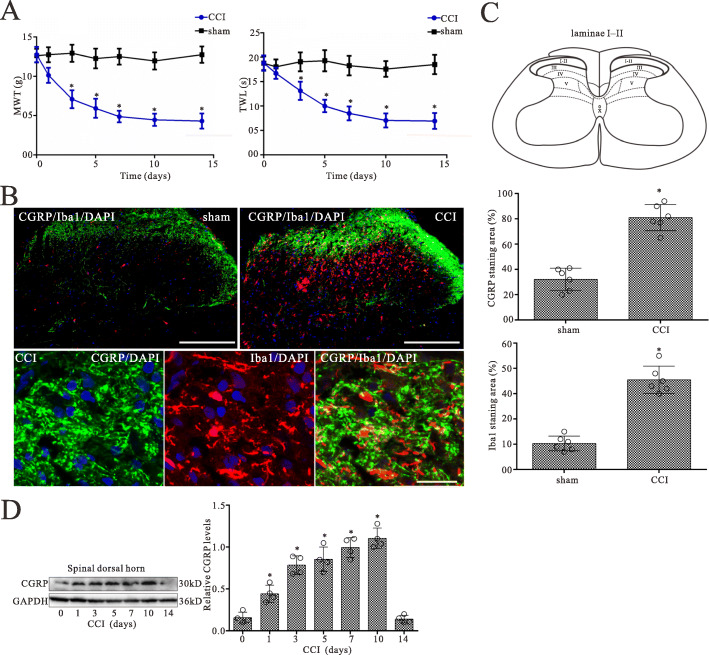
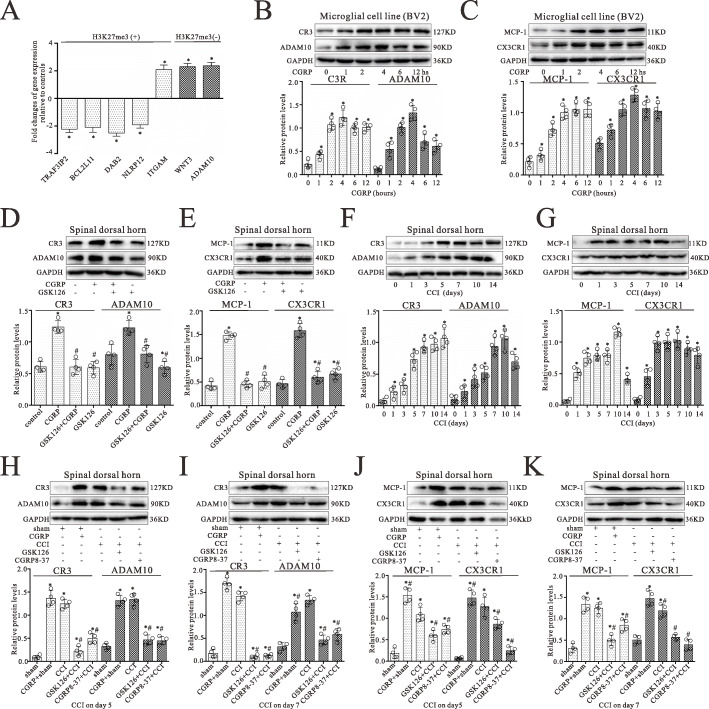
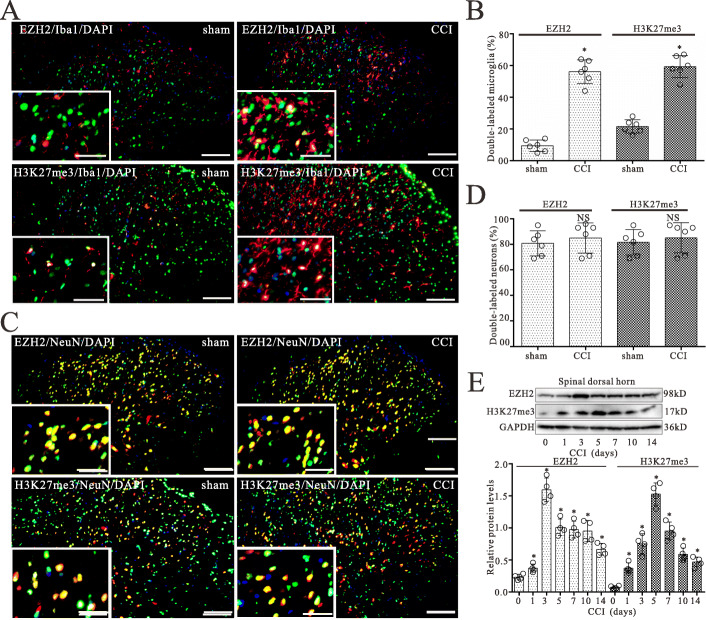
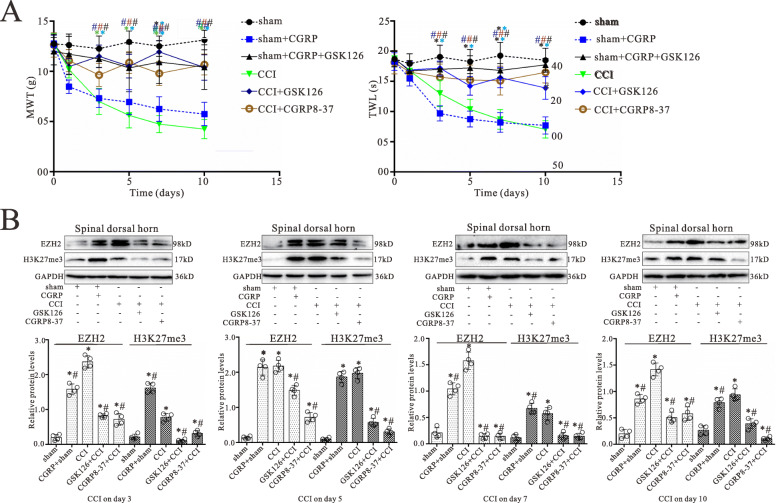
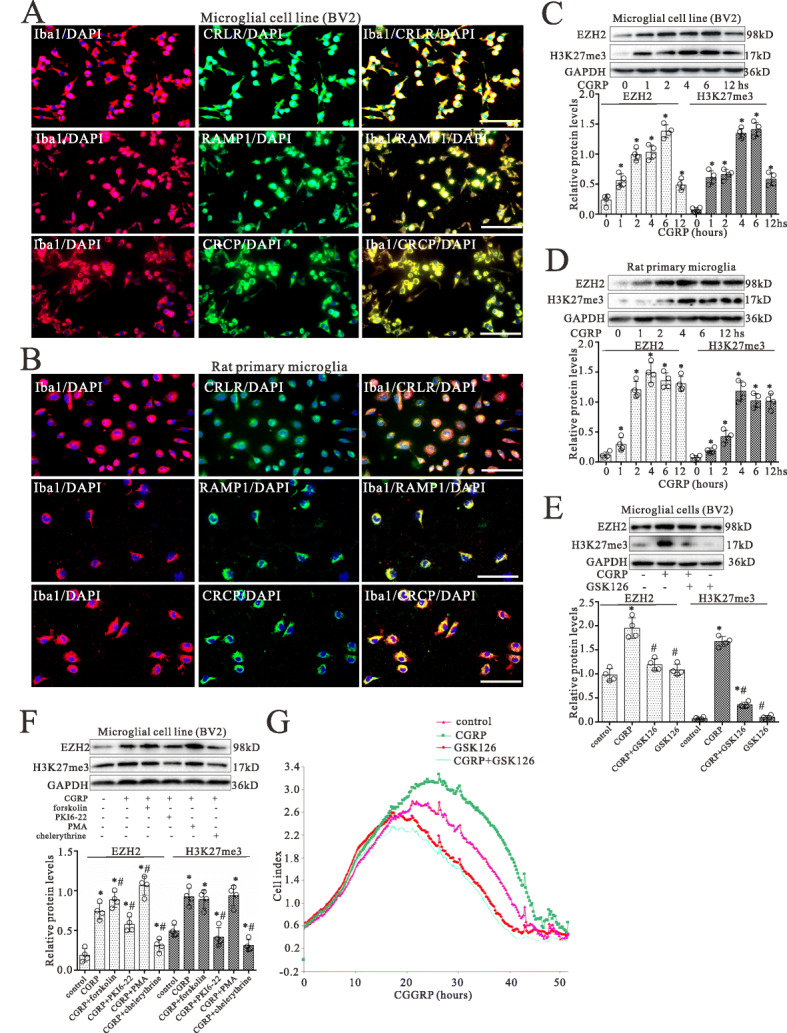
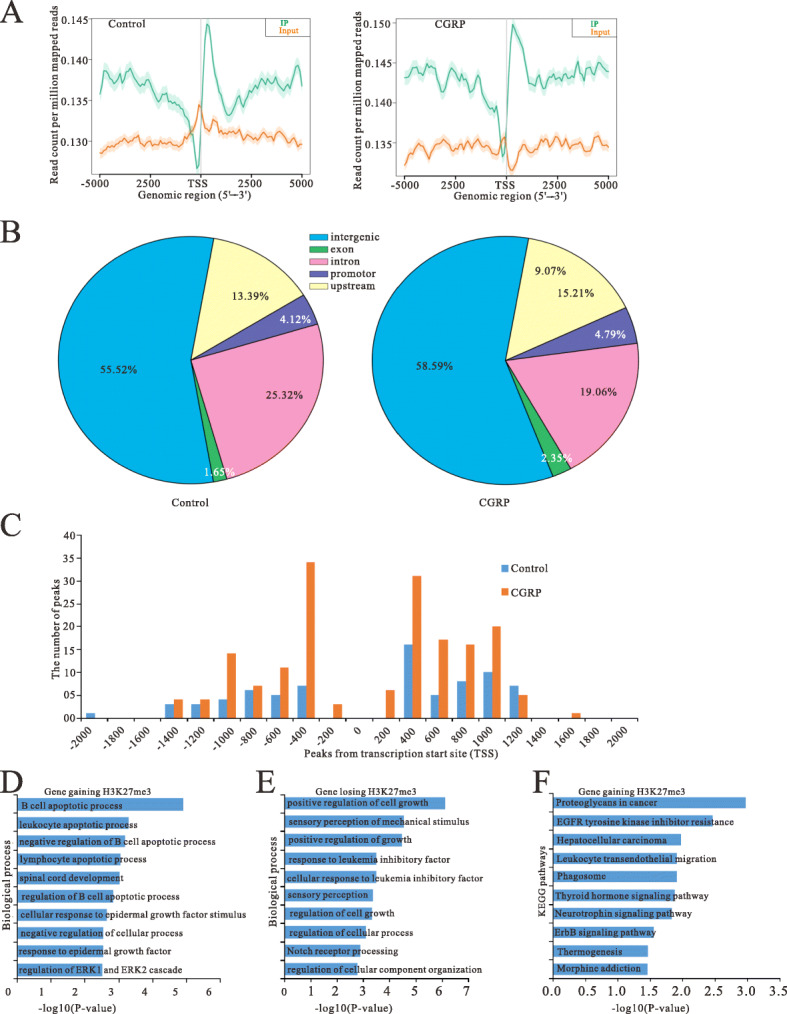
Overexpressions of EZH2 and H3K27me3 were confirmed in spinal microglia of CCI rats by immunofluorescence. CGRP treatment induced the increased of H3K27me3 expression in the spinal dorsal horn and cultured microglial cells (BV2) through EZH2. ChIP-seq data indicated that CGRP significantly altered H3K27me3 enrichments on gene promoters in microglia following CGRP treatment, including 173 gaining H3K27me3 and 75 losing this mark, which mostly enriched in regulation of cell growth, phagosome, and inflammation. qRT-PCR verified expressions of representative candidate genes (TRAF3IP2, BCL2L11, ITGAM, DAB2, NLRP12, WNT3, ADAM10) and real-time cell analysis (RTCA) verified microglial proliferation. Additionally, CGRP treatment and CCI increased expressions of ITGAM, ADAM10, MCP-1, and CX3CR1, key mediators of microglial activation in spinal dorsal horn and cultured microglial cells. Such increased effects induced by CCI were suppressed by CGRP antagonist and EZH2 inhibitor, which were concurrently associated with the attenuated mechanical and thermal hyperalgesia in CCI rats.
Our findings highly indicate that CGRP is implicated in the genesis of neuropathic pain through regulating microglial activation via EZH2-mediated H3K27me3 in the spinal dorsal horn.
降钙素基因相关肽(CGRP)作为一种在转录水平上介导小胶质细胞激活的物质,可能促进伤害性信号的传递。增强子结合蛋白 2(EZH2)介导的组蛋白 H3 赖氨酸 27(H3K27me3)三甲基化是一种表观遗传标记,可调节外周神经损伤后的炎症相关基因表达。在这项研究中,我们探讨了神经损伤后 CGRP 与小胶质细胞激活中 H3K27me3 之间的关系,并阐明了慢性神经病理性疼痛发病机制中的潜在机制。
用 CGRP 处理小胶质细胞(BV2),并通过 ChIP-seq 检测基因启动子上 H3K27me3 的差异富集。使用慢性缩窄性损伤(CCI)大鼠模型评估 CGRP 对小胶质细胞激活和 EZH2/H3K27me3 信号转导在 CCI 诱导的神经病理性疼痛中的作用。
免疫荧光证实 CCI 大鼠脊髓小胶质细胞中 EZH2 和 H3K27me3 的表达增加。CGRP 处理通过 EZH2 诱导脊髓背角和培养的小胶质细胞(BV2)中 H3K27me3 的表达增加。ChIP-seq 数据表明,CGRP 处理后,CGRP 显著改变了小胶质细胞中基因启动子上 H3K27me3 的富集,包括 173 个获得 H3K27me3 和 75 个失去该标记,这些标记主要富集在细胞生长、吞噬体和炎症的调节中。qRT-PCR 验证了代表性候选基因(TRAF3IP2、BCL2L11、ITGAM、DAB2、NLRP12、WNT3、ADAM10)的表达和实时细胞分析(RTCA)验证了小胶质细胞的增殖。此外,CGRP 处理和 CCI 增加了脊髓背角和培养的小胶质细胞中 ITGAM、ADAM10、MCP-1 和 CX3CR1 的表达,这些都是小胶质细胞激活的关键介质。CCI 引起的这种增加效应被 CGRP 拮抗剂和 EZH2 抑制剂抑制,同时与 CCI 大鼠机械和热痛觉过敏的减弱相关。
我们的研究结果表明,CGRP 通过 EZH2 介导的 H3K27me3 调节脊髓背角中小胶质细胞的激活,从而参与神经病理性疼痛的发生。