Faculty of Nursing, University of Calgary, Calgary, Canada.
Department of Oncology, Division of Palliative Medicine, Cumming School of Medicine, University of Calgary, Calgary, Canada.
Psychooncology. 2021 Oct;30(10):1728-1738. doi: 10.1002/pon.5737. Epub 2021 May 29.
Compassion has long been considered a cornerstone of quality pediatric healthcare by patients, parents, healthcare providers and systems leaders. However, little dedicated research on the nature, components and delivery of compassion in pediatric settings has been conducted. This study aimed to define and develop a patient, parent, and healthcare provider informed empirical model of compassion in pediatric oncology in order to begin to delineate the key qualities, skills and behaviors of compassion within pediatric healthcare.
Data was collected via semi-structured interviews with pediatric oncology patients (n = 33), parents (n = 16) and healthcare providers (n = 17) from 4 Canadian academic medical centers and was analyzed in accordance with Straussian Grounded Theory.
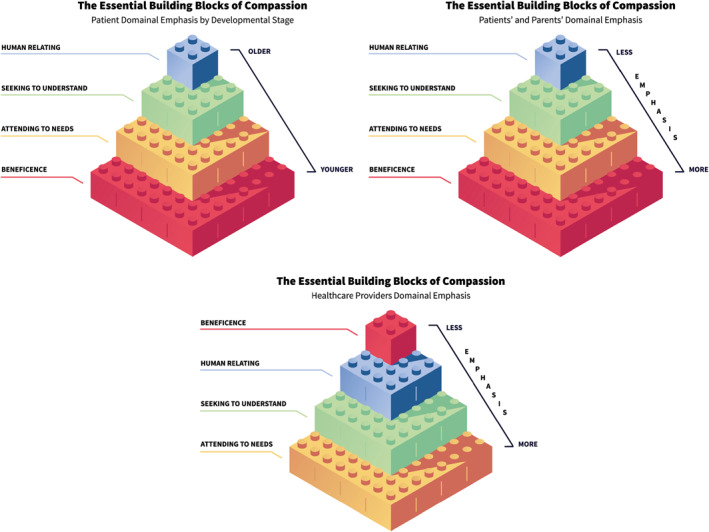
Four domains and 13 related themes were identified, generating the Pediatric Compassion Model, that depicts the dimensions of compassion and their relationship to one another. A collective definition of compassion was generated-a beneficent response that seeks to address the suffering and needs of a person and their family through relational understanding, shared humanity, and action.
A patient, parent, and healthcare provider informed empirical pediatric model of compassion was generated from this study providing insight into compassion from both those who experience it and those who express it. Future research on compassion in pediatric oncology and healthcare should focus on barriers and facilitators of compassion, measure development, and intervention research aimed at equipping healthcare providers and system leaders with tools and training aimed at improving it.
患者、家长、医护人员和医疗系统领导者长期以来一直认为同情是儿科医疗保健质量的基石。然而,针对儿科环境中同情的本质、组成部分和表现形式,专门开展的研究甚少。本研究旨在定义并开发一个由儿科肿瘤患者、家长和医护人员共同提供信息的同情实证模型,以便开始描绘儿科医疗保健中同情的关键品质、技能和行为。
从加拿大 4 所学术医疗中心的儿科肿瘤患者(n=33)、家长(n=16)和医护人员(n=17)处收集半结构化访谈数据,并根据 Straussian 扎根理论进行分析。
确定了 4 个领域和 13 个相关主题,生成了儿科同情模型,描绘了同情的维度及其相互关系。还生成了一个关于同情的集体定义——一种有益的反应,旨在通过关系理解、共同人性和行动来解决一个人和他的家人的痛苦和需求。
本研究产生了一个由患者、家长和医护人员共同提供信息的实证儿科同情模型,为那些体验过同情和表达过同情的人提供了关于同情的深入了解。未来在儿科肿瘤学和医疗保健方面对同情的研究应侧重于同情的障碍和促进因素、测量发展以及干预研究,旨在为医护人员和系统领导者提供工具和培训,以提高其能力。