Salloum Nadia Liber, Copley Phillip Correia, Mancuso-Marcello Marco, Emelifeonwu John, Kaliaperumal Chandrasekaran
Department of Clinical Neurosciences, Royal Infirmary of Edinburgh, Little France Crescent, Edinburgh, EH16 4SA, UK.
Acta Neurochir (Wien). 2021 Sep;163(9):2383-2389. doi: 10.1007/s00701-021-04873-5. Epub 2021 May 22.
Burnout is becoming an increasingly recognised phenomenon within the medical profession. This study aims to investigate the presence of burnout amongst neurosurgical trainees in the UK and Ireland as well as investigating potential exacerbating and protective factors.
An online survey was sent to all neurosurgical trainees in the UK and Ireland via the British Neurosurgical Trainees' Association (BNTA) mailing list. Responding participants anonymously completed the Copenhagen Burnout Inventory (CBI) and answered questions about known risk factors for burnout including workplace environment, workplace bullying, time spent on leisure activities and sleep and reported likelihood of leaving neurosurgery. We also collated data on responders' demographics. We compared CBI scores for participants with and without risk factors to determine correlation with CBI.
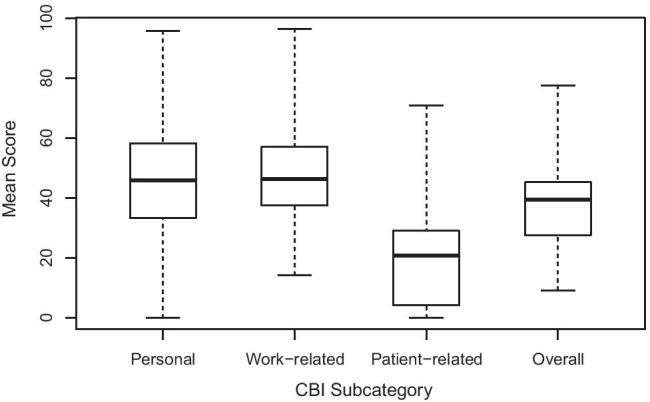
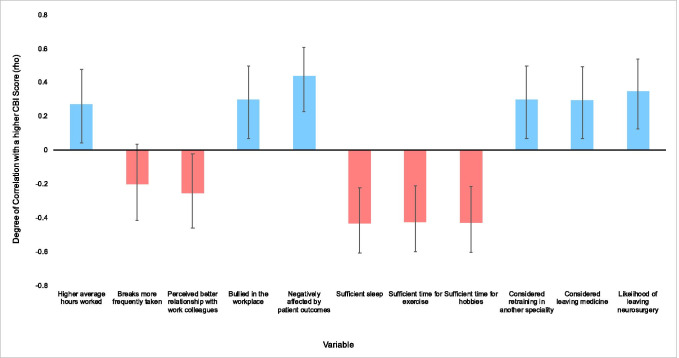
There were 75 respondents (response rate 42%) from a range of ages and all training grades, 72% of whom were male. The median CBI score was 38.85 (IQR 17.76). Participants showed a higher degree of personal and workplace burnout (median CBIs of 47.02, IQR 25.00; and 49.14, IQR 19.64, respectively) compared with patient-related burnout (median CBI 18.67, IQR 25.00). Participants with the following self-reported risk factors were significantly more likely to have higher CBIs: workplace bullying (p = 0.01), getting on less well with colleagues (p < 0.05), working longer hours (p < 0.05) and insufficient sleep, exercise and leisure time (all p < 0.01). Those with higher CBI scores were more likely to consider leaving neurosurgical training (p = 0.01).
We identified a high burnout incidence in a cohort representative of UK neurosurgical trainees, although our results may have been skewed somewhat by selection bias. We determined potential risk factors for burnout related to specific workplace stressors and time for non-work activities. In the future, changes to training curricula should address these issues, aiming to improve training, enhance patient care and reduce attrition rates.
职业倦怠在医疗行业中日益受到关注。本研究旨在调查英国和爱尔兰神经外科住院医师中职业倦怠的情况,并探究可能加剧或起到保护作用的因素。
通过英国神经外科住院医师协会(BNTA)的邮件列表,向英国和爱尔兰所有神经外科住院医师发送在线调查问卷。参与调查的人员匿名填写哥本哈根职业倦怠量表(CBI),并回答有关职业倦怠已知风险因素的问题,包括工作环境、职场霸凌、休闲活动时间、睡眠情况,以及报告离开神经外科领域的可能性。我们还整理了受访者的人口统计学数据。我们比较了有和没有风险因素的参与者的CBI得分,以确定与CBI的相关性。
共有75名受访者(回复率42%),年龄和培训等级各异,其中72%为男性。CBI得分中位数为38.85(四分位距17.76)。与患者相关的倦怠相比,参与者在个人和工作场所倦怠方面表现出更高程度(个人倦怠CBI中位数为47.02,四分位距25.00;工作场所倦怠CBI中位数为49.14,四分位距19.64),患者相关倦怠的CBI中位数为18.67(四分位距25.00)。自我报告有以下风险因素的参与者CBI得分显著更高的可能性更大:职场霸凌(p = 0.01)、与同事相处不融洽(p < 0.05)、工作时间更长(p < 0.05)以及睡眠、锻炼和休闲时间不足(所有p < 0.01)。CBI得分较高的人更有可能考虑退出神经外科培训(p = 0.01)。
我们在一组具有英国神经外科住院医师代表性的人群中发现了较高的职业倦怠发生率,尽管我们的结果可能在一定程度上受到选择偏倚的影响。我们确定了与特定工作场所压力源和非工作活动时间相关的职业倦怠潜在风险因素。未来,培训课程的改变应解决这些问题,旨在改善培训、提高患者护理质量并降低流失率。