Pelham H R
MRC Laboratory of Molecular Biology, Cambridge, UK.
EMBO J. 1988 Apr;7(4):913-8. doi: 10.1002/j.1460-2075.1988.tb02896.x.
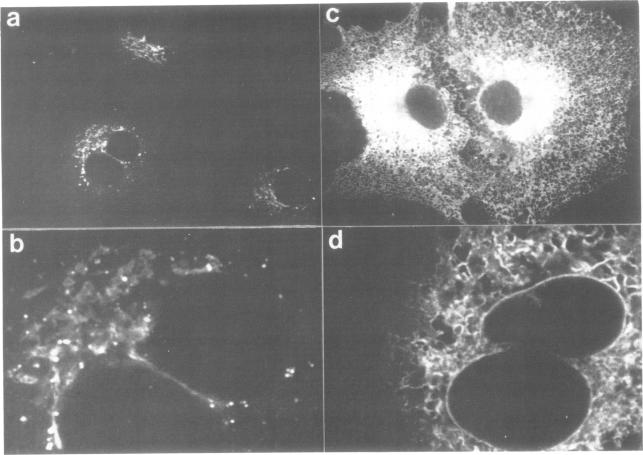
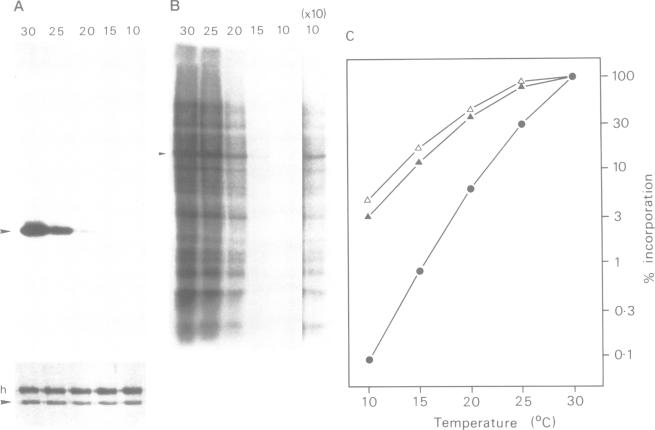
Several soluble proteins that reside in the lumen of the ER contain a specific C-terminal sequence (KDEL) which prevents their secretion. This sequence may be recognized by a receptor that either immobilizes the proteins in the ER, or sorts them from other proteins at a later point in the secretory pathway and returns them to their normal location. To distinguish these possibilities, I have attached an ER retention signal to the lysosomal protein cathepsin D. The oligosaccharide side chains of this protein are normally modified sequentially by two enzymes to form mannose-6-phosphate residues; these enzymes do not act in the ER, but are thought to be located in separate compartments within (or near) the Golgi apparatus. Cathepsin D bearing the ER signal accumulates within the ER, but continues to be modified by the first of the mannose-6-phosphate forming enzymes. Modification is strongly temperature-dependent, which is also a feature of ER-to-Golgi transport. These results support the idea that luminal ER proteins are continuously retrieved from a post-ER compartment, and that this compartment contains N-acetylglucosaminyl-1-phosphotransferase activity.
几种位于内质网腔的可溶性蛋白质含有特定的C末端序列(KDEL),该序列可阻止它们的分泌。这个序列可能会被一种受体识别,该受体要么将蛋白质固定在内质网中,要么在分泌途径的后期将它们与其他蛋白质区分开来,并将它们送回正常位置。为了区分这些可能性,我将内质网保留信号连接到溶酶体蛋白组织蛋白酶D上。该蛋白的寡糖侧链通常由两种酶依次修饰,形成甘露糖-6-磷酸残基;这些酶不在内质网中起作用,而是被认为位于高尔基体内部(或附近)的不同区室中。带有内质网信号的组织蛋白酶D在内质网中积累,但继续被第一种形成甘露糖-6-磷酸的酶修饰。修饰强烈依赖温度,这也是从内质网到高尔基体运输的一个特征。这些结果支持这样一种观点,即内质网腔蛋白不断地从内质网后的区室中回收,并且该区室含有N-乙酰葡糖胺-1-磷酸转移酶活性。