Kaskikallio Alar, Karrasch Mira, Koikkalainen Juha, Lötjönen Jyrki, Rinne Juha O, Tuokkola Terhi, Parkkola Riitta, Grönholm-Nyman Petra
Department of Psychology, Åbo Akademi University, Turku, Finland.
Combinostics Ltd., Tampere, Finland.
Front Aging Neurosci. 2021 May 6;13:614809. doi: 10.3389/fnagi.2021.614809. eCollection 2021.
White matter hyperintensities (WMHs) are markers for cerebrovascular pathology, which are frequently seen in patients with mild cognitive impairment (MCI) and Alzheimer's disease (AD). Verbal fluency is often impaired especially in AD, but little research has been conducted concerning the specific effects of WMH on verbal fluency in MCI and AD.
Our aim was to examine the relationship between WMH and verbal fluency in healthy old age and pathological aging (MCI/AD) using quantified MRI data.
Measures for semantic and phonemic fluency as well as quantified MRI imaging data from a sample of 42 cognitively healthy older adults and 44 patients with MCI/AD (total = 86) were utilized. Analyses were performed both using the total sample that contained seven left-handed/ambidextrous participants, as well with a sample containing only right-handed participants ( = 79) in order to guard against possible confounding effects regarding language lateralization.
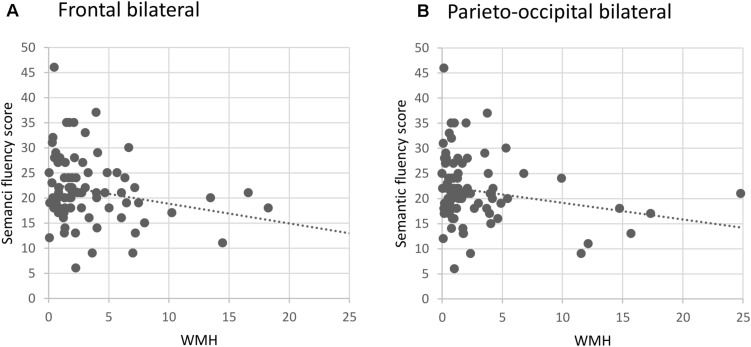
After controlling for age and education and adjusting for multiple correction, WMH in the bilateral frontal and parieto-occipital areas as well as the right temporal area were associated with semantic fluency in cognitively healthy and MCI/AD patients but only in the models containing solely right-handed participants.
The results indicate that white matter pathology in both frontal and parieto-occipital cerebral areas may have associations with impaired semantic fluency in right-handed older adults. However, elevated levels of WMH do not seem to be associated with cumulative effects on verbal fluency impairment in patients with MCI or AD. Further studies on the subject are needed.
脑白质高信号(WMHs)是脑血管病变的标志物,在轻度认知障碍(MCI)和阿尔茨海默病(AD)患者中经常出现。言语流畅性通常会受损,尤其是在AD患者中,但关于WMH对MCI和AD患者言语流畅性的具体影响的研究较少。
我们的目的是使用定量MRI数据研究健康老年人和病理性衰老(MCI/AD)中WMH与言语流畅性之间的关系。
利用了42名认知健康的老年人和44名MCI/AD患者(共86人)样本的语义和音素流畅性测量以及定量MRI成像数据。为了防止语言偏侧化可能产生的混杂效应,对包含7名左撇子/双手灵巧参与者的总样本以及仅包含右撇子参与者的样本(n = 79)都进行了分析。
在控制年龄和教育程度并进行多重校正后,双侧额叶和顶枕叶区域以及右侧颞叶区域的WMH与认知健康和MCI/AD患者的语义流畅性相关,但仅在仅包含右撇子参与者的模型中如此。
结果表明,额叶和顶枕叶脑区的白质病变可能与右撇子老年人的语义流畅性受损有关。然而,WMH水平升高似乎与MCI或AD患者言语流畅性损害的累积效应无关。需要对该主题进行进一步研究。