Leichner Ashley, Akhtar Aemal, Nic A Bhaird Caoimhe, Wener Rebecca, Perera Shiromi M, Weissbecker Inka
Health Technical Unit, International Rescue Committee, Washington, DC, USA.
School of Psychology, University of New South Wales, Sydney, NSW, Australia.
Glob Ment Health (Camb). 2021 Mar 15;8:e10. doi: 10.1017/gmh.2021.8. eCollection 2021.
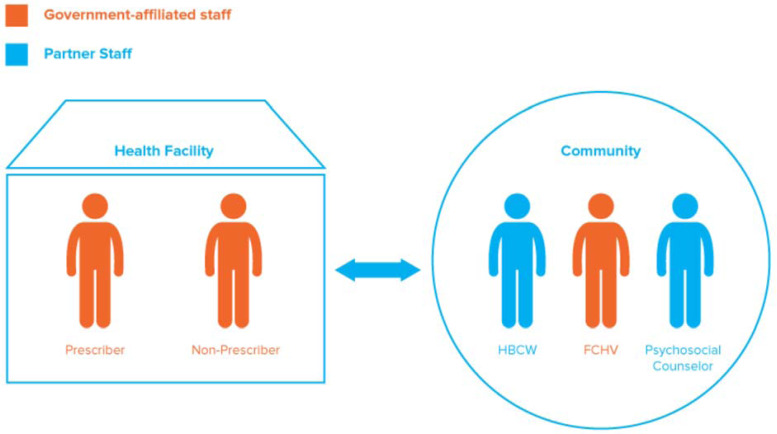
In the aftermath of the devastating 2015 earthquakes in Nepal, three non-governmental organizations collaborated to develop a program responding to the immediate mental health and psychosocial support (MHPSS) needs in three severely affected districts: Dhading, Gorkha, and Sindhuli. The program was implemented between April 2015 and February 2017 and aimed to (i) strengthen health worker capacity to provide integrated MHPSS services; and (ii) increase access to mental health services. This paper describes the program's implementation and the results of a pragmatic evaluation of the program's overall reach, effectiveness, and lessons learned.
The mixed-methods evaluation used routine program data, quantitative data from pre- and post-tests conducted with trainees and service users, and qualitative data from stakeholder interviews and focus group discussions.
A total of 1041 health workers received MHPSS training and supervision. Participants demonstrated significant improvements in skills, knowledge, and self-rated perceived competency. Trainees went on to provide MHPSS services to 3422 people. The most commonly identified presenting problems were epilepsy (29%) and depression (26%). A total of 67% of service users reported being 'completely satisfied' with the services received and 83% of those experiencing severe functional impairments on enrollment demonstrated improvement after receiving services.
Despite operational challenges, the program successfully engaged both laypeople and health workers to provide MHPSS in the aftermath of the crisis. Lessons learned can inform the planning and implementation of future training and integration programs to provide large-scale MHPSS efforts in humanitarian settings.
在2015年尼泊尔发生毁灭性地震后,三个非政府组织合作开展了一个项目,以满足三个受灾严重地区——达丁、戈尔哈和辛杜利——对心理健康和社会心理支持(MHPSS)的紧迫需求。该项目于2015年4月至2017年2月实施,旨在:(i)加强卫生工作者提供综合MHPSS服务的能力;(ii)增加获得心理健康服务的机会。本文描述了该项目的实施情况以及对该项目总体覆盖范围、有效性和经验教训的务实评估结果。
混合方法评估使用了常规项目数据、对培训学员和服务使用者进行的前后测试的定量数据,以及来自利益相关者访谈和焦点小组讨论的定性数据。
共有1041名卫生工作者接受了MHPSS培训和监督。参与者在技能、知识和自我评定的感知能力方面有显著提高。培训学员随后为3422人提供了MHPSS服务。最常见的就诊问题是癫痫(29%)和抑郁症(26%)。共有67%的服务使用者报告对所接受的服务“完全满意”,83%在登记时存在严重功能障碍的人在接受服务后症状有所改善。
尽管存在操作上的挑战,但该项目在危机后成功地促使非专业人员和卫生工作者共同提供MHPSS。吸取的经验教训可为未来培训和整合项目的规划与实施提供参考,以便在人道主义环境中开展大规模的MHPSS工作。