Kjærvik Marit, Ramstedt Madeleine, Schwibbert Karin, Dietrich Paul M, Unger Wolfgang E S
Surface Analysis and Interfacial Chemistry, Bundesanstalt für Materialforschung und -prüfung (BAM), Berlin, Germany.
Department of Chemistry, Umeå University, Umeå, Sweden.
Front Chem. 2021 Apr 30;9:666161. doi: 10.3389/fchem.2021.666161. eCollection 2021.
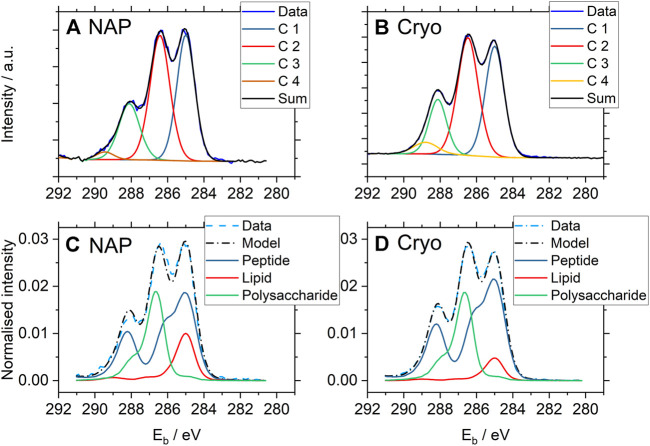
Bacteria generally interact with the environment via processes involving their cell-envelope. Thus, techniques that may shed light on their surface chemistry are attractive tools for providing an understanding of bacterial interactions. One of these tools is Al Kα-excited photoelectron spectroscopy (XPS) with its estimated information depth of <10 nm. XPS-analyses of bacteria have been performed for several decades on freeze-dried specimens in order to be compatible with the vacuum in the analysis chamber of the spectrometer. A limitation of these studies has been that the freeze-drying method may collapse cell structure as well as introduce surface contaminants. However, recent developments in XPS allow for analysis of biological samples at near ambient pressure (NAP-XPS) or as frozen hydrated specimens (cryo-XPS) in vacuum. In this work, we have analyzed bacterial samples from a reference strain of the Gram-negative bacterium using both techniques. We compare the results obtained and, in general, observe good agreement between the two techniques. Furthermore, we discuss advantages and disadvantages with the two analysis approaches and the output data they provide. XPS reference data from the bacterial strain are provided, and we propose that planktonic cells of this strain (DSM 50090) are used as a reference material for surface chemical analysis of bacterial systems.
细菌通常通过涉及其细胞包膜的过程与环境相互作用。因此,能够揭示其表面化学性质的技术是有助于理解细菌相互作用的有吸引力的工具。其中一种工具是Al Kα激发光电子能谱(XPS),其估计的信息深度小于10纳米。几十年来,为了与光谱仪分析室中的真空环境兼容,一直在对冻干标本进行细菌的XPS分析。这些研究的一个局限性在于,冷冻干燥方法可能会破坏细胞结构并引入表面污染物。然而,XPS的最新进展使得能够在近常压(NAP-XPS)下或在真空中作为冷冻水合标本(cryo-XPS)对生物样品进行分析。在这项工作中,我们使用这两种技术分析了革兰氏阴性菌参考菌株的细菌样品。我们比较了获得的结果,总体上观察到这两种技术之间有良好的一致性。此外,我们讨论了这两种分析方法及其提供的输出数据的优缺点。提供了该细菌菌株的XPS参考数据,并且我们建议将该菌株(DSM 50090)的浮游细胞用作细菌系统表面化学分析的参考材料。