Demus Daniel, Naber Annemieke, Dotz Viktoria, Jansen Bas C, Bladergroen Marco R, Nouta Jan, Sijbrands Eric J G, Van Hoek Mandy, Nicolardi Simone, Wuhrer Manfred
Leiden University Medical Center, Center for Proteomics and Metabolomics, Leiden, Netherlands.
Ludger Ltd., Culham Science Centre, Abingdon, United Kingdom.
Front Chem. 2021 May 7;9:678883. doi: 10.3389/fchem.2021.678883. eCollection 2021.
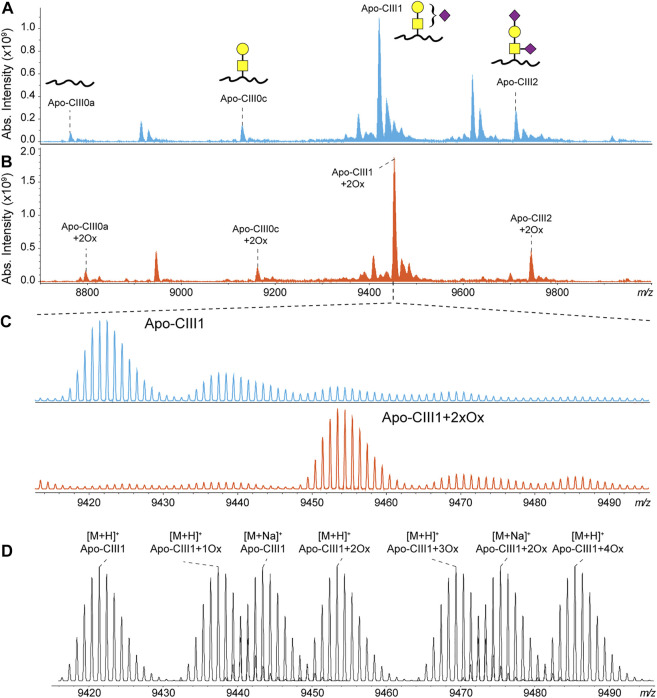
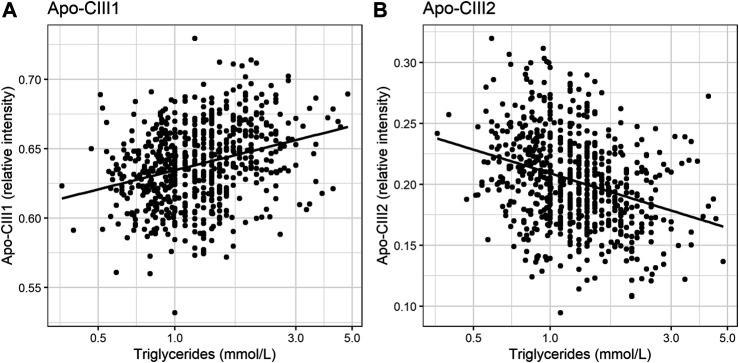
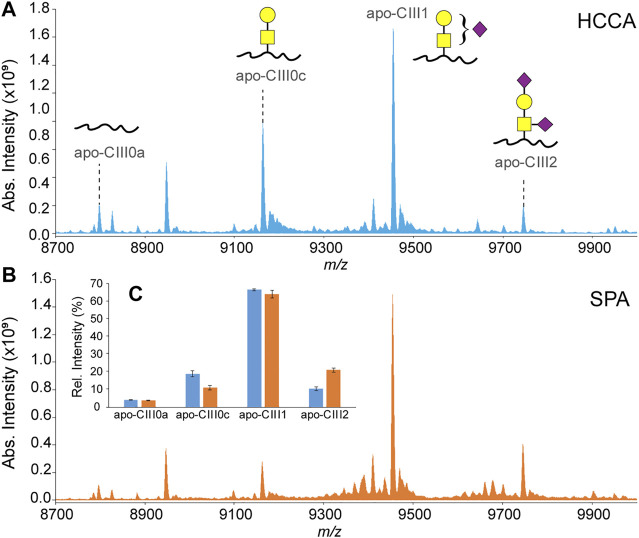
Apolipoprotein-CIII (apo-CIII) is a glycoprotein involved in lipid metabolism and its levels are associated with cardiovascular disease risk. Apo-CIII sialylation is associated with improved plasma triglyceride levels and its glycosylation may have an effect on the clearance of triglyceride-rich lipoproteins by directing these particles to different metabolic pathways. Large-scale sample cohort studies are required to fully elucidate the role of apo-CIII glycosylation in lipid metabolism and associated cardiovascular disease. In this study, we revisited a high-throughput workflow for the analysis of intact apo-CIII by ultrahigh-resolution MALDI FT-ICR MS. The workflow includes a chemical oxidation step to reduce methionine oxidation heterogeneity and spectrum complexity. Sinapinic acid matrix was used to minimize the loss of sialic acids upon MALDI. MassyTools software was used to standardize and automate MS data processing and quality control. This method was applied on 771 plasma samples from individuals without diabetes allowing for an evaluation of the expression levels of apo-CIII glycoforms against a panel of lipid biomarkers demonstrating the validity of the method. Our study supports the hypothesis that triglyceride clearance may be regulated, or at least strongly influenced by apo-CIII sialylation. Interestingly, the association of apo-CIII glycoforms with triglyceride levels was found to be largely independent of body mass index. Due to its precision and throughput, the new workflow will allow studying the role of apo-CIII in the regulation of lipid metabolism in various disease settings.
载脂蛋白 CIII(apo-CIII)是一种参与脂质代谢的糖蛋白,其水平与心血管疾病风险相关。apo-CIII 的唾液酸化与血浆甘油三酯水平的改善有关,其糖基化可能通过将富含甘油三酯的脂蛋白导向不同的代谢途径,从而对这些脂蛋白的清除产生影响。需要大规模样本队列研究来充分阐明 apo-CIII 糖基化在脂质代谢及相关心血管疾病中的作用。在本研究中,我们重新审视了一种通过超高分辨率 MALDI FT-ICR MS 分析完整 apo-CIII 的高通量工作流程。该工作流程包括一个化学氧化步骤,以减少蛋氨酸氧化异质性和光谱复杂性。使用芥子酸基质以尽量减少 MALDI 过程中唾液酸的损失。使用 MassyTools 软件对 MS 数据处理和质量控制进行标准化和自动化。该方法应用于 771 份来自无糖尿病个体的血浆样本,从而能够针对一组脂质生物标志物评估 apo-CIII 糖型的表达水平,证明了该方法的有效性。我们的研究支持这样一种假设,即甘油三酯清除可能受 apo-CIII 唾液酸化调节,或至少受到其强烈影响。有趣的是,发现 apo-CIII 糖型与甘油三酯水平的关联在很大程度上独立于体重指数。由于其精度和通量,新的工作流程将有助于研究 apo-CIII 在各种疾病背景下脂质代谢调节中的作用。