Department of Biomedical Sciences and Program in Molecular, Cellular, and Integrative Neurosciences, Colorado State University, Fort Collins, CO 80523.
Department of Biomedical Sciences and Program in Molecular, Cellular, and Integrative Neurosciences, Colorado State University, Fort Collins, CO 80523
eNeuro. 2021 Jun 16;8(3). doi: 10.1523/ENEURO.0087-21.2021. Print 2021 May-Jun.
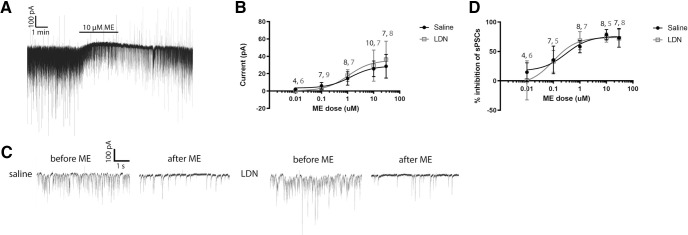
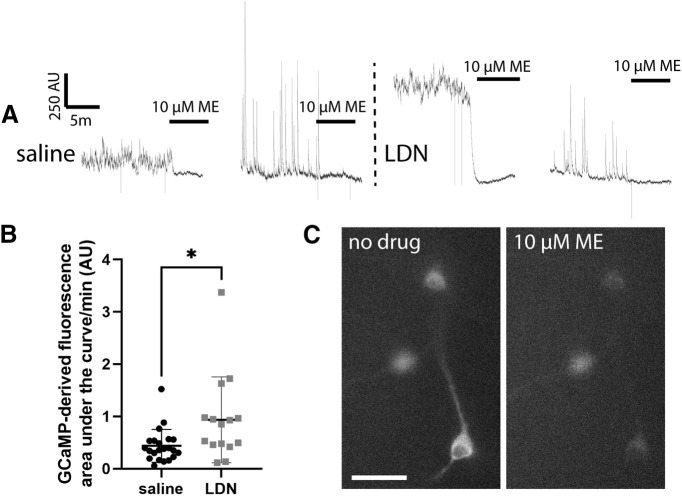
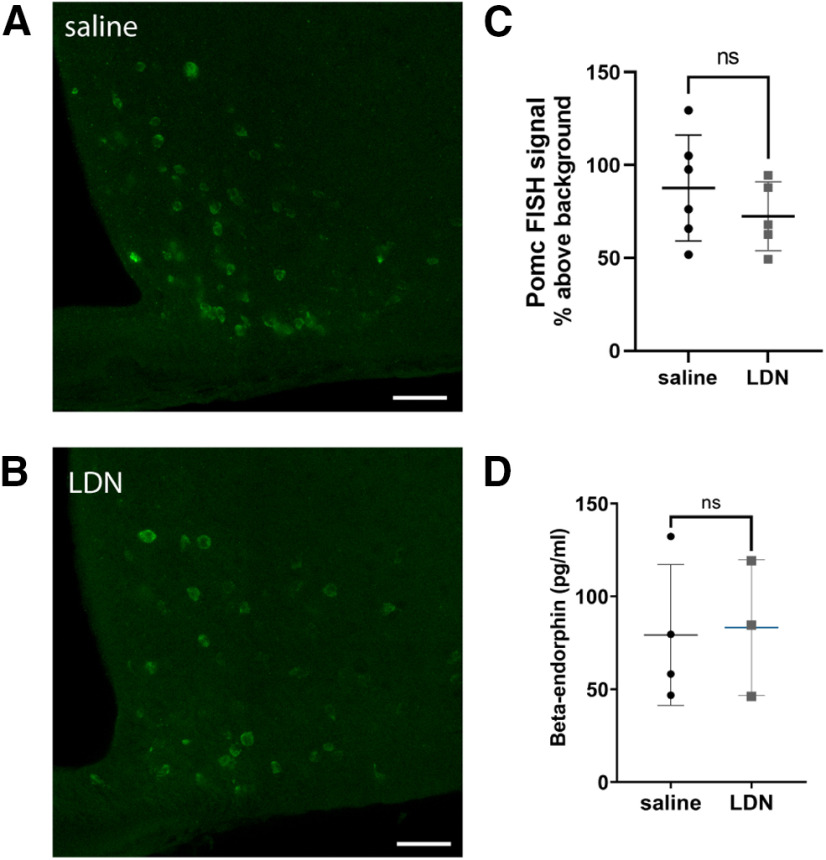
Naltrexone is an opioid receptor antagonist approved for the treatment of alcohol and opioid use disorders at doses of 50-150 mg/d. Naltrexone has also been prescribed at much lower doses (3-6 mg/d) for the off-label treatment of inflammation and pain. Currently, a compelling mechanistic explanation for the reported efficacy of low-dose naltrexone (LDN) is lacking and none of the proposed mechanisms can explain patient reports of improved mood and sense of well-being. Here, we examined the possibility that LDN might alter the activity of the endogenous opioid system involving proopiomelanocortin (POMC) neurons in the arcuate nucleus of the hypothalamus (ARH) in male and female mice. Known actions of POMC neurons could account for changes in pain perception and mood. However, using electrophysiologic, imaging and peptide measurement approaches, we found no evidence for such a mechanism. LDN did not change the sensitivity of opioid receptors regulating POMC neurons, the production of the β-endorphin precursor mRNA, nor the release of β-endorphin into plasma. Spontaneous postsynaptic currents (sPSCs) onto POMC neurons were slightly decreased after LDN treatment and GCaMP fluorescent signal, a proxy for intracellular calcium levels, was slightly increased. However, LDN treatment did not appear to change POMC neuron firing rate, resting membrane potential, nor action potential threshold. Therefore, LDN appears to have only slight effects on POMC neurons that do not translate to changes in intrinsic excitability or baseline electrical activity and mechanisms beyond POMC neurons and altered opioid receptor sensitivity should continue to be explored.
纳曲酮是一种阿片受体拮抗剂,批准用于治疗酒精和阿片类药物使用障碍,剂量为 50-150mg/d。纳曲酮也以更低的剂量(3-6mg/d)被处方用于非标签治疗炎症和疼痛。目前,缺乏对低剂量纳曲酮(LDN)报告疗效的令人信服的机制解释,也没有任何提出的机制可以解释患者报告的改善情绪和幸福感。在这里,我们研究了 LDN 可能改变涉及下丘脑弓状核(ARH)中 proopiomelanocortin(POMC)神经元的内源性阿片系统活性的可能性。POMC 神经元的已知作用可以解释疼痛感知和情绪变化。然而,使用电生理、成像和肽测量方法,我们没有发现这种机制的证据。LDN 没有改变调节 POMC 神经元的阿片受体的敏感性、β-内啡肽前体 mRNA 的产生,也没有改变β-内啡肽释放到血浆中。LDN 治疗后 POMC 神经元的自发性突触后电流(sPSCs)略有降低,而 GCaMP 荧光信号(细胞内钙水平的替代物)略有增加。然而,LDN 治疗似乎并没有改变 POMC 神经元的放电率、静息膜电位或动作电位阈值。因此,LDN 似乎对 POMC 神经元只有轻微的影响,这些影响不会转化为内在兴奋性或基线电活动的变化,并且应该继续探索超越 POMC 神经元和改变阿片受体敏感性的机制。