Department of Internal Medicine, Division of Gastroenterology, Kyung Hee University Hospital at Gang Dong, Seoul, Republic of Korea.
Medicine (Baltimore). 2021 May 28;100(21):e25820. doi: 10.1097/MD.0000000000025820.
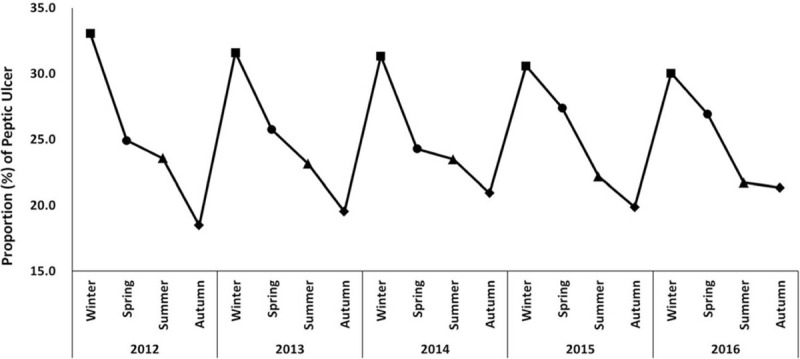
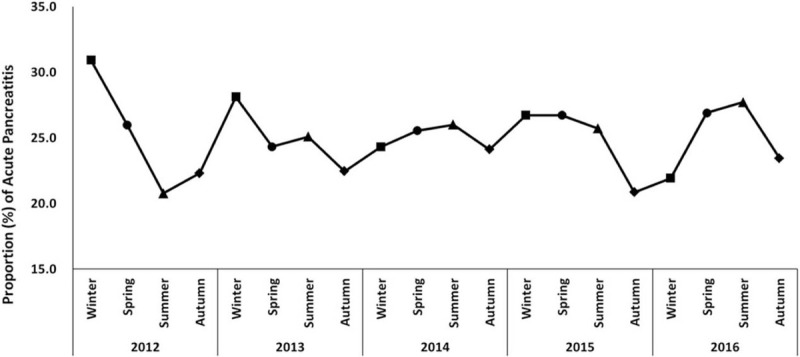
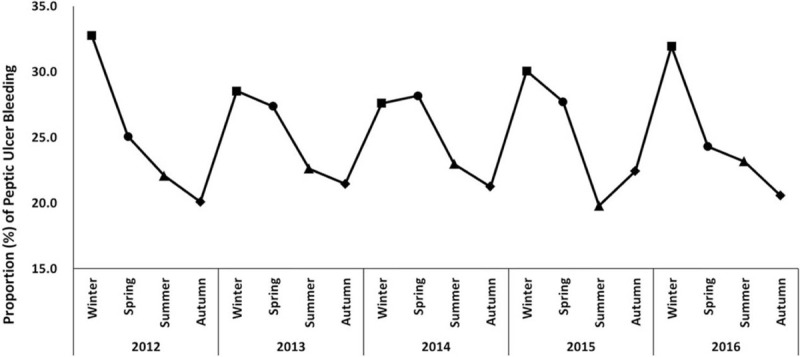
Although gastrointestinal diseases are reported at various times throughout the year, some particular seasons are associated with a higher incidence of these diseases. This study aimed to identify the seasonal variations of peptic ulcer (PU), peptic ulcer bleeding (PUB), and acute pancreatitis (AP) in South Korea.We conducted a retrospective, observational cohort study of all subjects aged >18 years between 2012 and 2016 using the Health Insurance Review and Assessment-National Patient Samples database, previously converted to the standardized Observational Medical Outcomes Partnership-Common Data Model. We assessed the overall seasonal variations of PU, PUB, and AP and further analyzed seasonal variations according to age and sex subgroups.In total, 14,626 patients with PU, 3575 with PUB, and 9023 with AP were analyzed for 5 years. A clear seasonal variation was noted in PU, with the highest incidence rate during winter, the second highest during spring, the third highest during summer, and the lowest incidence during autumn for 5 years (P < .001). PUB also showed significant seasonal fluctuations, with winter peak for 4 years, except 1 year, which had a spring peak (P < .001). However, AP showed no clear seasonal variations (P = .090). No significant differences in the seasonal variation of PU, PUB, and AP were observed according to sex and age subgroups (<60 years vs ≥60 years).Seasonal variation of PU and PUB should be considered when determining allocation of available health care resources.
虽然胃肠道疾病在一年中的不同时间都有报道,但有些特定的季节与这些疾病的发病率较高有关。本研究旨在确定韩国消化性溃疡(PU)、消化性溃疡出血(PUB)和急性胰腺炎(AP)的季节性变化。我们使用 2012 年至 2016 年的健康保险审查和评估-国家患者样本数据库(先前转换为标准化观察医疗结果伙伴关系-通用数据模型)进行了一项回顾性、观察性队列研究,该数据库纳入了所有年龄>18 岁的患者。我们评估了 PU、PUB 和 AP 的总体季节性变化,并根据年龄和性别亚组进一步分析了季节性变化。总共分析了 14626 例 PU、3575 例 PUB 和 9023 例 AP 患者,随访 5 年。PU 存在明显的季节性变化,冬季发病率最高,其次是春季,夏季第三,秋季最低,5 年来均如此(P<0.001)。PUB 也显示出明显的季节性波动,4 年冬季高峰,除了 1 年春季高峰(P<0.001)。然而,AP 没有明显的季节性变化(P=0.090)。根据性别和年龄亚组(<60 岁与≥60 岁),PU、PUB 和 AP 的季节性变化无显著差异。在确定现有卫生保健资源的分配时,应考虑 PU 和 PUB 的季节性变化。