Research Center for Reproductive Medicine, Gynecological Endocrinology and Menopause, IRCCS San Matteo Foundation, Department of Clinical, Surgical, Diagnostic and Pediatric Sciences, University of Pavia, Pavia, Italy.
Seattle Women's: Health, Research, Gynecology, Seattle, WA.
Menopause. 2021 May 24;28(8):875-882. doi: 10.1097/GME.0000000000001793.
To determine prevalence and health-related quality of life (HRQOL) of moderate-to-severe vasomotor symptoms (VMS) in postmenopausal women in Europe, the US, and Japan, and among subgroups of women not taking hormone therapy (HT).
Screening surveys were sent to a random sample of women aged 40 to 65 years; full questionnaires followed to those who completed them and met inclusion criteria. Women with successfully treated VMS, breast cancer, or on HT for medical conditions were excluded. The Menopause-Specific QOL (MENQOL) and Work Productivity and Activity Impairment (WPAI) questionnaires were included in the questionnaire.
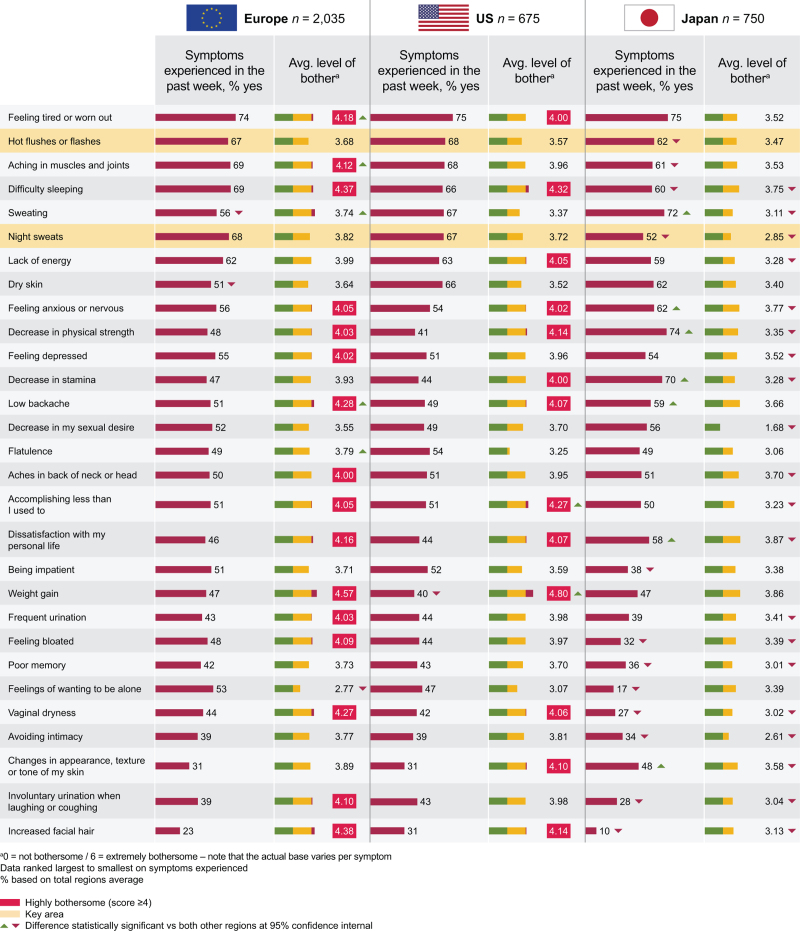
Of 25,161 women completing the screening survey, 11,771 were postmenopausal and 3,460 met inclusion criteria and completed the full questionnaire. Prevalence of moderate-to-severe VMS was 40%, 34%, and 16% in Europe, the US, and Japan, respectively. A large proportion were HT averse, albeit eligible (Europe 56%, US 54%, Japan 79%). In total, 12%, 9%, and 8% in Europe, the US, and Japan, respectively, were HT-contraindicated. A high proportion were HT-cautious (Europe 70%, US 69%, Japan 52%). Most common menopausal symptoms reported in the MENQOL were feeling tired or worn out (Europe/US 74%, Japan 75%), aching in muscles and joints (Europe 69%, US 68%, Japan 61%), difficulty sleeping (Europe 69%, US 66%, Japan 60%), and hot flashes (Europe 67%, US 68%, Japan 62%). Overall, the most bothersome symptom was weight gain. As measured by the WPAI, hot flashes and night sweats had a greater impact on daily activities than on working activities.
A high proportion of women experienced moderate-to-severe VMS, with associated symptoms impacting QOL.
确定欧洲、美国和日本绝经后妇女中中重度血管舒缩症状(VMS)的流行率和与健康相关的生活质量(HRQOL),以及未接受激素治疗(HT)的女性亚组中的流行率和 HRQOL。
向 40 至 65 岁的女性随机抽样发送筛选调查;对完成并符合纳入标准的人进行完整问卷。成功治疗 VMS、乳腺癌或因医疗状况接受 HT 的女性被排除在外。调查问卷包括绝经特异性生活质量问卷(MENQOL)和工作生产力和活动障碍问卷(WPAI)。
在完成筛选调查的 25161 名女性中,有 11771 名处于绝经后状态,有 3460 名符合纳入标准并完成了完整问卷。欧洲、美国和日本中重度 VMS 的患病率分别为 40%、34%和 16%。尽管有资格,但很大一部分女性对 HT 有抵触情绪(欧洲 56%,美国 54%,日本 79%)。在欧洲、美国和日本,分别有 12%、9%和 8%的人 HT 禁忌。很大一部分女性对 HT 持谨慎态度(欧洲 70%,美国 69%,日本 52%)。MENQOL 报告的最常见绝经症状是疲倦或疲惫(欧洲/美国 74%,日本 75%)、肌肉和关节疼痛(欧洲 69%,美国 68%,日本 61%)、睡眠困难(欧洲 69%,美国 66%,日本 60%)和热潮(欧洲 67%,美国 68%,日本 62%)。总体而言,最令人烦恼的症状是体重增加。根据 WPAI 的测量,热潮和盗汗对日常活动的影响大于对工作活动的影响。
很大一部分女性经历了中重度 VMS,相关症状影响了生活质量。