MRC Human Genetics Unit, Institute of Genetics and Cancer, University of Edinburgh, Crewe Road, Edinburgh, UK.
Blizard institute, Barts and The London School of Medicine and Dentistry, Queen Mary University of London, London, UK.
Nat Commun. 2021 May 25;12(1):3127. doi: 10.1038/s41467-021-23500-6.
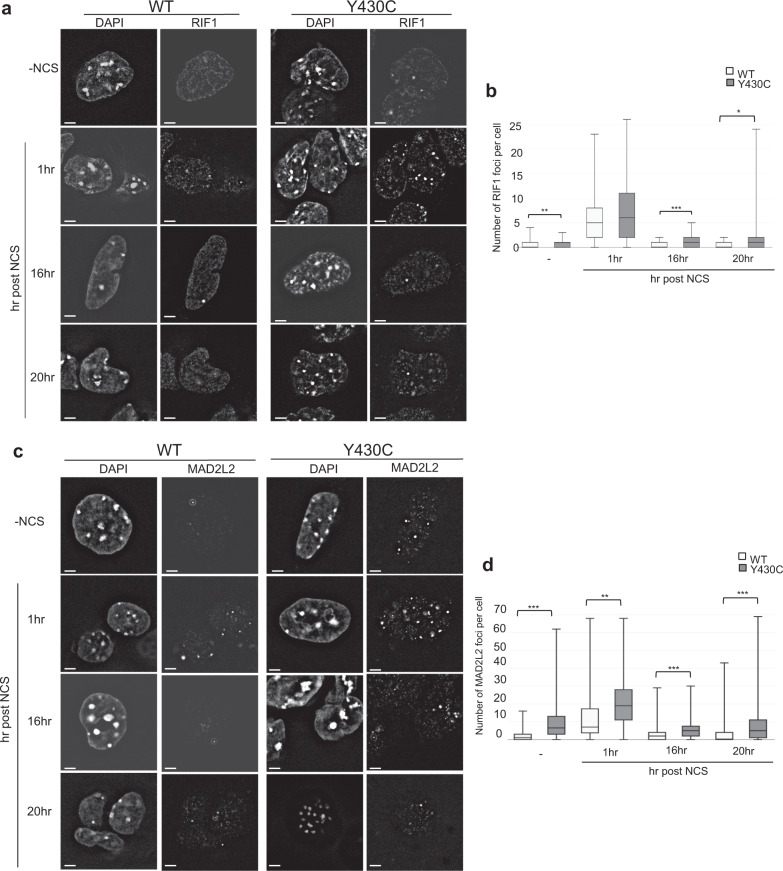
Cornelia de Lange syndrome is a multisystem developmental disorder typically caused by mutations in the gene encoding the cohesin loader NIPBL. The associated phenotype is generally assumed to be the consequence of aberrant transcriptional regulation. Recently, we identified a missense mutation in BRD4 associated with a Cornelia de Lange-like syndrome that reduces BRD4 binding to acetylated histones. Here we show that, although this mutation reduces BRD4-occupancy at enhancers it does not affect transcription of the pluripotency network in mouse embryonic stem cells. Rather, it delays the cell cycle, increases DNA damage signalling, and perturbs regulation of DNA repair in mutant cells. This uncovers a role for BRD4 in DNA repair pathway choice. Furthermore, we find evidence of a similar increase in DNA damage signalling in cells derived from NIPBL-deficient individuals, suggesting that defective DNA damage signalling and repair is also a feature of typical Cornelia de Lange syndrome.
康氏综合征是一种多系统发育障碍疾病,通常由编码黏合蛋白加载器 NIPBL 的基因突变引起。相关表型通常被认为是转录调节异常的结果。最近,我们在 BRD4 中发现了一个与康氏综合征类似的错义突变,该突变降低了 BRD4 与乙酰化组蛋白的结合。在这里,我们表明,尽管这种突变减少了增强子上的 BRD4 占有率,但它不会影响小鼠胚胎干细胞中多能性网络的转录。相反,它会延迟细胞周期,增加 DNA 损伤信号,并扰乱突变细胞中 DNA 修复的调节。这揭示了 BRD4 在 DNA 修复途径选择中的作用。此外,我们发现源自 NIPBL 缺陷个体的细胞中 DNA 损伤信号也有类似的增加,这表明有缺陷的 DNA 损伤信号和修复也是典型的康氏综合征的一个特征。