Ackermann Jakob, Casari Fabio A, Germann Christoph, Weigelt Lizzy, Wirth Stephan H, Viehöfer Arnd F
Department of Orthopedics, University Hospital Balgrist, University of Zurich, Zurich, Switzerland.
Department of Radiology, University Hospital Balgrist, University of Zurich, Zurich, Switzerland.
Orthop J Sports Med. 2021 May 14;9(5):23259671211007439. doi: 10.1177/23259671211007439. eCollection 2021 May.
Autologous matrix-induced chondrogenesis (AMIC) has been shown to result in favorable clinical outcomes in patients with osteochondral lesions of the talus (OLTs). Though, the influence of ankle instability on cartilage repair of the ankle has yet to be determined.
PURPOSE/HYPOTHESIS: To compare the clinical and radiographic outcomes in patients with and without concomitant lateral ligament stabilization (LLS) undergoing AMIC for the treatment of OLT. It was hypothesized that the outcomes would be comparable between these patient groups.
Cohort study; Level of evidence, 3.
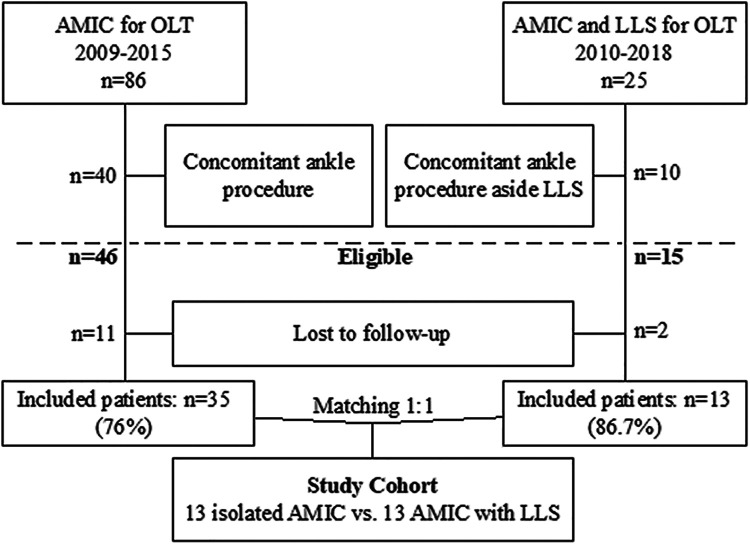
Twenty-six patients (13 with and 13 without concomitant ankle instability) who underwent AMIC with a mean follow-up of 4.2 ± 1.5 years were enrolled in this study. Patients were matched 1:1 according to age, body mass index (BMI), lesion size, and follow-up. Postoperative magnetic resonance imaging and Tegner, American Orthopaedic Foot & Ankle Society (AOFAS), and Cumberland Ankle Instability Tool (CAIT) scores were obtained at a minimum follow-up of 2 years. A musculoskeletal radiologist scored all grafts according to the MOCART (magnetic resonance observation of cartilage repair tissue) 1 and MOCART 2.0 scores.
The patients' mean age was 33.4 ± 12.7 years, with a mean BMI of 26.2 ± 3.7. Patients with concomitant LLS showed worse clinical outcome measured by the AOFAS (85.1 ± 14.4 vs 96.3 ± 5.8; = .034) and Tegner (3.8 ± 1.1 vs 4.4 ± 2.3; = .012) scores. Postoperative CAIT and AOFAS scores were significantly correlated in patients with concomitant LLS ( = 0.766; = .002). A CAIT score >24 (no functional ankle instability) resulted in AOFAS scores comparable with scores in patients with isolated AMIC (90.1 ± 11.6 vs 95.3 ± 6.6; = .442). No difference was seen between groups regarding MOCART 1 and 2.0 scores ( = .714 and = .371, respectively).
Concurrently performed AMIC and LLS in patients with OLT and ankle instability resulted in clinical outcomes comparable with isolated AMIC if postoperative ankle stability was achieved. However, residual ankle instability was associated with worse postoperative outcomes, highlighting the need for adequate stabilization of ankle instability in patients with OLT.
自体基质诱导软骨形成术(AMIC)已被证明在距骨骨软骨损伤(OLT)患者中能产生良好的临床效果。然而,踝关节不稳定对踝关节软骨修复的影响尚未确定。
目的/假设:比较接受AMIC治疗OLT的患者在伴有或不伴有外侧韧带稳定术(LLS)情况下的临床和影像学结果。假设这些患者组之间的结果具有可比性。
队列研究;证据等级,3级。
本研究纳入了26例接受AMIC治疗的患者(13例伴有踝关节不稳定,13例不伴有踝关节不稳定),平均随访时间为4.2±1.5年。根据年龄、体重指数(BMI)、损伤大小和随访情况将患者1:1配对。在至少2年的随访时获取术后磁共振成像以及Tegner、美国矫形足踝协会(AOFAS)和坎伯兰踝关节不稳定工具(CAIT)评分。一名肌肉骨骼放射科医生根据MOCART(软骨修复组织的磁共振观察)1和MOCART 2.0评分对所有移植物进行评分。
患者的平均年龄为33.4±12.7岁,平均BMI为26.2±3.7。伴有LLS的患者在AOFAS评分(85.1±14.4对96.3±5.8;P = 0.034)和Tegner评分(3.8±1.1对4.4±2.3;P = 0.012)方面显示出较差的临床结果。伴有LLS的患者术后CAIT和AOFAS评分显著相关(r = 0.766;P = 0.002)。CAIT评分>24(无功能性踝关节不稳定)导致AOFAS评分与单纯AMIC患者的评分相当(90.1±11.6对95.3±6.6;P = 0.442)。两组在MOCART 1和2.0评分方面未见差异(分别为P = 0.714和P = 0.371)。
OLT和踝关节不稳定患者同时进行AMIC和LLS,如果术后踝关节达到稳定,则临床结果与单纯AMIC相当。然而,残余踝关节不稳定与较差的术后结果相关,这突出了OLT患者踝关节不稳定充分稳定的必要性。