Schön Klinik München Harlaching, FIFA Medical Centre of Excellence, Munich, Germany.
Department of Orthopeadics and Trauma Surgery, Musculoskeletal University Center Munich (MUM), University Hospital, Ludwig Maximilian University Munich, Munich, Germany.
Cartilage. 2023 Sep;14(3):292-304. doi: 10.1177/19476035231161806. Epub 2023 Apr 21.
Peer-reviewed literature was analyzed regarding different topics relevant to osteochondral lesions of the talus (OLTs) treatment. This process concluded with a statement for each topic reflecting the best scientific evidence available for a particular diagnostic or therapeutic concept, including the grade of recommendation. Besides the scientific evidence, all group members rated the statements to identify possible gaps between literature and current clinical practice.
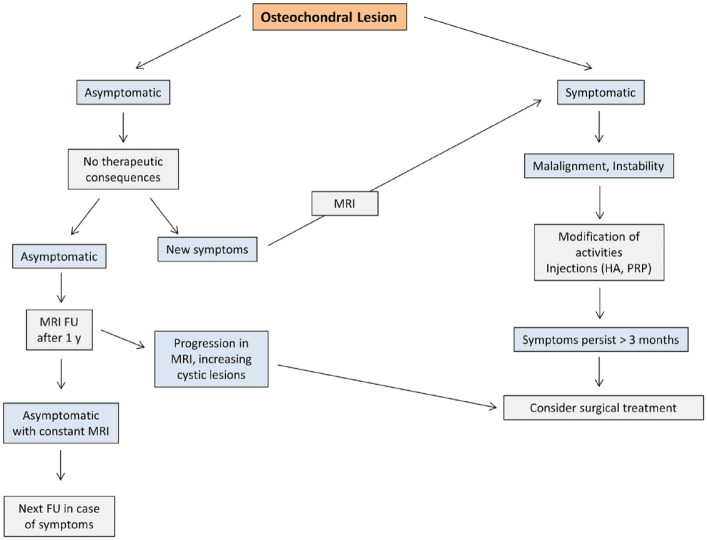
In patients with minimal symptoms, OLT progression to ankle osteoarthritis is unlikely. Risk factors for progression are the depth of the lesion on MRI, subchondral cyst formation, and the extent of bone marrow edema. Conservative management is the adaptation of activities to the performance of the ankle joint. A follow-up imaging after 12 months helps not to miss any progression. It is impossible to estimate the probability of success of conservative management from initial symptoms and imaging. Cast immobilization is an option in OLTs in children, with a success rate of approximately 50%, although complete healing, estimated from imaging, is rare. In adults, improvement by conservative management ranges between 45% and 59%. Rest and restrictions for sports activities seem to be more successful than immobilization. Intra-articular injections of hyaluronic acid and platelet-rich plasma can improve pain and functional scores for more than 6 months. If 3 months of conservative management does not improve symptoms, surgery can be recommended.
分析了与距骨骨软骨病变(OLTs)治疗相关的不同主题的同行评议文献。这一过程得出了针对每个主题的陈述,反映了特定诊断或治疗概念的现有最佳科学证据,包括推荐等级。除了科学证据外,所有小组成员还对这些陈述进行了评分,以确定文献与当前临床实践之间可能存在的差距。
对于症状轻微的患者,OLTs 进展为踝关节骨关节炎的可能性不大。进展的危险因素是 MRI 上病变的深度、软骨下囊肿形成和骨髓水肿的程度。保守治疗是根据踝关节的功能调整活动。12 个月后的随访影像学检查有助于避免任何进展。从初始症状和影像学检查无法估计保守治疗成功的概率。对于儿童的 OLTs,石膏固定是一种选择,成功率约为 50%,尽管从影像学上估计,完全愈合很少见。在成年人中,保守治疗的改善率在 45%至 59%之间。休息和限制运动活动似乎比固定更成功。关节内注射透明质酸和富含血小板的血浆可以改善疼痛和功能评分超过 6 个月。如果 3 个月的保守治疗不能改善症状,可以推荐手术。