Laboratory of Myeloid Malignancies, National Heart, Lung, and Blood Institute, National Institutes of Health, Bethesda, MD.
Medical College of Wisconsin, Milwaukee, WI.
JCO Precis Oncol. 2021 Jan 25;5. doi: 10.1200/PO.20.00355. eCollection 2021.
Patients with myelodysplastic syndrome (MDS) are at risk of relapse after allogeneic hematopoietic cell transplantation. The utility of ultra-deep genomic testing to predict and the impact of conditioning intensity to prevent MDS relapse are unknown.
Targeted error-corrected DNA sequencing was performed on preconditioning blood samples from patients with MDS (n = 48) from the Blood and Marrow Transplant Clinical Trials Network 0901 phase III randomized clinical trial, which compared outcomes by allogeneic hematopoietic cell transplantation conditioning intensity in adult patients with < 5% marrow myeloblasts and no leukemic myeloblasts in blood on morphological analysis at the time of pretransplant assessment. Clinical end points (53-month median follow-up) included transplant-related mortality (TRM), relapse, relapse-free survival (RFS), and overall survival (OS). Of the 48 patients examined, 14 experienced TRM, 23 are relapse-free, and 11 relapsed, of which 7 died.
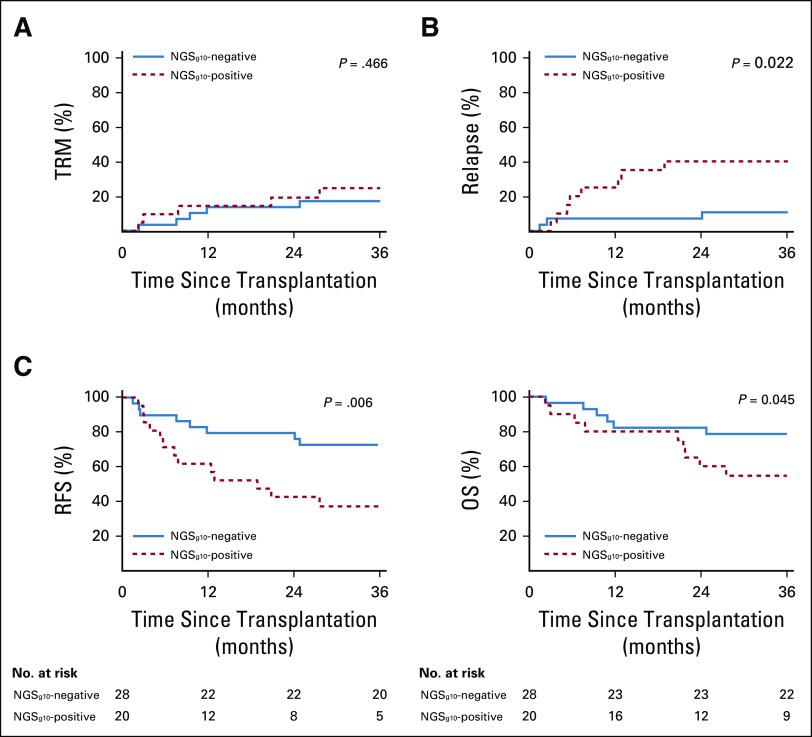
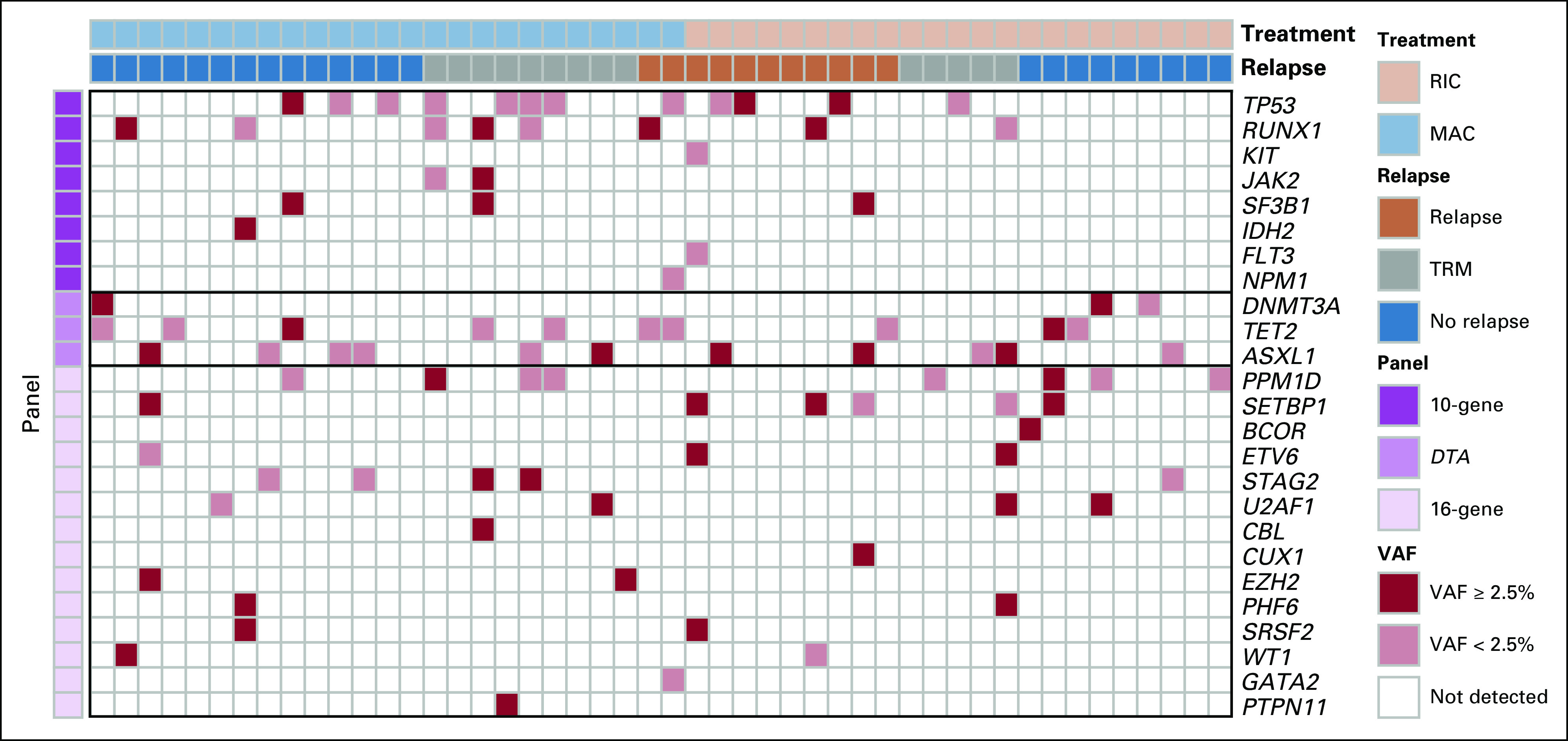
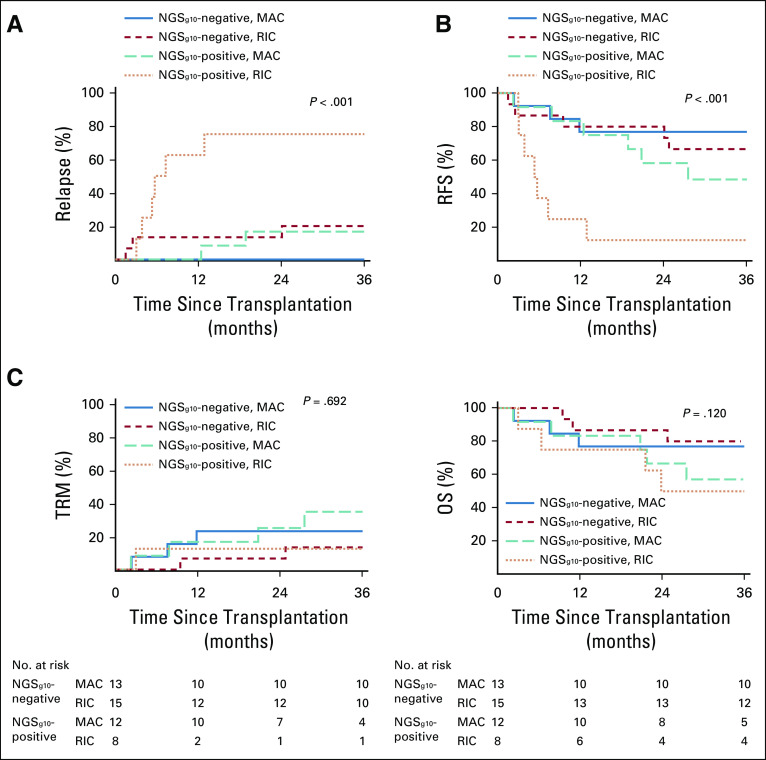
Using a previously described set of 10 gene regions, 42% of patients (n = 20) had mutations detectable before random assignment to reduced intensity conditioning (RIC) or myeloablative conditioning (MAC). Testing positive was associated with increased rates of relapse (3-year relapse, 40% 11%; = .022) and decreased OS (3-year OS, 55% 79%, = .045). In those testing positive, relapse rates were higher (3-year relapse, 75% 17%; = .003) and RFS was lower (3-year RFS, 13% 49%; = .003) in RIC versus MAC arms. Testing additional genes, including those associated with MDS, did not improve prognostication.
This study provides evidence that targeted DNA sequencing in patients with MDS before transplant can identify those with highest post-transplant relapse rates. In those testing positive, random assignment to MAC lowered but did not eliminate relapse risk.
骨髓增生异常综合征(MDS)患者在异基因造血细胞移植后有复发的风险。超深度基因组检测在预测中的应用以及预处理强度对预防 MDS 复发的影响尚不清楚。
对血液和骨髓移植临床研究网络 0901 期 III 期随机临床试验中 48 例 MDS 患者(n = 48)的预处理血液样本进行靶向纠错 DNA 测序,该临床试验比较了成人患者的异基因造血细胞移植预处理强度的结果,这些患者在移植前评估时的形态学分析中骨髓原始细胞<5%,血液中无白血病原始细胞。临床终点(53 个月中位随访)包括移植相关死亡率(TRM)、复发、无复发生存(RFS)和总生存(OS)。在 48 例检查的患者中,有 14 例发生 TRM,23 例无复发,11 例复发,其中 7 例死亡。
使用先前描述的 10 个基因区域集,42%的患者(n = 20)在随机分配到强度降低的预处理(RIC)或清髓预处理(MAC)之前可检测到突变。检测呈阳性与较高的复发率(3 年复发率,40% 11%;P =.022)和降低的 OS(3 年 OS,55% 79%,P =.045)相关。在检测呈阳性的患者中,RIC 组的复发率较高(3 年复发率,75% 17%;P =.003),RFS 较低(3 年 RFS,13% 49%;P =.003)。检测其他基因,包括与 MDS 相关的基因,并没有改善预后。
本研究提供的证据表明,移植前对 MDS 患者进行靶向 DNA 测序可以识别出移植后复发率最高的患者。在检测呈阳性的患者中,随机分配到 MAC 可降低但不能消除复发风险。