Department of Hematology & Medical Oncology, Taussig Cancer Institute, Cleveland Clinic, Cleveland, OH.
Department of Cardiovascular & Metabolic Sciences, Lerner Research Institute, Cleveland Clinic, Cleveland, OH.
Med. 2021 Apr 9;2(4):423-434. doi: 10.1016/j.medj.2021.02.002. Epub 2021 Mar 12.
Cancer immunotherapy is associated with several immune-related adverse events, but the relationship between immunotherapy and venous thromboembolism has not been thoroughly studied.
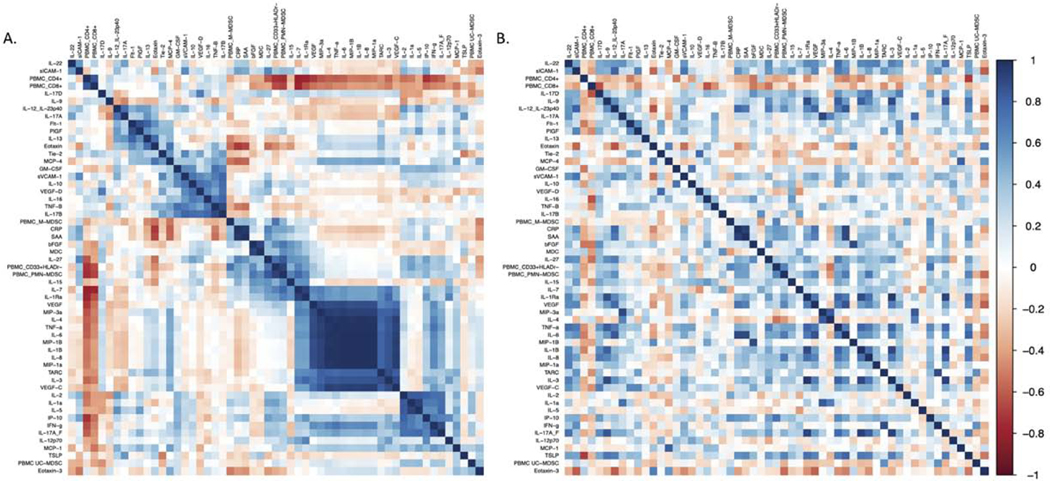
We conducted a retrospective cohort study of 1,686 patients who received immunotherapy for a variety of malignancies to determine the incidence of venous thromboembolism and the impact of venous thromboembolism on survival. To examine the potential role of inflammation in venous thromboembolism, we also profiled immune cells and plasma cytokines in blood samples obtained prior to initiation of immunotherapy in a sub-cohort of patients treated on clinical trials who subsequently did (N = 15), or did not (N = 10) develop venous thromboembolism.
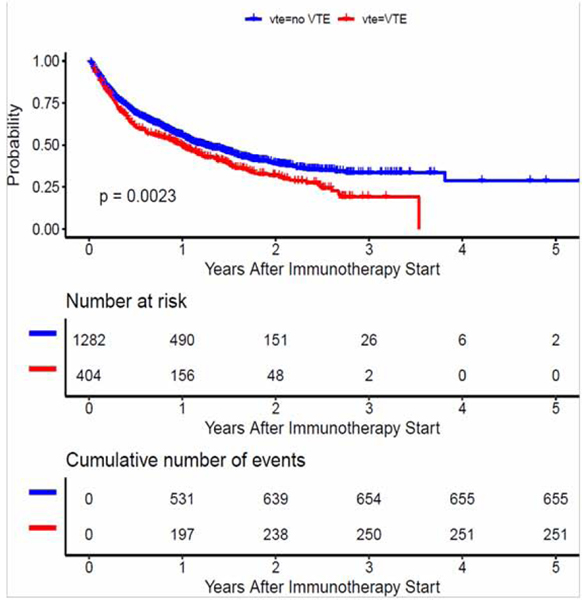
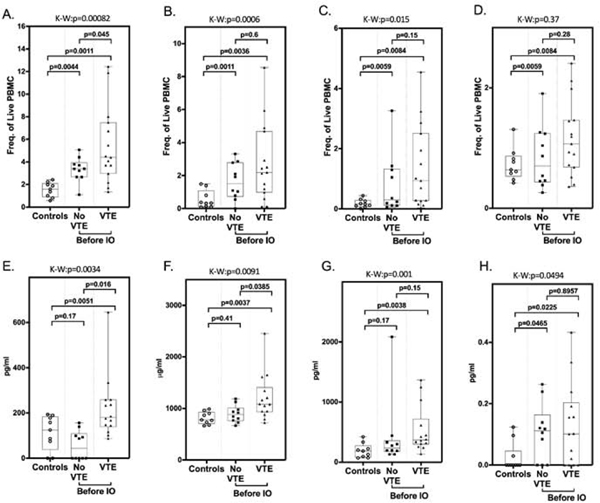
Venous thromboembolism occurred while on immunotherapy in 404/1686 patients (24%) and was associated with decreased overall survival [HR=1.22 (95% CI 1.06-1.41), p<0.008]. Patients that developed venous thromboembolism had significantly higher pretreatment levels of myeloid-derived suppressor cells (5.382 ± 0.873 vs. 3.341 ± 0.3402, mean ± SEM; p=0.0045), interleukin 8 (221.2 ± 37.53 vs. 111.6 ± 25.36, mean ± SEM; p=0.016), and soluble vascular cell adhesion protein 1 (1210 ± 120.6 vs. 895.5 ± 53.34, mean ± SEM; p=0.0385).
These findings demonstrate that venous thromboembolism is an underappreciated and important immune-related adverse event associated with cancer immunotherapy, and may implicate an interleukin 8 and myeloid-derived suppressor cell-driven pathway in pathogenesis.
癌症免疫疗法与多种免疫相关不良反应相关,但免疫疗法与静脉血栓栓塞之间的关系尚未得到彻底研究。
我们对 1686 名接受各种恶性肿瘤免疫治疗的患者进行了回顾性队列研究,以确定静脉血栓栓塞的发生率以及静脉血栓栓塞对生存的影响。为了研究炎症在静脉血栓栓塞中的潜在作用,我们还对接受临床试验治疗的患者亚组的血液样本中的免疫细胞和血浆细胞因子进行了分析,这些患者随后(N=15)或未(N=10)发生静脉血栓栓塞。
在 1686 名患者中有 404 名(24%)在接受免疫治疗时发生了静脉血栓栓塞,并且与总生存率降低有关[风险比(HR)=1.22(95%可信区间 1.06-1.41),p<0.008]。发生静脉血栓栓塞的患者预处理时的骨髓来源抑制细胞(5.382±0.873 与 3.341±0.3402,平均值±SEM;p=0.0045)、白细胞介素 8(221.2±37.53 与 111.6±25.36,平均值±SEM;p=0.016)和可溶性血管细胞黏附蛋白 1(1210±120.6 与 895.5±53.34,平均值±SEM;p=0.0385)水平显著升高。
这些发现表明,静脉血栓栓塞是癌症免疫治疗中一种被低估的重要免疫相关不良事件,并且可能涉及白细胞介素 8 和骨髓来源抑制细胞驱动的途径。