The First Affiliated Hospital of Zhejiang Chinese Medical University, Hangzhou, China.
College of Pharmaceutical Science, Zhejiang Chinese Medical University, Hangzhou, China.
Braz J Med Biol Res. 2021 May 24;54(8):e10685. doi: 10.1590/1414-431X2020e10685. eCollection 2021.
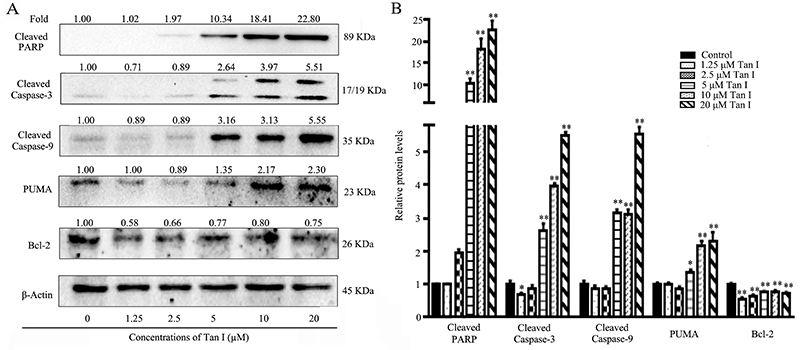
Tanshinone I (Tan I) is one of the main bioactive ingredients derived from Salvia miltiorrhiza Bunge, which has exhibited antitumor activities toward various human cancer cells. However, its effects and underlying mechanisms on human chronic myeloid leukemia (CML) cells still require further investigation. This study determined the effects and mechanisms of anti-proliferative and apoptosis induction activity induced by Tan I against K562 cells. The cytotoxic effect of Tan I at varying concentrations on K562 cells was evaluated via MTT assay. Cell apoptosis was further investigated through DAPI staining and flow cytometry analysis. The expression levels of apoptosis-related proteins and activities of JNK/ATF2 and ERK signaling pathways were analyzed by western blot. Quantitative PCR was performed to further determine mRNA expression levels of JNK1/2 and ERK1/2 after Tan I treatment. The results indicated that Tan I significantly inhibited K562 cell growth and induced apoptosis in a concentration- and time-dependent manner. It induced significant cellular morphological changes and increased apoptosis rates in CML cells. Tan I promoted the cleavages of caspase-related proteins, as well as increased the expression levels of PUMA. Furthermore, Tan I significantly activated JNK and inhibited ATF-2 and ERK signaling pathways. The mRNA expression levels of JNK1/2 and ERK1/2 were up-regulated by Tan I, further confirming its regulatory effects on JNK/ERK signaling pathways. Overall, our results indicated that Tan I suppressed cell viability via JNK- and ERK-mediated apoptotic pathways in K562 cells, suggesting that it might be a promising candidate as a novel anti-leukemia drug.
丹参酮 I(Tan I)是从丹参中提取的主要生物活性成分之一,对多种人类癌细胞表现出抗肿瘤活性。然而,其对人慢性髓系白血病(CML)细胞的作用及其机制仍需进一步研究。本研究旨在确定 Tan I 对 K562 细胞的抗增殖和诱导凋亡活性的作用及其机制。通过 MTT 法评估 Tan I 在不同浓度下对 K562 细胞的细胞毒性作用。通过 DAPI 染色和流式细胞术分析进一步研究细胞凋亡。通过 Western blot 分析凋亡相关蛋白的表达水平以及 JNK/ATF2 和 ERK 信号通路的活性。通过定量 PCR 进一步确定 Tan I 处理后 JNK1/2 和 ERK1/2 的 mRNA 表达水平。结果表明,Tan I 以浓度和时间依赖性方式显著抑制 K562 细胞生长并诱导细胞凋亡。它诱导 CML 细胞发生明显的细胞形态变化并增加细胞凋亡率。Tan I 促进了与 caspase 相关的蛋白的裂解,同时增加了 PUMA 的表达水平。此外,Tan I 显著激活了 JNK 并抑制了 ATF-2 和 ERK 信号通路。Tan I 上调了 JNK1/2 和 ERK1/2 的 mRNA 表达水平,进一步证实了其对 JNK/ERK 信号通路的调节作用。总之,我们的研究结果表明,Tan I 通过 JNK 和 ERK 介导的凋亡途径抑制 K562 细胞活力,表明其可能是一种有前途的新型抗白血病药物候选物。