Zhou Shujie, Liu Mingguo, Ren Fei, Meng Xiangjiao, Yu Jinming
Cheeloo College of Medicine, Shandong University, Jinan, Shandong, China.
Department of Radiation Oncology, Shandong Cancer Hospital affiliated to Shandong First Medical University, Jinan, Shandong, China.
Biomark Res. 2021 May 26;9(1):38. doi: 10.1186/s40364-021-00294-9.
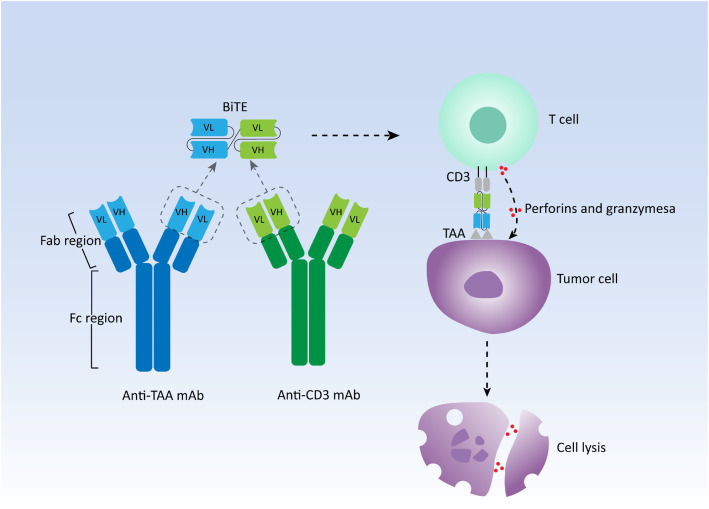
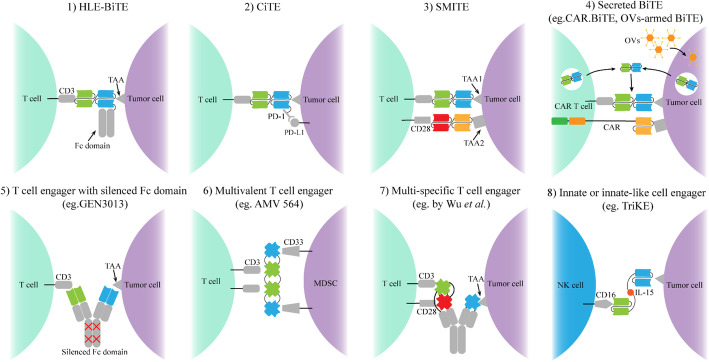
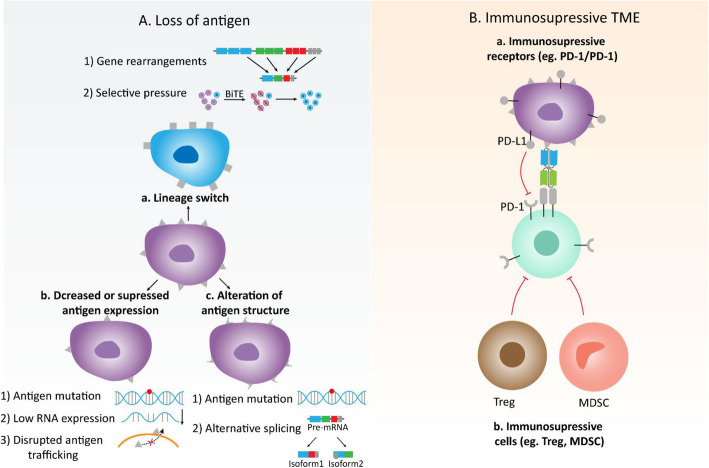
T cell-based immunotherapies have revolutionized treatment paradigms in various cancers, however, limited response rates secondary to lack of significant T-cell infiltration in the tumor site remain a major problem. To address this limitation, strategies for redirecting T cells to treat cancer are being intensively investigated, while the bispecific T cell engager (BiTE) therapy constitutes one of the most promising therapeutic approaches. BiTE is a bispecific antibody construct with a unique function, simultaneously binding an antigen on tumor cells and a surface molecule on T cells to induce tumor lysis. BiTE therapy represented by blinatumomab has achieved impressive efficacy in the treatment of B cell malignancies. However, major mechanisms of resistance to BiTE therapy are associated with antigen loss and immunosuppressive factors such as the upregulation of immune checkpoints. Thus, modification of antibody constructs and searching for combination strategies designed to further enhance treatment efficacy as well as reduce toxicity has become an urgent issue, especially for solid tumors in which response to BiTE therapy is always poor. In particular, immunotherapies focusing on innate immunity have attracted increasing interest and have shown promising anti-tumor activity by engaging innate cells or innate-like cells, which can be used alone or complement current therapies. In this review, we depict the landscape of BiTE therapy, including clinical advances with potential response predictors, challenges of treatment toxicity and resistance, and developments of novel immune cell-based engager therapy.
基于T细胞的免疫疗法彻底改变了各种癌症的治疗模式,然而,由于肿瘤部位T细胞浸润不足导致的反应率有限仍然是一个主要问题。为了解决这一局限性,正在深入研究将T细胞重定向用于治疗癌症的策略,而双特异性T细胞衔接器(BiTE)疗法是最有前景的治疗方法之一。BiTE是一种具有独特功能的双特异性抗体构建体,它同时结合肿瘤细胞上的抗原和T细胞上的表面分子以诱导肿瘤溶解。以blinatumomab为代表的BiTE疗法在治疗B细胞恶性肿瘤方面取得了令人瞩目的疗效。然而,对BiTE疗法产生耐药性的主要机制与抗原丢失和免疫抑制因子有关,如免疫检查点的上调。因此,修饰抗体构建体并寻找旨在进一步提高治疗效果以及降低毒性的联合策略已成为一个紧迫的问题,尤其是对于对BiTE疗法反应一直较差的实体瘤。特别是,专注于先天免疫的免疫疗法已引起越来越多的关注,并通过激活先天细胞或类先天细胞显示出有前景的抗肿瘤活性,这些细胞可以单独使用或补充当前疗法。在这篇综述中,我们描述了BiTE疗法的概况,包括具有潜在反应预测指标的临床进展、治疗毒性和耐药性的挑战,以及新型基于免疫细胞的衔接器疗法的发展。