Dzialo C M, Mannisi M, Halonen K S, de Zee M, Woodburn J, Andersen M S
Anybody Technology A/S, Aalborg, Denmark.
Department of Materials and Production, Aalborg University, Aalborg, Denmark.
Int Biomech. 2019 Dec;6(1):54-65. doi: 10.1080/23335432.2019.1629839.
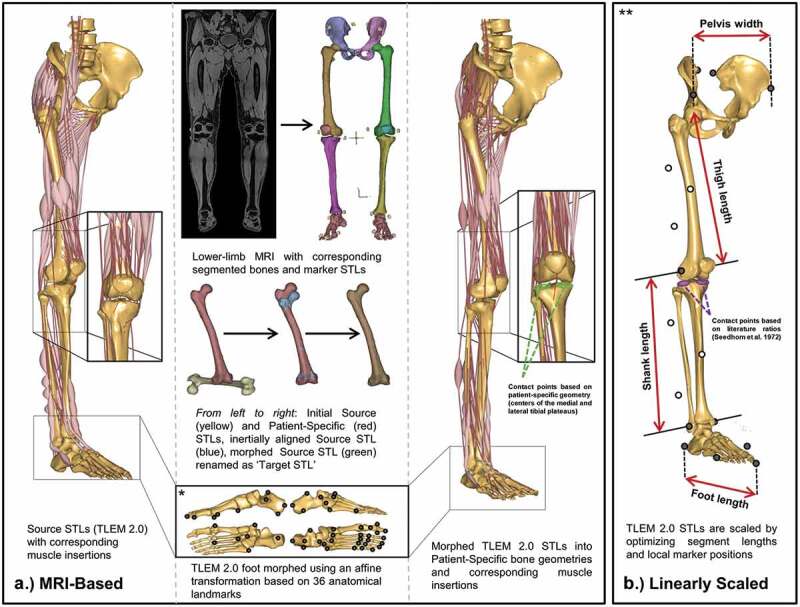
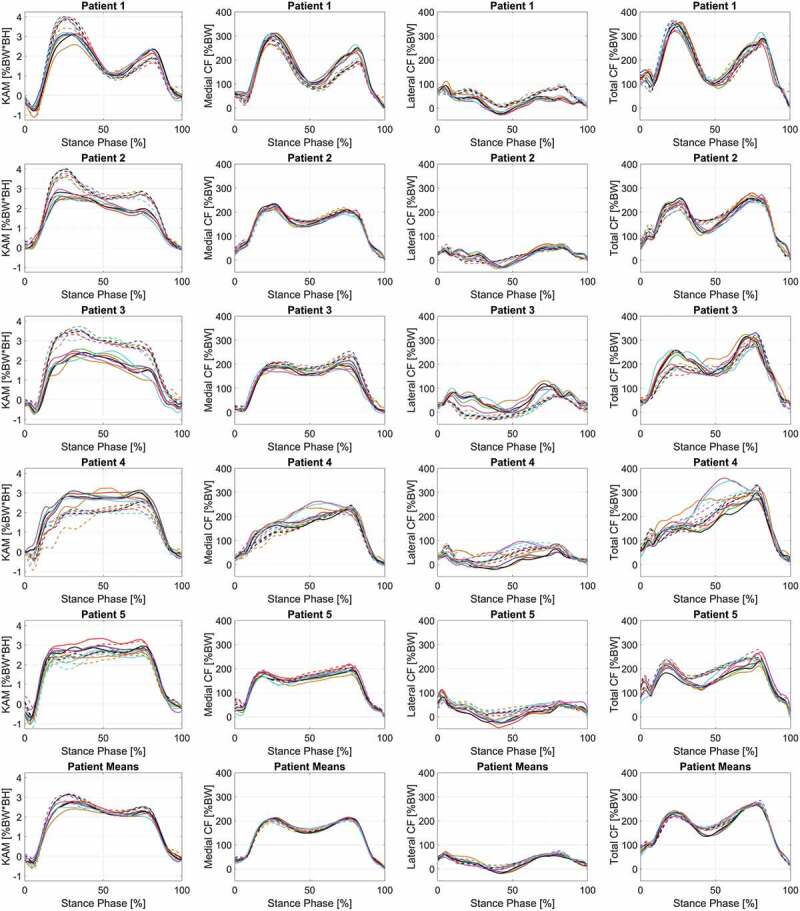
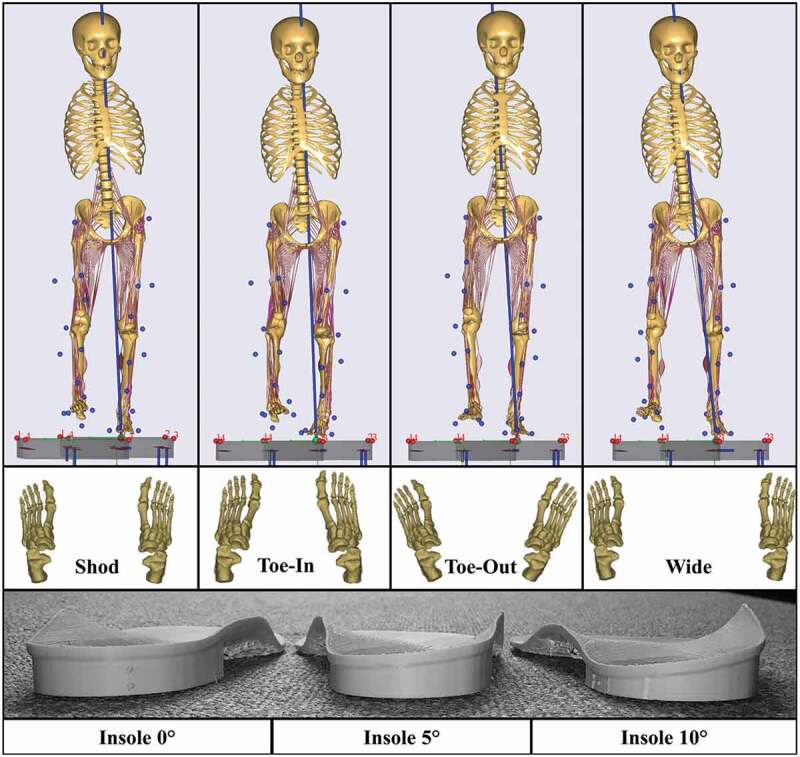
Gait modifications and laterally wedged insoles are non-invasive approaches used to treat medial compartment knee osteoarthritis. However, the outcome of these alterations is still a controversial topic. This study investigates how gait alteration techniques may have a unique effect on individual patients; and furthermore, the way we scale our musculoskeletal models to estimate the medial joint contact force may influence knee loading conditions. Five patients with clinical evidence of medial knee osteoarthritis were asked to walk at a normal walking speed over force plates and simultaneously 3D motion was captured during seven conditions (0°-, 5°-, 10°-insoles, shod, toe-in, toe-out, and wide stance). We developed patient-specific musculoskeletal models, using segmentations from magnetic resonance imaging to morph a generic model to patient-specific bone geometries and applied this morphing to estimate muscle insertion sites. Additionally, models were created of these patients using a simple linear scaling method. When examining the patients' medial compartment contact force (peak and impulse) during stance phase, a 'one-size-fits-all' gait alteration aimed to reduce medial knee loading did not exist. Moreover, the different scaling methods lead to differences in medial contact forces; highlighting the importance of further investigation of musculoskeletal modeling methods prior to use in the clinical setting.
步态改变和外侧楔形鞋垫是用于治疗内侧间室膝关节骨关节炎的非侵入性方法。然而,这些改变的效果仍是一个有争议的话题。本研究调查了步态改变技术如何可能对个体患者产生独特影响;此外,我们缩放肌肉骨骼模型以估计内侧关节接触力的方式可能会影响膝关节的负荷情况。五名有内侧膝关节骨关节炎临床证据的患者被要求以正常步行速度在测力板上行走,同时在七种情况下(0°、5°、10°鞋垫、穿鞋、内八字、外八字和宽步幅)捕捉三维运动。我们利用磁共振成像的分割结果开发了患者特异性肌肉骨骼模型,将通用模型变形为患者特异性骨骼几何形状,并应用这种变形来估计肌肉附着点。此外,使用简单的线性缩放方法为这些患者创建了模型。在检查患者站立期内侧间室接触力(峰值和冲量)时,不存在一种“一刀切”的旨在减少内侧膝关节负荷的步态改变方法。此外,不同的缩放方法导致内侧接触力存在差异;这突出了在临床应用前进一步研究肌肉骨骼建模方法的重要性。