Division of Pediatric Critical Care Medicine, Department of Pediatrics, Stanford University School of Medicine, Stanford, California.
Department of Medicine, Stanford University School of Medicine, Stanford, California.
JAMA Netw Open. 2021 May 3;4(5):e2111575. doi: 10.1001/jamanetworkopen.2021.11575.
Poor work-life integration (WLI) occurs when career and personal responsibilities come in conflict and may contribute to the ongoing high rates of physician burnout. The characteristics associated with WLI are poorly understood.
To identify personal and professional factors associated with WLI in physicians and identify factors that modify the association between gender and WLI.
DESIGN, SETTING, AND PARTICIPANTS: This cross-sectional study was based on electronic and paper surveys administered October 2017 to March 2018 at private, academic, military, and veteran's practices across the US. It used a population-based sample of US physicians across all medical specialties. Data analysis was performed from November 2019 to July 2020.
WLI was assessed using an 8-item scale (0-100 point scale, with higher scores indicating favorable WLI), alongside personal and professional factors. Multivariable linear regressions evaluated independent associations with WLI as well as factors that modify the association between gender and WLI.
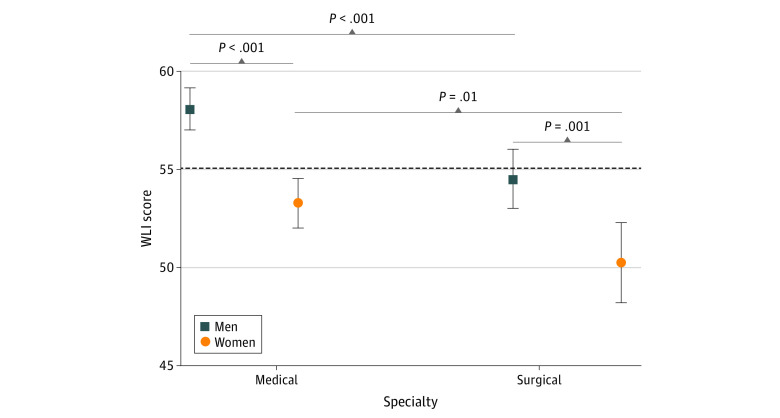
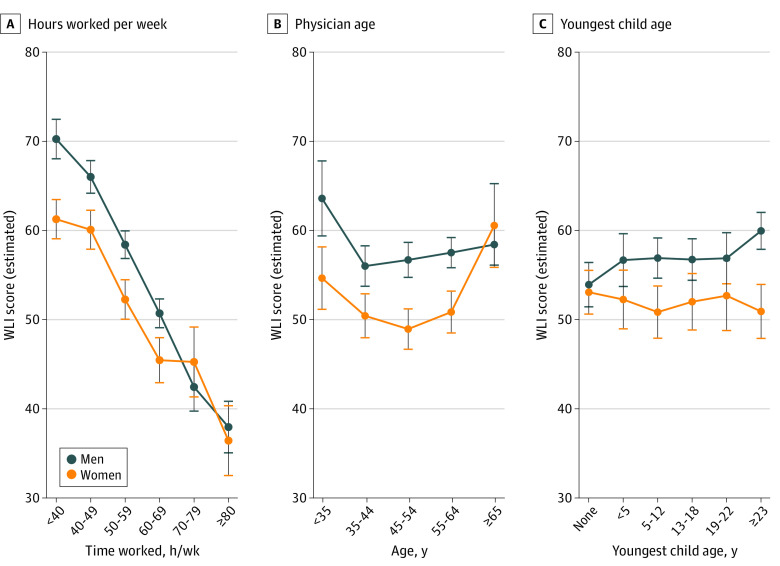
Of 5197 physicians completing surveys, 4370 provided complete responses. Of the physicians who provided complete responses, 2719 were men, 3491 were White/Caucasian (80.8%), 3560 were married (82.4%), and the mean (SD) age was 52.3 (12.0) years. The mean (SD) WLI score was 55 (23). Women reported lower (worse) mean (SD) WLI scores than men overall (52 [22] vs 57 [23]; mean difference, -5 [-0.2 SDs]; P < .001). In multivariable regression, lower WLI was independently associated with being a woman (linear regression coefficient, -6; SE, 0.7; P < .001) as well as being aged 35 years or older (eg, aged 35 to 44 years: linear regression coefficient, -7; SE, 1.4; P < .001), single (linear regression coefficient, -3 vs married; SE, 1.1; P = .003), working more hours (eg, 50 to 59 hours per week vs less than 40 hours per week: linear regression coefficient, -9; SE, 1.0; P < .001) and call nights (linear regression coefficient, -1 for each call night per week; SE, 0.2; P < .001), and being in emergency medicine (linear regression coefficient, -18; SE, 1.6, P < .001), urology (linear regression coefficient, -11; SE, 4.0; P = .009), general surgery (linear regression coefficient, -4; SE, 2.0; P = .04), anesthesiology (linear regression coefficient, -4; SE, 1.7; P = .03), or family medicine (linear regression coefficient, -3; SE, 1.4; P = .04) (reference category, internal medicine subspecialties). In interaction modeling, physician age, youngest child's age, and hours worked per week modified the associations between gender and WLI, such that the largest gender disparities were observed in physicians who were aged 45 to 54 years (estimated WLI score for women, 49; 95% CI, 47-51; estimated WLI score for men, 57, 95% CI, 55-59; P < .001), had youngest child aged 23 years or older (estimated WLI score for women, 51; 95% CI, 48-54; estimated WLI score for men, 60; 95% CI, 58-62; P < .001), and were working less than 40 hours per week (estimated WLI score for women, 61; 95% CI, 59-63; estimated WLI score for men; 70; 95% CI, 68-72; P < .001).
This study found that lower WLI was reported by physicians who are women, single, aged 35 years or older, and who work more hours and call nights. These findings suggest that systemic change is needed to improve WLI among physicians.
当职业和个人责任发生冲突时,就会出现较差的工作-生活整合(WLI),这可能是导致医生持续高 burnout 率的原因之一。与 WLI 相关的特征尚未被很好地理解。
确定与医生 WLI 相关的个人和职业因素,并确定改变性别与 WLI 之间关联的因素。
设计、地点和参与者:本横断面研究基于 2017 年 10 月至 2018 年 3 月在美国私人、学术、军事和退伍军人医疗机构进行的电子和纸质调查。它使用了基于人群的美国所有医学专业医生的样本。数据分析于 2019 年 11 月至 2020 年 7 月进行。
使用 8 项量表(0-100 分制,分数越高表示 WLI 越有利)评估 WLI,同时评估个人和职业因素。多变量线性回归评估了与 WLI 的独立关联,以及改变性别与 WLI 之间关联的因素。
在完成调查的 5197 名医生中,有 4370 名提供了完整的回复。在提供完整回复的医生中,2719 名是男性,3491 名是白人/高加索人(80.8%),3560 名是已婚(82.4%),平均(SD)年龄为 52.3(12.0)岁。平均(SD)WLI 得分为 55(23)。总体而言,女性报告的平均(SD)WLI 评分低于男性(52 [22] 与 57 [23];平均差异,-5[-0.2 SDs];P<0.001)。在多变量回归中,WLI 较低与女性(线性回归系数,-6;SE,0.7;P<0.001)以及年龄在 35 岁或以上(例如,年龄在 35 至 44 岁:线性回归系数,-7;SE,1.4;P<0.001)、单身(线性回归系数,-3 与已婚;SE,1.1;P=0.003)、工作时间较长(例如,每周工作 50 至 59 小时与每周工作不到 40 小时:线性回归系数,-9;SE,1.0;P<0.001)和值夜班(线性回归系数,每周值一个夜班为-1;SE,0.2;P<0.001)以及急诊医学(线性回归系数,-18;SE,1.6;P<0.001)、泌尿科(线性回归系数,-11;SE,4.0;P=0.009)、普通外科(线性回归系数,-4;SE,2.0;P=0.04)、麻醉科(线性回归系数,-4;SE,1.7;P=0.03)或家庭医学(线性回归系数,-3;SE,1.4;P=0.04)(参考类别:内科亚专科)有关。在交互建模中,医生年龄、最小子女年龄和每周工作时间改变了性别与 WLI 之间的关联,在年龄为 45 至 54 岁的医生中观察到最大的性别差异(女性的估计 WLI 评分,49;95%CI,47-51;男性的估计 WLI 评分,57;95%CI,55-59;P<0.001),最小子女年龄在 23 岁或以上(女性的估计 WLI 评分,51;95%CI,48-54;男性的估计 WLI 评分,60;95%CI,58-62;P<0.001),每周工作时间少于 40 小时(女性的估计 WLI 评分,61;95%CI,59-63;男性的估计 WLI 评分,70;95%CI,68-72;P<0.001)。
本研究发现,女性、单身、年龄在 35 岁或以上以及工作时间较长和值夜班的医生报告的 WLI 较低。这些发现表明,需要进行系统性变革,以改善医生的 WLI。