Department of Neuropathology, Charité-Universitätsmedizin Berlin, corporate member of Freie Universität Berlin, Humboldt-Universität zu Berlin and Berlin Institute of Health, Berlin, Germany.
Department of Neurology with Institute for Translational Neurology, Münster University Hospital (UKM), Münster, Germany.
Brain Pathol. 2021 May;31(3):e12957. doi: 10.1111/bpa.12957.
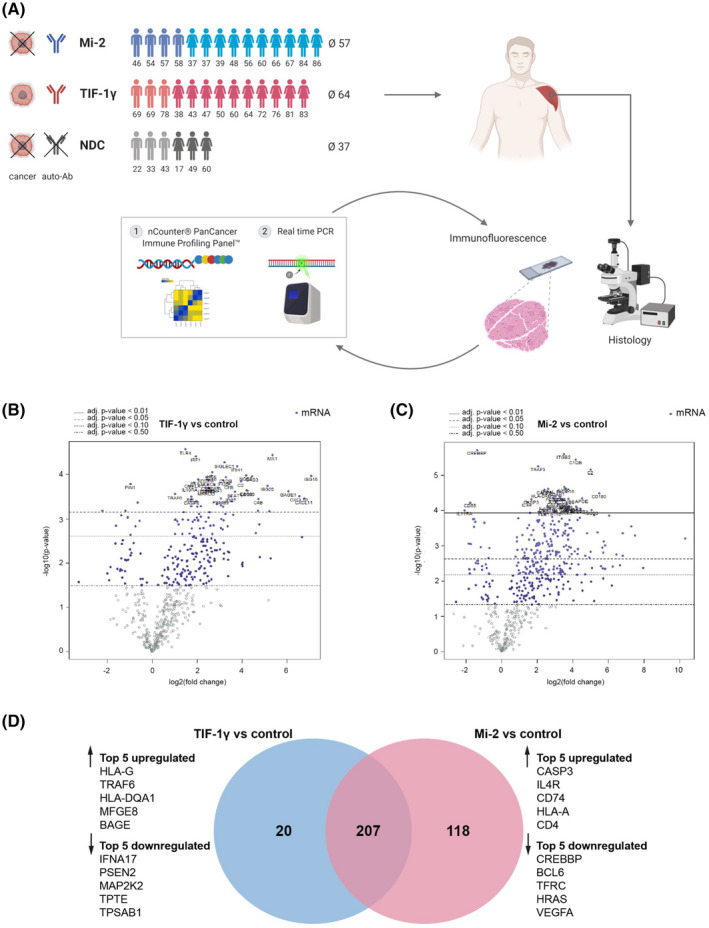
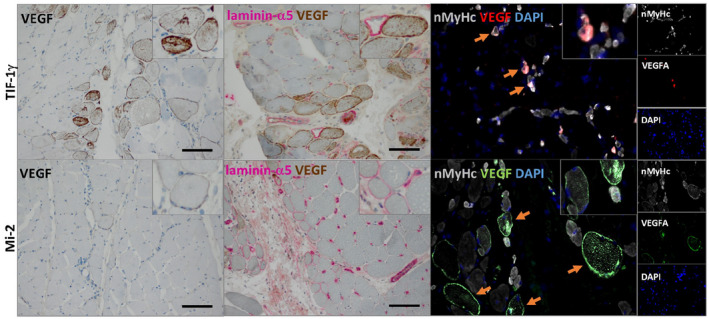
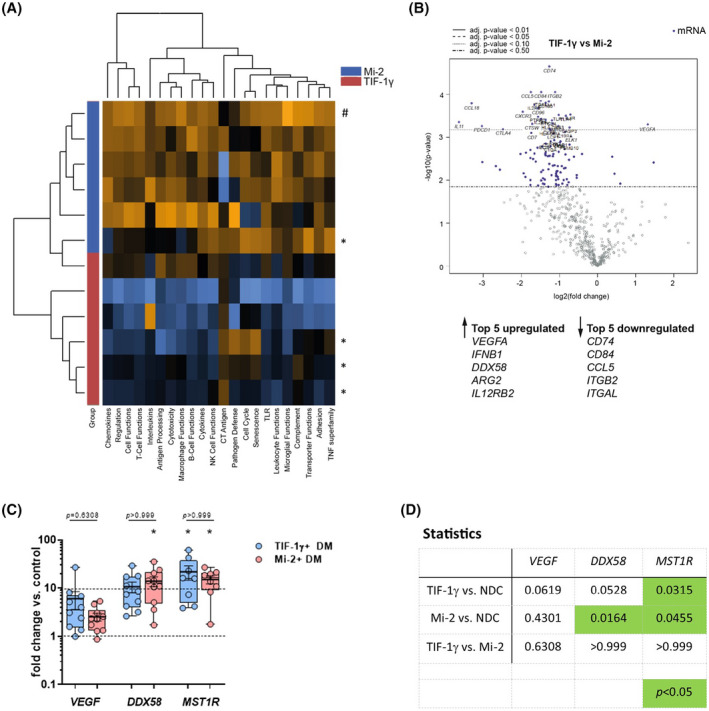
Dermatomyositis (DM) is a systemic idiopathic inflammatory disease affecting skeletal muscle and skin, clinically characterized by symmetrical proximal muscle weakness and typical skin lesions. Recently, myositis-specific autoantibodies (MSA) became of utmost importance because they strongly correlate with distinct clinical manifestations and prognosis. Antibodies against transcription intermediary factor 1γ (TIF-1γ) are frequently associated with increased risk of malignancy, a specific cutaneous phenotype and limited response to therapy in adult DM patients. Anti-Mi-2 autoantibodies, in contrast, are typically associated with classic DM rashes, prominent skeletal muscle weakness, better therapeutic response and prognosis, and less frequently with cancer. Nevertheless, the sensitivity of autoantibody testing is only moderate, and alternative reliable methods for DM patient stratification and prediction of cancer risk are needed. To further investigate these clinically distinct DM subgroups, we herein analyzed 30 DM patients (n = 15 Mi-2 and n = 15 TIF-1 γ ) and n = 8 non-disease controls (NDC). We demonstrate that the NanoString technology can be used as a very sensitive method to clearly differentiate these two clinically distinct DM subgroups. Using the nCounter PanCancer Immune Profiling Panel™, we identified a set of significantly dysregulated genes in anti-TIF-1γ patient muscle biopsies including VEGFA, DDX58, IFNB1, CCL5, IL12RB2, and CD84. Investigation of type I IFN-regulated transcripts revealed a striking type I interferon signature in anti-Mi-2 patient biopsies. Our results help to stratify both subgroups and predict, which DM patients require an intensified diagnostic procedure and might have a poorer outcome. Potentially, this could also have implications for the therapeutic approach.
皮肌炎 (DM) 是一种影响骨骼肌和皮肤的系统性特发性炎症性疾病,临床上表现为对称性近端肌无力和典型的皮肤损伤。最近,肌炎特异性自身抗体 (MSA) 变得非常重要,因为它们与独特的临床表现和预后密切相关。针对转录中介因子 1γ (TIF-1γ) 的抗体通常与恶性肿瘤风险增加、特定的皮肤表型以及成人 DM 患者治疗反应受限相关。相比之下,抗 Mi-2 自身抗体通常与典型的 DM 皮疹、明显的骨骼肌无力、更好的治疗反应和预后相关,且与癌症的相关性较低。然而,自身抗体检测的敏感性仅为中等水平,因此需要替代可靠的方法来对 DM 患者进行分层,并预测癌症风险。为了进一步研究这些临床上明显不同的 DM 亚组,我们在此分析了 30 名 DM 患者(n=15 名 Mi-2 和 n=15 名 TIF-1γ)和 n=8 名非疾病对照(NDC)。我们证明 NanoString 技术可用作一种非常敏感的方法,可明确区分这两个临床上明显不同的 DM 亚组。使用 nCounter PanCancer Immune Profiling Panel™,我们在抗 TIF-1γ 患者的肌肉活检中鉴定出一组显著失调的基因,包括 VEGFA、DDX58、IFNB1、CCL5、IL12RB2 和 CD84。对 I 型干扰素调节转录本的研究揭示了抗 Mi-2 患者活检中明显的 I 型干扰素特征。我们的研究结果有助于对这两个亚组进行分层,并预测哪些 DM 患者需要进行强化诊断程序,并且可能预后较差。潜在地,这也可能对治疗方法产生影响。