Mahabir V Kishan, Smith Christopher S, Vannabouathong Christopher, Merchant Jamil J, Garibaldi Alisha L
CB2 Insights, 5045 Orbitor Dr, Building 11, Suite 300, Mississauga, ON, L4W 4Y4, Canada.
J Cannabis Res. 2021 May 27;3(1):15. doi: 10.1186/s42238-021-00075-z.
US states have been adopting their own medical cannabis laws since 1996. There is substantial variability in the medical cannabis programs between states, and these differences have not been thoroughly investigated in the literature. The objective of the study was to compare medical cannabis patient characteristics across five states to identify differences potentially caused by differing policies surrounding condition eligibility.
We conducted secondary analyses following a retrospective study of a registry database with data from 33 medical cannabis evaluation clinics in the US, owned and operated by CB2 Insights. This study narrowed the dataset to include patients from five states with the largest samples: Massachusetts (n = 27,892), Colorado (n = 16,434), Maine (n = 4591), Connecticut (n = 2643), and Maryland (n = 2403) to conduct an in-depth study of the characteristics of patients accessing medical cannabis in these states, including analysis of variance to compare average ages and number of conditions and chi-squared tests to compare proportions of patient characteristics between states.
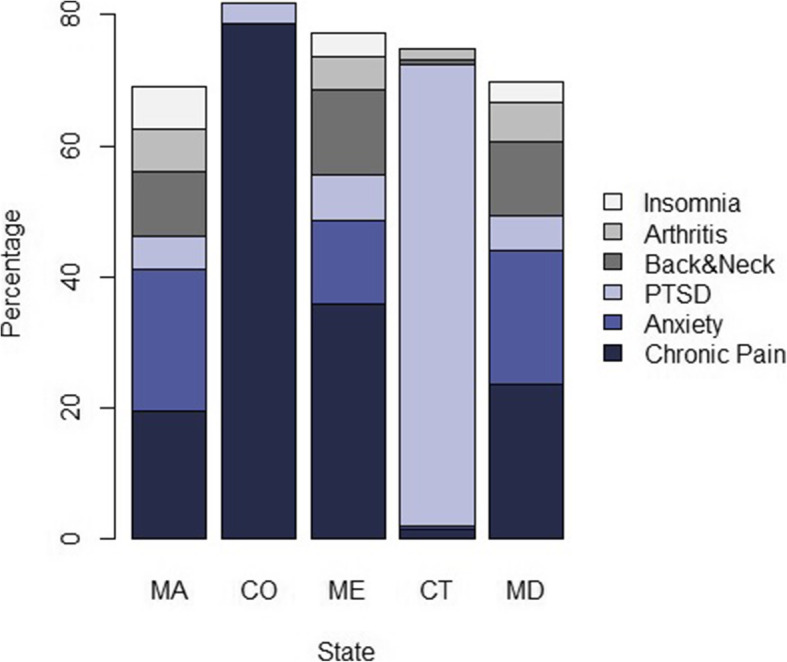
Average ages varied between the states, with the youngest average in Connecticut (42.2) and the oldest in Massachusetts (47.0). Males represented approximately 60% of the patients with data on gender in each state. The majority of patients in each state had cannabis experience prior to seeking medical certification. Primary medical conditions varied for each state, with chronic pain, anxiety, and back and neck problems topping the list in varying orders for Massachusetts, Maine, and Maryland. Colorado had 78.7% of patients report chronic pain as their primary condition, and 70.4% of patients in Connecticut reported post-traumatic stress disorder as their primary medical condition.
This study demonstrated the significant impact that policy has on patients' access to medical cannabis in Massachusetts, Colorado, Maine, Connecticut, and Maryland utilizing real-world data. It highlights how qualifications differ between the five states and brings into question the routes through which patients in states with stricter regulations surrounding eligible conditions choose to seek treatment with cannabis. These patients may turn to alternative treatments, or to the illicit or recreational cannabis markets, where permitted.
自1996年以来,美国各州纷纷采用各自的医用大麻法律。各州之间的医用大麻项目存在很大差异,而这些差异在文献中尚未得到充分研究。本研究的目的是比较五个州的医用大麻患者特征,以确定因条件资格相关政策不同而可能导致的差异。
我们在对一个登记数据库进行回顾性研究后进行了二次分析,该数据库的数据来自美国CB2 Insights拥有并运营的33家医用大麻评估诊所。本研究缩小了数据集范围,纳入来自样本量最大的五个州的患者:马萨诸塞州(n = 27,892)、科罗拉多州(n = 16,434)、缅因州(n = 4591)、康涅狄格州(n = 2643)和马里兰州(n = 2403),以深入研究这些州使用医用大麻的患者特征,包括进行方差分析以比较平均年龄和病症数量,以及进行卡方检验以比较各州患者特征的比例。
各州的平均年龄有所不同,康涅狄格州平均年龄最小(42.2岁),马萨诸塞州平均年龄最大(47.0岁)。在每个州有性别数据的患者中,男性约占60%。每个州的大多数患者在寻求医疗认证之前就有使用大麻的经历。每个州的主要医疗病症各不相同,慢性疼痛、焦虑以及背部和颈部问题在马萨诸塞州、缅因州和马里兰州以不同顺序位居前列。科罗拉多州有78.7%的患者报告慢性疼痛是其主要病症,康涅狄格州有70.4%的患者报告创伤后应激障碍是其主要医疗病症。
本研究利用实际数据证明了政策对马萨诸塞州、科罗拉多州、缅因州、康涅狄格州和马里兰州患者获取医用大麻的重大影响。它突出了这五个州在资格条件方面的差异,并对那些在符合条件方面监管更严格的州的患者选择使用大麻进行治疗的途径提出了质疑。这些患者可能会转向替代治疗,或者转向非法或娱乐性大麻市场(如果允许的话)。